


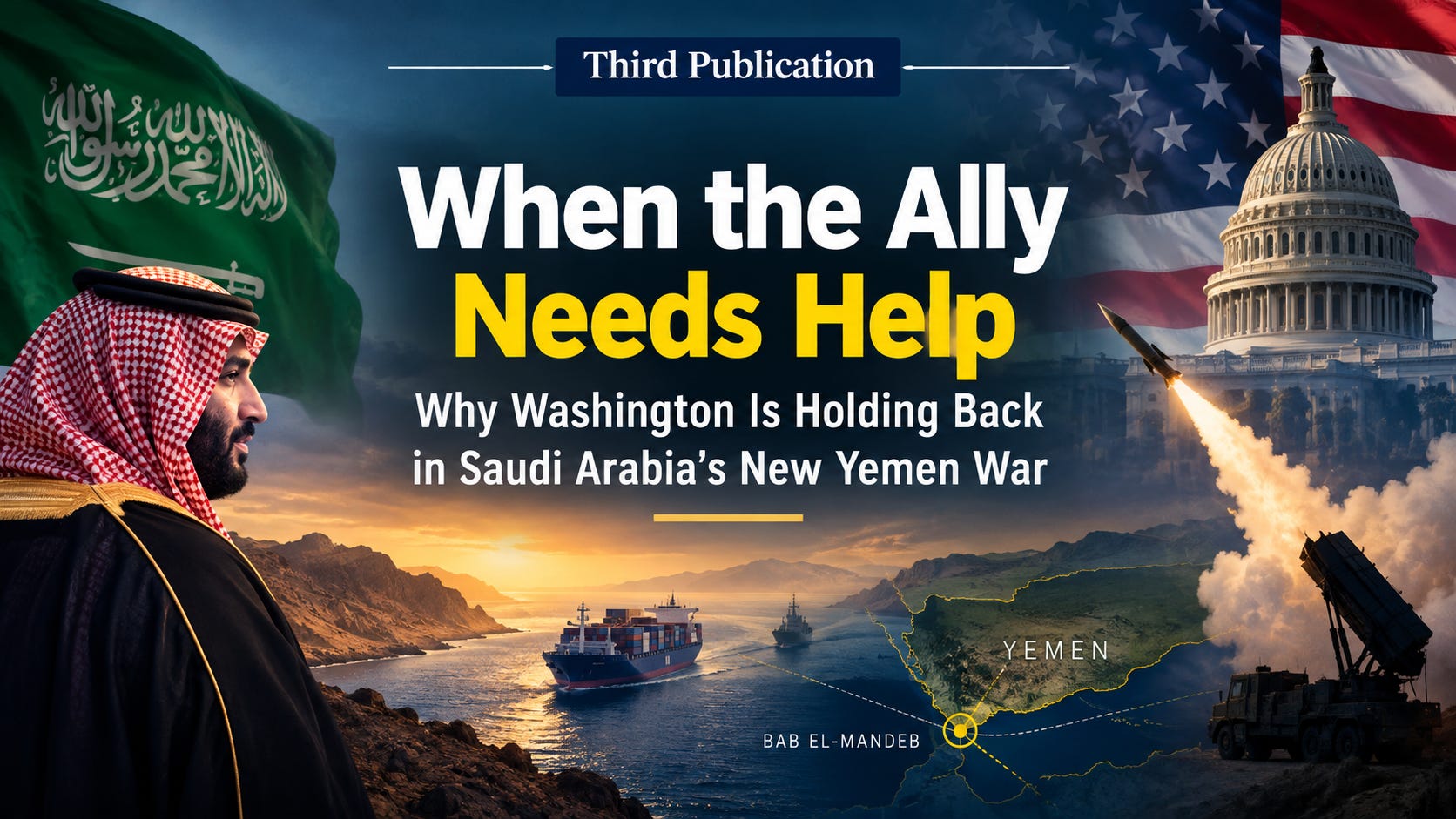
The Riyadh Attack Changes the Question
The bigger question is not simply another missile attack, but what happens when a key US security partner comes under direct attack while Washington remains reluctant to intervene militarily.
The stakes are rising as the Houthis expand along Yemen’s Red Sea coast and gain leverage around the Bab el-Mandeb, a critical global maritime chokepoint—while the United States is already deeply engaged in the wider US–Iran–Israel conflict.
Saudi Arabia: Ally, But Not an Automatic American War Commitment
The US–Saudi relationship is longstanding and extensive, built on decades of military cooperation, arms supplies and security ties.
Saudi Arabia had sought a stronger mutual-defence treaty with Washington, but negotiations did not produce one, according to CSIS. Instead, Riyadh received the new designation, a strategic defence agreement and commitments involving advanced weapons. That distinction has become critical during the current crisis.
The Historical Pattern
When Saudi Arabia intervened against the Houthis in 2015, the United States provided logistical, intelligence and advisory support. Washington later reduced its direct involvement, ending aerial-refuelling support in 2018 and restricting some arms sales amid concerns over civilian casualties and congressional pressure, according to the Congressional Research Service.
Washington Is Already Fighting Another War
The US–Iran war is the central constraint. Washington is already committing substantial military resources against Iran, while Israel remains a major US security partner.
The conflict has consumed large quantities of missiles, interceptors and precision weapons, raising concerns over US air-defence and weapons inventories.
Opening another major campaign against the Houthis could turn the region into a single, interconnected theatre of conflict. A direct US attack could therefore risk widening the very regional conflict that Washington is simultaneously seeking to contain.
Washington Is Also Talking to the Houthis
One of the most revealing developments came earlier this month, when Reuters reported that US officials met Houthi representatives in Oman over the Red Sea crisis and continuation of the US–Houthi ceasefire.
The engagement is notable given Washington’s designation of the Houthis as a terrorist organisation and its previous military operations against them. It suggests that the immediate US priority may be containing the conflict, protecting shipping and avoiding another prolonged military front, rather than seeking outright elimination of the Houthis.
What Riyadh Asked For — and What Washington Provided
Reuters reported that Saudi Crown Prince Mohammed bin Salman sought US military assistance against the Houthis. Washington reportedly declined direct strikes but offered intelligence-sharing and targeting support.
This does not signal abandonment of Saudi Arabia, but it does indicate a distinction between supporting Riyadh and directly entering the conflict.
Washington’s current approach appears to include:
Diplomatic and intelligence support: continuing
Targeting assistance and arms cooperation: continuing
Advanced weapons sales: continuing
Direct US strikes on the Houthis: not at present
Automatic military intervention: not indicated
Indirect engagement with the Houthis: reportedly through Oman
In effect, Washington appears to be drawing a clear line against direct US military intervention in Yemen.
The F-35 Decision Reveals the Broader Relationship
The contrast is significant. While Washington has declined direct strikes against the Houthis on Saudi Arabia’s behalf, the US State Department has approved a potential $24.3 billion sale of 48 F-35 fighter jets to Saudi Arabia, subject to congressional approval.
This suggests the US–Saudi defence relationship remains intact, with Washington distinguishing between strengthening Saudi Arabia’s long-term military capabilities and committing US forces to another active conflict.
Why Israel Is Different
The comparison with Israel is significant. The US has a deeper institutionalised defence relationship with Israel, spanning military aid, intelligence, missile defence and defence technology.
AP reported this week on a proposed $2.8 billion weapons package for Israel, including 40,000 large bombs, largely financed through US foreign military financing.
Thus, while Saudi Arabia is becoming increasingly important to Washington, its defence relationship with the US remains structured differently from Israel’s long-standing alliance.
Saudi Arabia’s Immediate Vulnerability
The military problem is becoming more serious. Saudi Arabia is reportedly running short of some missile interceptors and has sought additional defensive assistance from France, Britain, Pakistan and Egypt. AP reported that the shortage is partly connected to the heavy consumption of US interceptors during the wider Iran war.
Modern missile and drone warfare creates a difficult cost-exchange problem: an expensive interceptor may be used against a relatively inexpensive incoming missile or drone.
Saudi Arabia can possess sophisticated aircraft and still face sustained pressure if an adversary can continuously launch comparatively inexpensive weapons from difficult terrain.
The Bab el-Mandeb Problem May Be Bigger Than Yemen
The geographical issue may ultimately matter more than the immediate Saudi-Houthi battlefield.
The Bab el-Mandeb connects the Red Sea with the Gulf of Aden and the Indian Ocean. Houthi territorial gains along Yemen’s western coast have increased their leverage over this maritime corridor. Reuters has reported increased risks to Saudi oil exports and international shipping.
Iran’s Role
The Houthis are an independent Yemeni movement, but Iran has provided significant support that has enhanced their military capabilities. The Congressional Research Service describes the Houthis as an Iran-backed movement with continuing ability to threaten international shipping, Israel and regional states. CFR similarly describes Iranian assistance as having significantly increased Houthi capabilities.
This creates a strategic dilemma for Washington.
If the US attacks the Houthis heavily, it risks widening the Iran war. If Washington refrains from doing so, the Houthis may expand their leverage over Saudi Arabia and the Red Sea.
Saudi Arabia is therefore caught between two American objectives: protect the kingdom while avoiding another major war.
Why Washington May Be Holding Back
Several factors appear to overlap:
1. The Iran war has priority.
The US military is already heavily engaged against Iran, and Yemen would create another operational theatre.
2. Interceptor stocks are under pressure.
The current conflict has consumed substantial American air-defence resources.
3. Washington wants to prevent escalation.
The United States appears interested in keeping the Houthi confrontation below the level that would trigger another sustained bombing campaign.
4. The Houthis have demonstrated resilience.
Years of Saudi-led and later American military operations have failed to eliminate the movement.
5. Shipping may be a more immediate American priority.
If Washington can keep US and international shipping largely outside the conflict, it may be possible to contain the crisis without launching another major campaign.
A Strategic Message for Riyadh
The current US position sends Saudi Arabia a clear strategic message: America remains a key security partner, but its support has limits when wider US priorities differ.
This could encourage Riyadh to further diversify its security relationships. Saudi Arabia has engaged European and regional partners, while defence ties with Pakistan and Türkiye provide additional security options. It has also turned to China diplomatically over the Houthi escalation, with Beijing reportedly urging Iran to help restrain the Houthis.
This represents strategic diversification rather than a rejection of the US
What to Watch Next
Seven developments could materially reshape the situation:
US direct strikes on the Houthis — would mark a major shift from Washington’s current approach.
A larger Saudi air or ground campaign — could pressure Washington to reconsider its position.
Houthi control of the Bab el-Mandeb — disruption here could have greater implications for global trade than individual attacks.
Progress in Iran–US negotiations — a broader diplomatic breakthrough could alter the Houthi equation.
Activation of Saudi defence partnerships — the roles of Pakistan and Türkiye would be closely watched.
Replenishment of interceptor stocks — US and Saudi inventory levels could determine how long intensive defence operations can continue.
Security of Saudi oil infrastructure — any major disruption to production, processing or exports could have consequences well beyond the region.
Bottom Line
The current situation does not indicate that America has abandoned Saudi Arabia. Rather, it points to a more nuanced strategic relationship.
Washington continues to strengthen its long-term defence ties with Riyadh—including the potential F-35 sale—while, for now, avoiding direct strikes against the Houthis on Saudi Arabia’s behalf.
The distinction matters: the US appears committed to its strategic partnership with Saudi Arabia without automatically entering every conflict that threatens the kingdom.
For Riyadh, this reinforces the case for diversifying security partnerships. For Washington, it highlights the challenge of balancing Saudi security, Iran, Israel, global shipping and the risk of another prolonged Yemen conflict.
For markets, the key question is whether the crisis remains a contained Saudi–Houthi confrontation or becomes another major front in the wider US–Iran–Israel conflict.
For now, the trajectory remains uncertain.
Disclaimer: This report is a research and analytical note based on publicly available information and current media, government and research sources. The geopolitical situation involving the US, Israel, Iran, Saudi Arabia and Yemen is highly volatile, and military or diplomatic developments may be incomplete, disputed or revised.
This report reflects publicly reported information as of 20 September 2026 and is not a prediction of future actions by any party. Claims by involved governments or groups are distinguished from independently corroborated information wherever possible.
Readers should verify rapidly changing developments through current primary and reputable news sources before relying on this report for investment, trading or other decisions.
Terminology note: This report uses “Houthis” to refer to the movement formally known as Ansar Allah (Ansarullah); the terms are used interchangeably throughout the report.