


Every research report begins with a question: should we start with an idea and examine the evidence, or study the evidence and allow an idea to emerge?
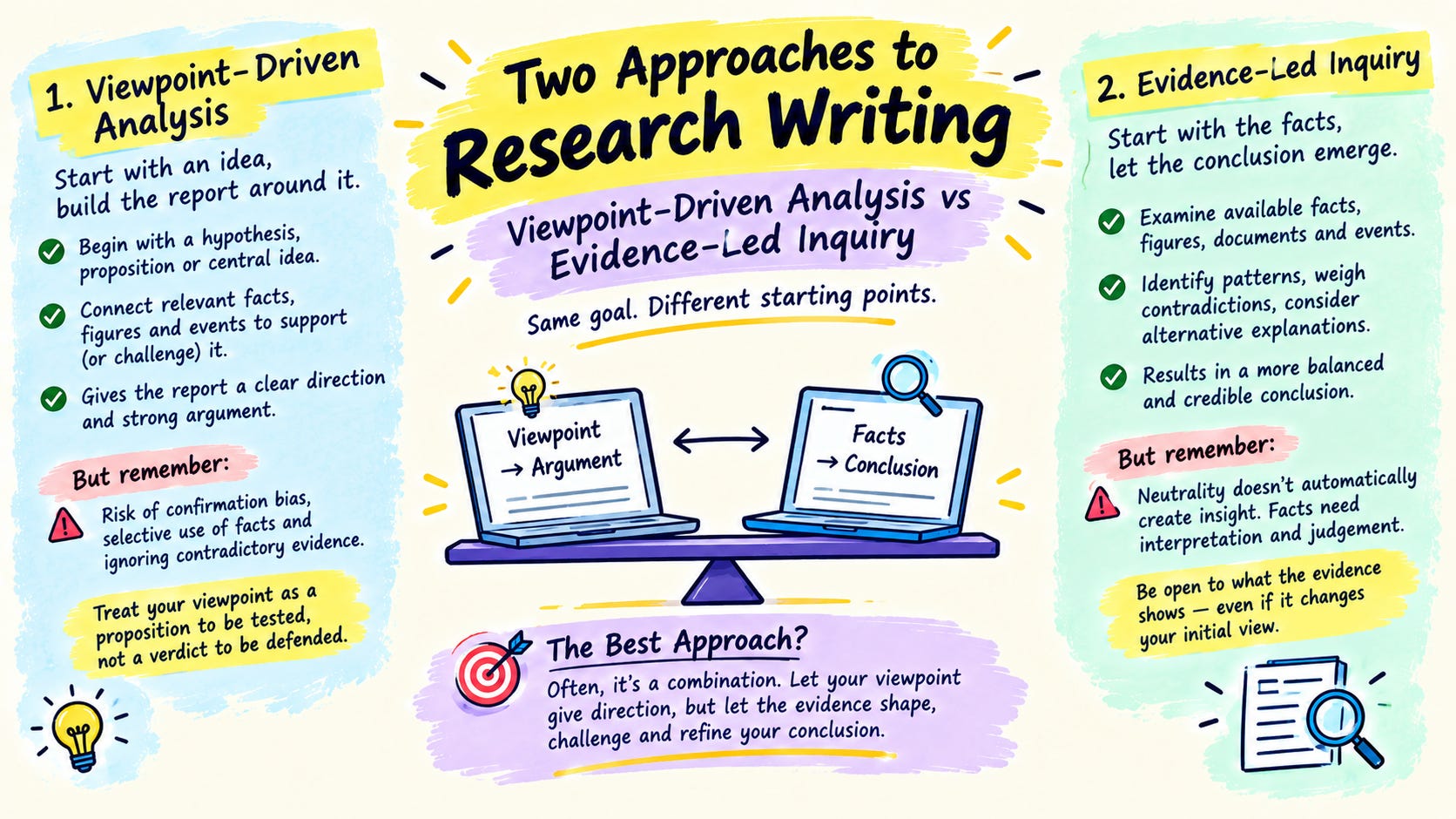
Viewpoint-driven analysis begins with a central proposition and builds an argument around it. Evidence-led inquiry begins with facts, figures and observations to develop a conclusion. Both approaches are valuable, but their effectiveness depends on how rigorously the evidence is examined and interpreted.
Viewpoint-Driven Analysis: Begin with an Idea
This approach starts with a hypothesis or central argument. Relevant facts, figures and developments are assembled to assess its validity and implications.
For example, an investment report may begin with the view that India’s expanding data-centre industry will create opportunities for electrical-equipment manufacturers. The analysis would examine demand, order books, financial performance, competition, valuations and risks.
The advantage is a clear direction and a coherent narrative. The danger is confirmation bias—selecting evidence that supports the initial view while overlooking contradictory findings.
A viewpoint should therefore be treated as a proposition to test, not a conclusion to defend.
Evidence-Led Inquiry: Begin with Facts
This approach starts with available evidence rather than a predetermined conclusion. The writer examines facts, identifies patterns, evaluates competing explanations and draws conclusions based on the findings.
Its strength lies in openness to unexpected discoveries. However, collecting facts alone is insufficient. Research must also explain their significance, identify underlying causes and assess possible consequences.
Evidence-led writing does not eliminate opinion; it requires opinions to remain open to revision when the evidence demands it.
Combining the Two Approaches
The strongest research often combines both methods. A central viewpoint identifies the question worth investigating, while evidence determines whether the original thesis stands, needs revision or should be rejected.
For instance, a report may explore whether India’s data-centre expansion will benefit electrical-equipment companies. Rather than assuming that industry growth guarantees investment returns, the writer must examine company capabilities, earnings potential, execution risks and valuations.
The same principle applies to political, economic and strategic research: the initial idea provides direction, but the evidence must determine the conclusion.
Conclusion: A Viewpoint Gives Direction; Evidence Gives Credibility
Research is not merely about collecting information or defending an opinion. It is about connecting evidence to an argument through clear reasoning and intellectual honesty.
A viewpoint gives a report focus. Evidence tests its validity. Interpretation explains its significance. The willingness to change one’s mind establishes credibility.
The objective is not to prove that the writer was right from the beginning, but to leave the reader better informed at the end.
Disclaimer: This article presents a general framework for research and analytical writing; the suitability of each approach depends on the research objective, source reliability, treatment of contrary evidence and distinction between facts and interpretation.