


When One Judge Became Bigger Than the Office
Political crises rarely begin with the moment history remembers.
They often begin with what appears to be a relatively contained institutional dispute—an official order, a confrontation between two powerful individuals or an attempt by one institution to discipline another.
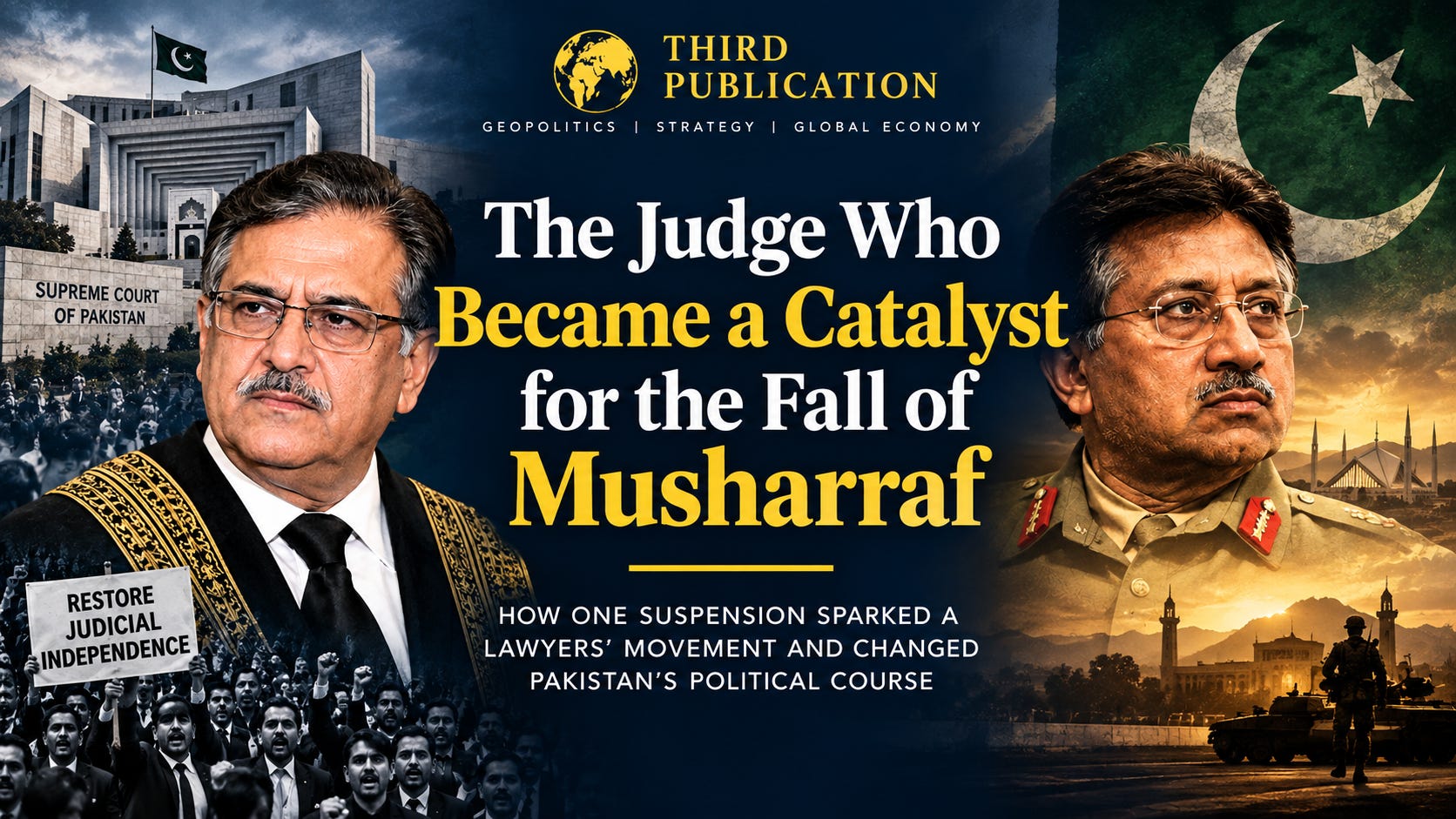
Pakistan’s confrontation between Chief Justice Iftikhar Muhammad Chaudhry and General Pervez Musharraf in 2007 was one such moment.
On 9 March 2007, Musharraf—then simultaneously President and Army Chief—suspended Chaudhry from functioning as Chief Justice and referred allegations against him to the Supreme Judicial Council.
What followed was much larger than either man.
Lawyers took to the streets. Civil-society groups rallied behind the Chief Justice. Opposition forces found a new focal point for resistance. The judiciary itself became an arena in which the limits of executive and military power were tested.
A dispute that could have remained inside the constitutional machinery instead escaped into the streets. And that is where its real historical importance lies.
The Background Was Already Loaded
To understand why the Chaudhry confrontation became so explosive, it is necessary to understand the political environment surrounding it.
Musharraf had seized power in a military coup in 1999 and remained Pakistan’s dominant political figure for almost a decade. By 2007, the relationship between Pakistan’s military establishment, political institutions and judiciary had already been shaped by years of constitutional tension.
The judiciary itself carried a complicated history.
Pakistan’s Supreme Court had previously validated Musharraf’s 1999 military takeover in Zafar Ali Shah v. General Pervez Musharraf. A later Supreme Court judgment acknowledged that the Court had recognised the military takeover and permitted constitutional amendments within specified limits.
Eight years later, however, the country’s Chief Justice had become the centre of resistance to the same military ruler.
That transformation tells us something important about institutions.
Institutions are not always static political actors. Their relationship with power can change as circumstances change and sometimes an institution that previously accommodated power can eventually become a source of resistance.
March 2007: The Suspension
The immediate confrontation began on 9 March 2007.
Musharraf ordered Chaudhry to stop functioning as Chief Justice and referred allegations concerning him to the Supreme Judicial Council. The expectation may have been that the matter would remain an internal institutional proceeding.
It did not.
Chaudhry refused to quietly accept the decision and challenged it. Lawyers across Pakistan rallied behind him.
The issue was rapidly transformed.
It was no longer simply:
Was the Chief Justice guilty of the allegations against him?
The deeper question became:
Could the executive—and ultimately the military establishment—remove or neutralise the country’s Chief Justice without provoking a constitutional confrontation?
That distinction changed everything.
The Lawyers’ Movement emerged around the demand for Chaudhry’s restoration, but its significance quickly expanded to include judicial independence, constitutional government and resistance to military influence over civilian institutions.
The Chief Justice had become a symbol.
The Moment the Judiciary Pushed Back
20 July 2007, confrontation reached its first decisive turning point. A 13-member Supreme Court bench ruled 10–3 against Musharraf’s action. The Court set aside the presidential reference and held that Chaudhry should be regarded as having continued to hold the office of Chief Justice.
For Musharraf, this was a major political setback.
The significance went beyond the reinstatement of one judge.
For perhaps the first time in the crisis, one of Pakistan’s most powerful institutions had demonstrated that it could openly challenge the authority of the country’s dominant political and military figure.
The confrontation had therefore changed character.
It was no longer simply a President versus a Chief Justice. But was becoming a question of who ultimately controlled the constitutional order.
Musharraf’s Counterattack
The reinstatement did not end the crisis.
It intensified it.
On 3 November 2007, Musharraf declared a state of emergency and issued a Provisional Constitutional Order. The Constitution was placed in abeyance, while judges who refused to take the new oath were removed from their positions.
The original dispute had now evolved into a much broader constitutional struggle.
The central question was no longer merely whether Iftikhar Chaudhry would remain Chief Justice.
It had become:
Could the military establishment continue to determine the limits within which Pakistan’s constitutional institutions were permitted to operate?
That was a much more consequential question.
And the answer would ultimately be determined not by one court ruling, but by the accumulation of political pressure that followed.
From Lawyers’ Movement to Political Crisis
The relationship between the Lawyers’ Movement and Musharraf’s eventual resignation needs to be understood carefully.
It would be misleading to say that Chaudhry personally brought down Musharraf.
He did not command an army.
He did not lead a political party.
He did not possess the institutional power to remove a president.
Instead, his importance came from something different.
He became the symbol around which resistance could organise.
The sequence was cumulative.
The suspension triggered the Lawyers’ Movement.
The movement brought together lawyers, civil society and opposition forces.
The Supreme Court’s reinstatement of Chaudhry represented a major setback for Musharraf.
The subsequent emergency and removal of judges deepened the constitutional crisis.
The 2008 elections strengthened civilian political forces.
Musharraf’s political position weakened.
The new governing coalition moved towards impeachment.
On 18 August 2008, Musharraf resigned rather than face the impeachment process.
History therefore works better here as a chain than as a single event.
The Difference Between a Catalyst and a Cause
This distinction is crucial.
A catalyst does not necessarily create the underlying conditions.
It accelerates them.
Musharraf’s eventual departure resulted from multiple forces: the Lawyers’ Movement, judicial confrontation, opposition mobilisation, the 2008 elections, declining political support and impeachment pressure from the civilian coalition.
Yet Chaudhry’s confrontation with Musharraf mattered because it gave these otherwise separate forces a common institutional and political focus.
That is why describing Chaudhry as the man who “toppled Musharraf” is too simplistic.
But describing him as irrelevant to Musharraf’s downfall would be equally misleading.
His suspension helped create the political front through which broader opposition to Musharraf’s increasingly centralised rule could consolidate.
The difference between “he caused it” and “he became the catalyst” is not merely semantic.
It is the difference between personality-driven history and institutional history.
The Deeper Story: Institutions Against Power
Most interesting part of the episode is not Musharraf or Chaudhry individually.
It is the institutional reversal.
The judiciary had once provided constitutional legitimacy to Musharraf’s military takeover.
Years later, the Chief Justice of that same judiciary became one of the central figures challenging his authority.
That tells us something about how political systems evolve.
Institutions may accommodate concentrated power for a period. But accommodation does not necessarily mean permanent submission.
At some point, institutional interests, constitutional principles, professional identity and political circumstances can collide.
When they do, an apparently isolated dispute can become a national crisis.
That is precisely what happened in Pakistan in 2007.
The Lawyers Were as Important as the Judge
It would also be a mistake to reduce the story to Iftikhar Chaudhry. The Lawyers’ Movement was critical because it transformed an institutional dispute into a mass political mobilisation.
Lawyers became the visible force on the streets.
Civil society joined them.
Opposition parties found common ground.
The judiciary became both the subject and the arena of the confrontation.
The importance of the movement therefore lies in the bridge it created between institutional resistance and public mobilisation.
A judge could challenge executive authority inside a courtroom. But a movement could challenge the political legitimacy of that authority outside it.
Together, those pressures proved far more consequential.
A Warning About Judicial Power
The legacy of Chaudhry is not entirely straightforward.
Supporters of the Lawyers’ Movement viewed him as a symbol of judicial independence.
Critics of the later activist judiciary questioned how far courts should intervene in political and administrative matters.
That debate matters.
Judicial independence does not automatically mean unlimited judicial power.
A judiciary strong enough to resist executive overreach must also confront the question of its own constitutional limits.
That tension is present in democracies everywhere.
The Pakistani experience therefore offers two different lessons.
The first is that a judiciary unable to resist political power risks becoming an instrument of that power.
The second is that a judiciary that becomes excessively political can itself create questions about institutional balance.
Both lessons deserve attention.
What Actually Changed?
The most important consequence of the 2007 confrontation was not simply that one Chief Justice returned to office. It was that the boundaries between Pakistan’s institutions became visible.
The crisis exposed the tension between:
military authority and civilian government;
executive power and judicial independence;
constitutional procedure and political reality;
and institutional authority and public legitimacy.
The confrontation forced these questions into the open. Once they entered public consciousness, they could not easily be put back inside a courtroom.
The Larger Lesson
There is a temptation in political history to search for a single hero, villain or decisive moment.
But institutional change rarely works that way.
Musharraf did not fall simply because Chaudhry resisted him.
Chaudhry did not succeed simply because he was a Chief Justice.
The Lawyers’ Movement did not operate in isolation.
The opposition parties did not create the crisis alone.
The 2008 elections did not suddenly produce Musharraf’s resignation.
Instead, these forces interacted.
One confrontation created mobilisation.
Mobilisation created political pressure.
Political pressure weakened authority.
A weakened political position made impeachment possible.
Prospect of impeachment ultimately contributed to Musharraf’s decision to resign.
That is the more compelling story.
The Judge Who Became a Symbol
Iftikhar Muhammad Chaudhry’s historical significance therefore lies less in the claim that he “brought down Musharraf” and more in what happened after Musharraf tried to silence him.
A dispute between one President and one Chief Justice became a national movement.
The movement became a constitutional crisis.
The constitutional crisis became part of a broader political realignment.
That realignment contributed to the end of nearly a decade of Musharraf’s dominance.
Chaudhry was not the man who single-handedly toppled Musharraf. He became something potentially more consequential: the institutional symbol around which resistance to concentrated power could organise.
That is why the events of 2007 remain important.
They remind us that political power is not sustained by office alone. It depends on institutions, legitimacy, public confidence and the willingness of other institutions to accept—or challenge—the boundaries imposed upon them.
Sometimes history turns not when a government falls, but when an institution decides that it will no longer quietly accept the limits placed upon it.
Disclaimer: This article is intended for informational and analytical purposes. It distinguishes documented events from interpretation and does not claim that any individual or institution alone caused the political outcomes described. Pakistan’s political and constitutional history remains highly contested, and readers should consider multiple perspectives when evaluating the events discussed.
Third Publication note:
Pakistan’s political and constitutional history is highly contested. This article distinguishes documented events from interpretations of their political significance. The focus is deliberately limited to the 2007–08 confrontation involving Justice Iftikhar Muhammad Chaudhry, the Lawyers’ Movement and General Pervez Musharraf, rather than the later controversies surrounding Chaudhry. The central argument is that Chaudhry did not single-handedly bring down Musharraf; rather, his suspension became a catalyst and symbol for a wider judicial, political and civil-society resistance that significantly weakened Musharraf’s position and contributed to the circumstances surrounding his resignation.