


Beyond the Headlines
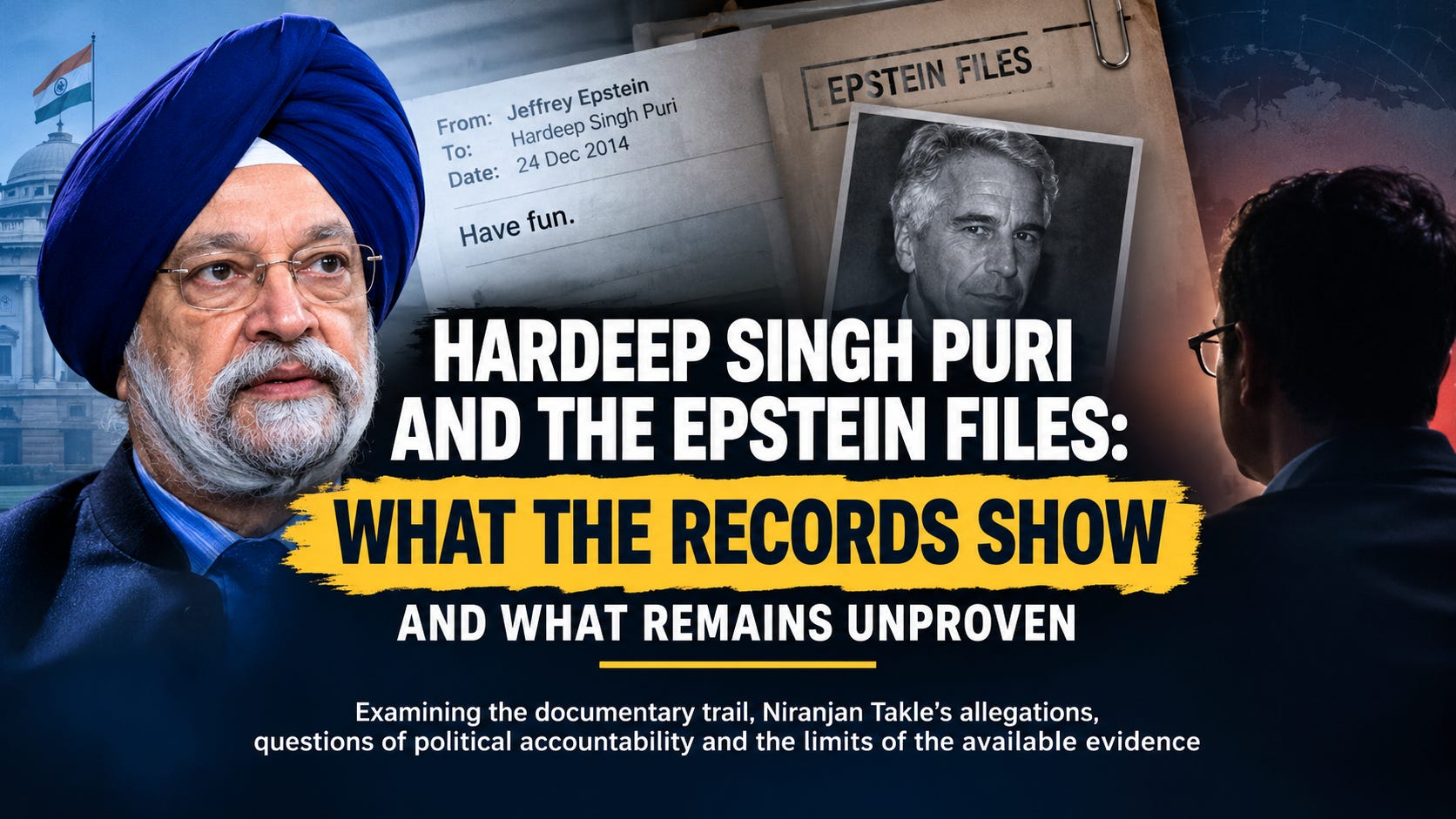
The release of Jeffrey Epstein-related documents has renewed scrutiny of the connections between influential figures, political establishments and international networks. In a discussion on the Public India channel, hosted by Bushra Khanam, journalist Niranjan Takle raises allegations concerning Union Minister Hardeep Singh Puri, Prime Minister Narendra Modi and India’s relationship with the United States.
The discussion raises broader questions about public accountability, alleged financial connections, political consistency and India’s foreign-policy independence. However, the claims vary in their evidentiary strength, ranging from reported emails and photographs to interpretations and wider political arguments. This report examines the key issues, distinguishing allegations from established facts and identifying where further verification is needed.
Hardeep Singh Puri and the Epstein Photographs
Journalist Niranjan Takle questions photographs reportedly released by the US Department of Justice that appear to show Union Minister Hardeep Singh Puri with Jeffrey Epstein. Congress leader Srinivas BV and MP Mahua Moitra are cited as questioning the circumstances of the encounter and whether it aligns with the account of delegation-related meetings.
The key issue is whether the photographs’ authenticity and context support the claims being made. While they may establish an encounter, they cannot independently reveal its purpose and the discussions.
Alleged Contradictions in Puri’s Public Statements
Takle questions Puri’s reported account of meeting Epstein three or four times in professional or delegation-related settings. He claims that emails from the US Department of Justice website indicate more than 10 one-on-one meetings between 2014 and 2017. He also cites 64 emails, contrasting this with Puri’s reported statement that he sent only one email.
A crucial distinction exists between email exchanges, proposed appointments and meetings that actually took place. Takle also interprets a reported reference to Epstein’s “exotic island” and the words “have fun” as potentially significant, but the wording alone does not establish what Puri knew. The central question is whether authenticated correspondence and meeting records support Puri’s public account. Any discrepancies should be put to him for an explanation before conclusions are drawn about his statements.
Calls for Resignation or Dismissal
Takle calls for Puri’s resignation or dismissal, describing him as an accomplice based on his interpretation of the correspondence and criticising media coverage of the controversy. These are allegations and political demands, not established findings of criminal complicity.
The controversy raises questions about ministerial transparency and accountability. Three issues require careful examination: whether the records confirm the reported interactions, whether Puri’s public statements are consistent with the evidence, and whether credible evidence establishes misconduct warranting political, administrative or legal action. Puri should have an opportunity to respond, and his explanation should be assessed against authenticated records.
Alleged Funding of Puri’s Daughter’s Firm
Takle raises financial allegations concerning Himayani Puri and Real Partners LLC, claiming that the firm received funds from a Soros-linked fund in 2014–15. He refers to US Securities and Exchange Commission (SEC) documents and alleges connections between individuals associated with the fund and Epstein’s network.
Verification requires examining the original corporate records to establish the entities involved, the nature and amount of the funding, its source and purpose, and whether any documentary evidence links the transactions to Epstein or unlawful activity.
Takle also alleges that BJP leaders apply inconsistent standards when raising concerns about George Soros-linked funding involving political critics versus individuals associated with the governing establishment. This argument can be assessed by comparing specific statements and the evidence cited. The discussion further mentions a ₹10 crore defamation case reportedly filed by Himayani Puri against a social-media account, whose status requires confirmation through court records.
Alleged References to Narendra Modi and Other Political Figures
The discussion cites an email reportedly claiming that Narendra Modi travelled to Israel and “danced” to please someone powerful, allegedly on Epstein’s instructions. Takle raises questions about the political implications of this communication and possible further disclosures. The discussion also recalls a remark attributed to Trump about his ability to damage Modi’s political career. These claims require authentication and examination in their full context, as an email may reflect opinion or an unverified assertion rather than established fact.
The speakers also refer to Anil Ambani’s alleged appearance in Epstein-related correspondence, including purported requests for meetings with influential American figures and an introduction involving a woman. The transcript does not provide sufficient primary evidence to establish the authenticity, context or outcome of these communications.
Alleged US Influence and India’s Policy Independence
The discussion questions whether India’s relationship with the United States has constrained its foreign-policy and economic independence. Concerns been also raised about US Ambassador Sergio Gor, Secretary of State Marco Rubio’s engagement with Indian officials, and diplomatic interactions they interpret as potential interference. They also link these concerns to oil imports, defence procurement, the treatment of deported Indian nationals and the purchase of election-related software from a US company.
On energy policy, the speakers allege that US pressure has influenced India’s purchases of Iranian and Russian oil in favour of American and Venezuelan crude.
On defence procurement, concerns about the F-35 fighter aircraft and possible American influence must be assessed against pricing, equipment specifications, maintenance, technology transfer and contractual terms. Allegations of coercion require documentary evidence.
The discussion also questions India’s diplomatic response to the deportation of Indian nationals in shackles, raising issues of national dignity, consular protection and government accountability. Separately, concerns about election-related software purchased from a US firm warrant scrutiny of the procurement process, data access, cybersecurity safeguards and the Election Commission’s role.
These issues merit independent examination through official records and verifiable evidence. While transparency is essential to protecting India’s strategic autonomy, the claims presented do not, by themselves, establish that Epstein’s network influenced Indian government policy or that the government acted under blackmail.
US Politics and the Release of the Epstein Files
The discussion places the Epstein files controversy within the broader US political landscape. The speakers refer to the reported release of approximately three million documents by the Department of Justice, some containing redactions, and calls by Democrats for fuller disclosure. They also speculate that the November midterm elections could intensify pressure for further revelations and mention Bill Clinton’s appearance in the files.
However, the discussion does not establish the precise scope of the release, the reasons for individual redactions or whether additional disclosures will follow.
Any political consequences will depend on what authenticated records actually demonstrate. Predictions about future disclosures or electoral impact remain speculative. Ultimately, the files should be assessed on the strength of their evidence, rather than the political advantage they may offer to either party.
Opposition Strategy and the Demand for Accountability
Takle argues that opposition parties and civil society should pursue the controversy through sustained, evidence-based scrutiny, including demands for Puri’s and Modi’s resignations.
A credible accountability effort would require examining authenticated records, raising specific questions in Parliament, clarifying discrepancies in public statements and pursuing appropriate investigations where evidence warrants. Journalists and civil-society organisations can help by distinguishing verified facts from allegations and correcting claims that are contradicted by reliable evidence.
Accountability standards must apply consistently across political parties and public institutions. Opposition demands are most meaningful when they are supported by credible evidence, clearly defined questions and conclusions proportionate to what the records establish.
What Needs to Be Verified Before Drawing Conclusions?
The discussion raises significant questions, but many claims require further verification through primary sources. Key priorities include:
Epstein records: Authenticate photographs and complete email chains, establish dates and participants, and distinguish actual meetings from proposed appointments.
Puri’s statements: Compare his precise public statements with authenticated records and seek clarification of any demonstrable discrepancies.
Financial allegations: Examine original SEC filings and corporate documents concerning Real Partners LLC, the alleged funding amounts, the entities involved and the source and purpose of the funds.
References to public figures: Verify the authenticity and context of emails mentioning prominent figures. A name appearing in a document does not establish wrongdoing.
Foreign policy and procurement: Review official oil-import data, defence contracts, diplomatic records and government statements before attributing decisions to American pressure.
Political and historical claims: Consult reliable historical, judicial and official records when examining ideological movements, communal violence and alleged legal violations.
The objective is to separate substantiated claims from unresolved questions and unsupported allegations. Conclusions should follow evidence, with uncertainties clearly acknowledged and those concerned given a fair opportunity to respond.
Accountability, Evidence and India’s Strategic Autonomy
The allegations raised span Hardeep Singh Puri’s reported interactions with Jeffrey Epstein, financial connections, political accountability and questions about US influence over Indian policy. Each requires careful examination of authenticated records and independent corroboration.
The wider concerns about India’s energy policy, defence procurement, diplomatic relations and electoral institutions deserve scrutiny in their own right. They should not be linked to the Epstein controversy without evidence establishing a direct connection.
Accountability must be consistent, regardless of political affiliation. Public officials should answer legitimate questions, but allegations must not be mistaken for proven misconduct. The way forward is to verify documents, examine financial and political claims, seek responses from those concerned and pursue credible evidence through appropriate institutions. This is essential to democratic transparency and an informed debate about India’s strategic independence.
Disclaimer
This report analyses claims raised by journalist Niranjan Takle in a Public India discussion hosted by Bushra Khanam. It is not an independent investigation, and the allegations concerning individuals, financial transactions, political influence and India’s foreign policy should not be treated as established facts. The underlying photographs, emails, financial filings and legal records have not all been independently verified. Readers should consult authenticated primary sources, reliable independent reporting and relevant judicial findings before drawing conclusions. This report does not determine guilt or innocence.
(153) Epstein Files LIVE: Hardeep Puri Meeting Photos, Jeffrey Epstein & New Revelations - YouTube