


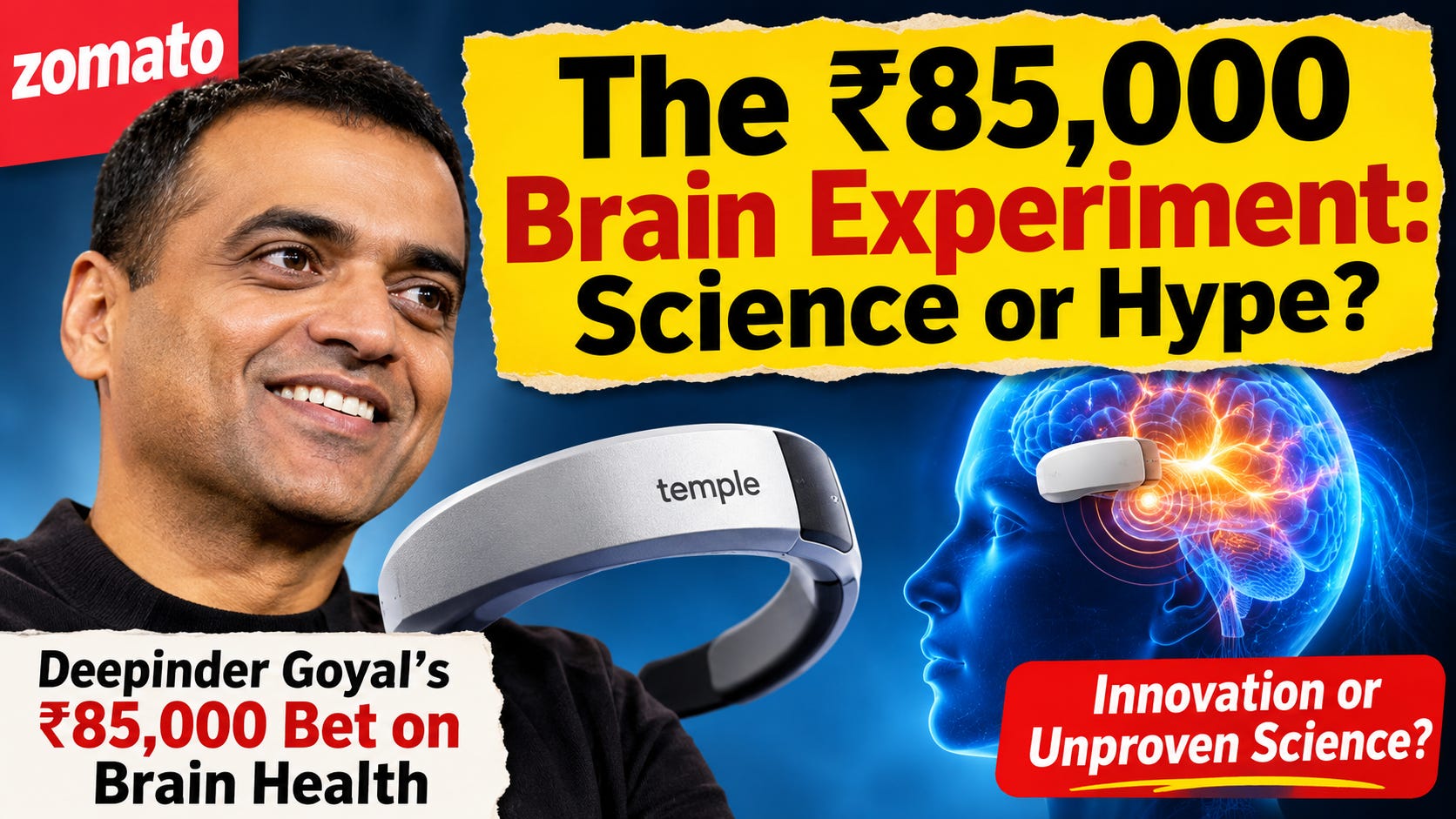
A very different venture
What if a device costing ₹85,000 could offer a window into the human brain—not just tracking how we sleep, exercise or recover, but attempting to measure changes in brain circulation and physiological workload?
That is the intriguing proposition behind Temple, the latest venture of Deepinder Goyal, co-founder of Zomato (now Eternal), as he steps into the relatively unexplored world of brain health, longevity and wearable technology.
Unlike conventional smartwatches, Temple is designed to monitor physiological signals associated with cerebral circulation and the body's workload, potentially opening new avenues for understanding how the brain responds to everyday activities and ageing.
But ambition has brought scrutiny. Doctors and researchers have questioned whether a sensor placed outside the skull can reliably reveal what is happening inside the brain. Is Temple a breakthrough in brain-health monitoring, or are its scientific claims running ahead of the evidence?
What exactly does Temple measure?
Temple revolves around two proprietary measurements.
BrainFlow: BrainFlow is designed to track relative changes in physiological signals associated with blood circulation in the brain.
The objective is to observe how these signals respond to changes in posture, exercise and other everyday activities. Unlike occasional clinical assessments, Temple aims to provide continuous monitoring.
It is important, however, to distinguish between tracking a signal associated with cerebral circulation and directly measuring the brain’s total blood supply. These are not interchangeable claims.
Entropy: Entropy is a proprietary score intended to indicate how hard the body is working to maintain its physiological state.
According to Goyal’s explanation, the score responds to factors such as exercise, sleep, stress, food, caffeine and meditation. It is intended to provide an indication of physiological workload and recovery.
The interesting question is whether this score represents a scientifically meaningful biomarker or simply a new way of presenting information derived from physiological signals.
That distinction will require transparent methodology and independent validation.
The Gravity Ageing Hypothesis: An ambitious scientific proposition
Temple is connected to Goyal’s broader Gravity Ageing Hypothesis.
The proposition explores whether gravity’s influence on blood circulation over a lifetime could contribute to the ageing process, particularly in the brain.
The underlying idea is that maintaining adequate blood circulation to the brain, positioned above the heart, involves physiological adjustments. Goyal is interested in whether these adjustments have consequences over decades.
This is an interesting research question. However, the existence of gravitational effects on circulation does not establish that gravity accelerates brain ageing.
The human body has sophisticated mechanisms to regulate cerebral blood supply, including adjustments in blood-vessel diameter and cerebral autoregulation.
As neurologists have pointed out, the brain maintains circulation through complex compensatory mechanisms even when posture changes.
Consequently, the Gravity Ageing Hypothesis should be treated as a research proposition, not an established scientific explanation of ageing.
The science behind the controversy
The most significant criticism concerns the location of Temple’s optical sensors.
The device sits near the superficial temporal artery, which supplies blood to the scalp and face. The brain itself receives blood primarily through the internal carotid and vertebral arteries.
This anatomical distinction matters.
Changes in scalp circulation do not necessarily correspond to changes in cerebral circulation. Exercise, temperature, stress and other physiological conditions can influence blood flow in superficial tissues.
Dr Cyriac Abby Philips, popularly known as The Liver Doc, has questioned whether Temple’s measurements can reliably establish what is happening inside the brain.
His criticism raises three important scientific issues:
Measurement location: A signal recorded near the temple must be distinguished from changes in superficial scalp circulation.
Representativeness: A measurement at one location cannot automatically be assumed to represent blood circulation throughout the brain.
Clinical interpretation: Even if a device tracks changes in cerebral circulation, that does not establish that its readings can predict cognitive decline, dementia or biological ageing.
Other medical professionals have also questioned whether the proprietary Entropy score has been adequately explained and validated.
These are legitimate questions. At the same time, criticism of a new technology should be assessed against its actual claims and published evidence, rather than dismissing the possibility of innovation merely because the technology is unfamiliar.
What does Goyal say in defence?
Goyal has defended Temple and pointed towards preliminary research supporting its BrainFlow technology.
Two company-funded research preprints have attracted particular attention.
The first compared Temple’s readings with Transcranial Doppler measurements, a recognised technique used to measure blood-flow velocity in major cerebral arteries.
The second study used time-domain near-infrared spectroscopy (TD-NIRS), a technique capable of distinguishing changes in blood volume in deeper brain tissue from those in superficial scalp layers.
According to the second study, involving 44 healthy young adult men across 60 testing sessions, the reported median correlation between Temple BrainFlow and the model-derived brain signal was:
0.912 during a head-down tilt.
0.843 during a stand-to-squat movement.
0.839 during a stand-to-supine transition.
For the head-down tilt experiment, the corresponding correlation with the scalp signal was 0.494.
These findings are interesting because they suggest that Temple’s readings may be tracking changes associated more closely with deeper brain signals than with scalp signals under certain controlled conditions.
However, the distinction between correlation and accuracy is crucial.
A correlation of 0.91 does not mean that the device is 91% accurate. It indicates that two signals moved together to a considerable degree under the particular experimental conditions.
The study itself also found that the difference between brain and scalp correlations was not statistically significant in the stand-to-supine experiment.
Furthermore, the research was funded and conducted by Temple, with company-related research interests among the authors. The findings were available as preprints and had not undergone peer review or independent replication as of November 10, 2026.
This does not invalidate the findings. It does mean that they should be treated as preliminary rather than conclusive.
Goyal has also maintained that Temple is a wellness and fitness product, not a medical diagnostic instrument. He has defended the research programme and indicated that independent testing and further scientific work are important.
The commercial proposition: Is ₹85,000 justified?
Temple opened pre-orders in India on November 1, 2026, at ₹85,000. Deliveries are expected to begin approximately three months after ordering, according to published reports.
This places the device firmly in the premium wearable category.
Goyal has reportedly committed substantial capital to the venture, with media reports citing an investment of approximately $30 million in its development. This figure should be understood as a reported investment estimate rather than independently audited project expenditure.
From a business perspective, Temple is entering an emerging market where consumers are increasingly interested in longevity, preventive wellness and continuous health monitoring.
Its differentiation lies in its proposed ability to monitor physiological signals that conventional wrist-worn fitness trackers do not specifically target.
If the technology proves reliable, it could create interesting opportunities in sports science, physiological research and personalised wellness.
But the commercial challenge is equally important.
At ₹85,000, consumers are paying a substantial premium for measurements whose independent validation and everyday usefulness remain uncertain.
A product’s technological novelty does not automatically establish consumer value. Ultimately, the question is whether the information it provides is reliable, understandable and useful enough to justify its price.
What the Evidence Establishes—and What It Doesn’t
It is useful to separate what is currently supported from what remains unproven.
What the evidence establishes:
Temple is a real wearable technology venture founded by Deepinder Goyal.
Its optical sensors are designed to monitor physiological signals associated with circulation near the brain.
BrainFlow and Entropy are its principal proprietary measurements.
Preliminary company-funded research has reported correlations between BrainFlow readings and established reference techniques under controlled conditions.
The device has been positioned as a wellness and fitness product rather than a medical diagnostic instrument.
Its ₹85,000 Indian pre-order price makes it an expensive proposition for consumers.
What the evidence does not yet establish:
That Temple can accurately measure absolute blood flow throughout the brain.
That its readings can reliably identify neurological disease or predict cognitive decline.
That Entropy is an independently validated biomarker of metabolism, recovery or biological ageing.
That the Gravity Ageing Hypothesis explains human ageing or establishes a causal relationship between gravity and brain deterioration.
That using Temple improves health outcomes, extends lifespan or prevents age-related diseases.
These distinctions are not minor technicalities. They define the boundary between a promising research instrument and a proven health technology.
Innovation deserves encouragement, but evidence deserves priority
We should not dismiss Temple simply because it challenges conventional approaches to health monitoring.
Entrepreneurship often involves exploring questions that established industries have not fully addressed. Goyal’s willingness to invest in an unconventional research area deserves recognition.
However, the burden of proof must remain with the technology and its claims.
The next meaningful milestones should include peer-reviewed publications, independent replication, larger and more diverse participant groups, transparent measurement methodology and evidence demonstrating that the information generated has practical value.
Most importantly, research must establish whether continuous monitoring can deliver meaningful insights beyond what existing medical and fitness technologies already provide.
For prospective buyers, patience may be the more sensible approach. At ₹85,000, waiting for independent validation is not necessarily a rejection of innovation; it is simply an exercise in informed decision-making.
Deepinder Goyal has placed an ambitious bet on the future of brain-health technology. Whether Temple becomes a meaningful breakthrough or an expensive experiment will depend not on the size of the investment or the strength of the publicity, but on what independent science eventually establishes.
Perhaps the larger lesson extends beyond Temple: In an age when technology increasingly promises to measure everything about us, should we first ask whether we truly understand what those measurements mean?
Sources and Further Reading
India Today – Temple BrainFlow research and the TD-NIRS study (September 25, 2026)
The Indian Express – Why doctors question Temple’s brain-health claims (November 5, 2026)
Rediff / PTI – Temple wearable and the scientific credibility debate (November 9, 2026)
Business Standard – Temple explained: Deepinder Goyal’s bet on wearables and longevity
Disclaimer
This report is prepared solely for informational, educational and analytical purposes. It represents an independent review intended to provide readers with greater clarity and understanding of the subject. The writer and Third Publication have no association, affiliation or commercial relationship with the company, its management or its representatives, and have not contacted the company in connection with the preparation of this report.
The article should not be construed as medical advice, a product endorsement, a commercial recommendation or a definitive judgement on scientific claims that remain subject to debate. Company statements, preliminary research findings and expert opinions are presented in their respective contexts and should be evaluated accordingly. Readers should exercise their own judgement and consult qualified medical professionals before making health-related decisions.
Third Publication
Beyond the headlines. Follow the evidence. Understand the consequences.