


A Story That Refuses to Disappear
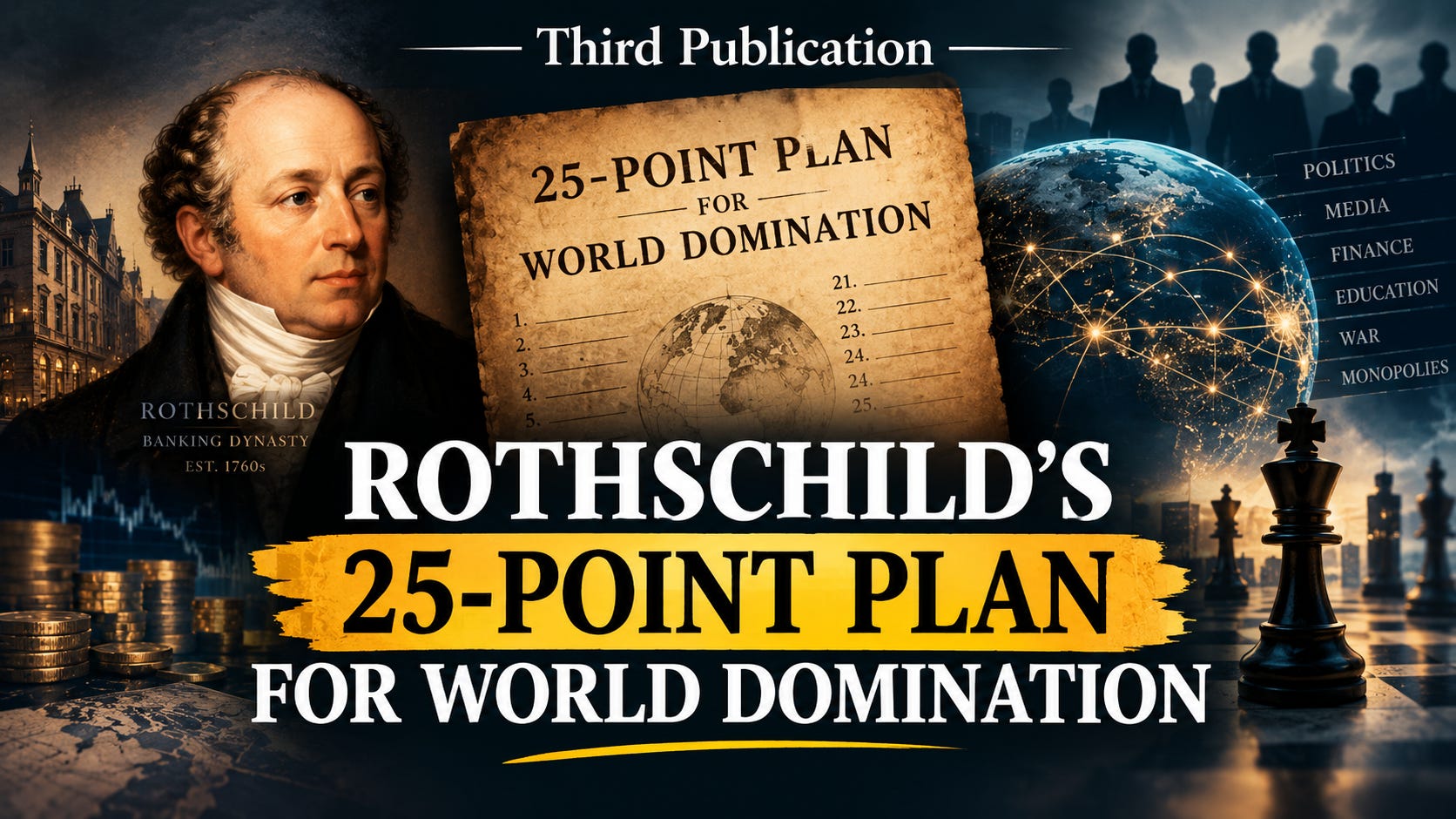
Few names in financial history have generated as much fascination, speculation and controversy as the Rothschild family. For decades, a document described as Rothschild’s 25-Point Plan for World Domination has circulated across websites, blogs and conspiracy-oriented publications. Allegedly dating to 1773, it is presented as a blueprint for controlling governments, financial systems, media, education and, ultimately, the world.
The document’s themes sound strikingly contemporary: political manipulation, propaganda, financial crises, social divisions, monopolies and the concentration of wealth.
But an essential question comes first: Is this really a historical document created by Mayer Amschel Rothschild, or is it a later conspiracy narrative presented as historical fact?
The distinction matters. A powerful financial family existed, and its members influenced European banking. That historical reality, however, does not establish the existence of a secret plan for global domination.
The most useful approach is therefore to examine what the document claims, what history confirms, and where the evidence ends.
The Rothschild Family: Financial Influence and Historical Reality
Mayer Amschel Rothschild (1744–1812) established a banking business in Frankfurt. His five sons subsequently expanded the family’s financial operations across major European centres, including London, Paris, Vienna, Naples and Frankfurt.
The resulting banking network became influential in European finance, including government borrowing and major financial transactions.
This history provides an understandable starting point for questions about wealth, political connections and financial power.
However, there is a fundamental difference between possessing substantial economic influence and controlling world events through a coordinated secret programme.
The Rothschild family’s financial prominence is historically documented. The alleged 25-point blueprint is a separate claim that requires independent evidence.
What Does the Alleged 25-Point Plan Propose?
Versions circulating online attribute a broad range of objectives to the Rothschild family. Although the wording differs between versions, the alleged programme can be understood through several recurring themes.
Political manipulation: The document describes influencing political candidates, weakening institutions, manipulating governments and ultimately establishing a system of centralised global authority.
Social division: It suggests exploiting class conflict, public emotions and divisions between groups to weaken collective resistance.
Information control: It portrays the press and propaganda as instruments for shaping public opinion while concealing the interests behind that influence.
Financial instability: The alleged plan describes using economic panic, scarcity and financial crises to increase dependence and consolidate power.
War and debt: It links armed conflict with government borrowing, suggesting that indebted states become more vulnerable to financial influence.
Monopolies and concentrated wealth: It envisions economic power becoming concentrated in a small number of hands, extending into property, industry, taxation and political authority.
Taken together, these themes present a comprehensive theory of hidden control. Yet the breadth of a claim does not establish its authenticity.
The Central Question: Where Is the Original Document?
The most important weakness in the claim concerns its historical provenance. The document is widely reproduced online, but circulation is not authentication. A document repeatedly copied across websites does not become historically reliable simply through repetition.
To establish that a text originated in 1773 and was authored or presented by Mayer Amschel Rothschild, researchers would look for evidence such as:
An original manuscript or a reliably documented archival copy.
A verifiable chain of ownership and provenance.
Contemporary references to the document.
Credible historical scholarship establishing its origin.
Independent evidence supporting its attribution and date.
These versions do not establish this evidentiary chain. Consequently, the attribution to Rothschild and the alleged 1773 origin cannot responsibly be presented as confirmed history.
The Illuminati Connection: A Chronological Problem
The alleged plan is frequently associated online with the Bavarian Illuminati, Freemasonry and the broader idea of a New World Order.
However, the Bavarian Illuminati was founded by Adam Weishaupt in 1776—three years after the alleged 1773 date of the Rothschild plan.
That chronological difference raises an obvious question for versions that connect the two directly.
The Illuminati, Freemasonry and the Rothschild banking houses were not interchangeable entities. Their histories, organisational structures and activities must be examined separately rather than combined into one continuous narrative without evidence.
Conspiracy narratives often gain persuasive force by connecting real historical people and organisations. But a collection of genuine names and events does not automatically produce a genuine historical explanation.
Why Does the Story Sound So Modern?
One reason the alleged plan continues to attract attention is that several of its themes describe recognisable political and economic phenomena.
Propaganda has been used by governments and political movements. Financial crises can destabilise societies and governments. Concentrated corporate power can influence markets and public policy. Political actors have sometimes exploited social divisions, while powerful industries can exert pressure on regulators.
Today’s information environment adds further complexity through social media, digital advertising, search engines, influencers and algorithmic recommendation systems.
But there is a crucial distinction between identifying a real mechanism of influence and claiming that one family designed a centuries-long strategy to control it. A similarity between an alleged historical document and modern events is not proof of historical continuity.
Financial crises may create opportunities for powerful institutions without having been deliberately engineered by them. Political influence can exist without implying total political control. And concentrated wealth does not demonstrate the existence of a single organisation directing global affairs.
The Psychology of Conspiracy Narratives
Complex events rarely have a single cause. Financial instability may involve monetary policy, excessive leverage, regulation, investor behaviour, geopolitics and government decisions. Political upheaval may reflect economic inequality, social grievances, leadership failures and institutional weaknesses.
A conspiracy narrative offers a simpler explanation: someone is secretly controlling everything.
Such explanations can be attractive because they turn uncertainty into an apparently coherent story. They connect otherwise unrelated events and provide a clear villain responsible for complicated outcomes.
Repeated exposure can strengthen the impression of credibility, particularly when the same claims appear across multiple websites without independent verification.
The alleged Rothschild plan illustrates this process. It combines genuine historical subjects—banking, wealth, political influence, war and propaganda—into a much larger claim of coordinated global control.
Important Distinction: Criticising Power Without Endorsing Prejudice
The Rothschild conspiracy narrative also requires careful handling because many versions incorporate antisemitic themes, including claims that Jewish people collectively participate in a hidden project to control humanity.
Such generalisations are unsupported and belong to a longstanding tradition of antisemitic conspiracy theories.
Criticism of financial institutions, wealthy individuals, corporate concentration or political influence is legitimate when based on evidence. Collective accusations against Jewish people—or any other group—are not a substitute for historical investigation.
The appropriate approach is to examine specific individuals, institutions, transactions and decisions, using verifiable evidence rather than assigning collective responsibility.
What Can We Learn from the Alleged Plan?
Rejecting the document’s unverified attribution does not mean that every subject it raises is irrelevant.
Several issues deserve serious examination:
Political influence: How do money, lobbying and personal networks affect public policy?
Media and propaganda: Who owns information platforms, and how do their incentives shape public debate?
Financial power: How do banks, corporations and investors influence governments and markets?
Economic concentration: When does market dominance weaken competition or increase political influence?
Regulatory capture: Under what circumstances do regulated industries influence the institutions responsible for overseeing them?
Financial crises: How do economic shocks redistribute wealth, alter political priorities and affect ordinary citizens?
These questions can be investigated through public records, financial disclosures, historical documents, regulatory findings and credible scholarship.
They also allow researchers to identify actual concentrations of power without assuming that every major event is part of a hidden master plan.
Influence Is Not the Same as Control
The alleged Rothschild 25-Point Plan for World Domination is best treated as an unverified conspiracy narrative, not an authenticated historical programme. Its attribution to Mayer Amschel Rothschild and its supposed origin in 1773 are not established by reliable historical evidence.
The Rothschild banking dynasty unquestionably occupies an important place in European financial history. Its rise demonstrates how capital, financial expertise, international networks and political connections can create considerable influence.
But influence has limits. Governments compete, corporations pursue conflicting interests, banks face market pressures, and political institutions frequently disagree. Even exceptionally wealthy individuals cannot simply command every government, market or international event.
The more productive question is not whether one family secretly controls the world. It is how power actually operates, who benefits from particular decisions, which institutions provide accountability, and what verifiable evidence supports a claim.
The real task is to investigate power without exaggerating it, question institutions without abandoning evidence, and distinguish documented history from narratives that merely sound convincing.
That is a more demanding approach than accepting a grand conspiracy—but it is also a far more reliable way to understand the world.
A Question for India: Is There Any Relevance Today?
Do you see any relevance of this theory in what is happening in India today, particularly amid the ongoing agitations, political confrontations and public debates over institutions, power and the control of narratives?
Could the alleged plan offer a lens through which to question how political influence, public opinion and social divisions interact—or would drawing such parallels risk connecting unrelated events without sufficient evidence?
The comparison is worth exploring, but the distinction between a thought-provoking question and a proven conspiracy must remain clear.
The real test is not whether events appear to fit a theory, but whether verifiable evidence supports the connection.
Disclaimer
This report is intended solely for educational, historical and analytical purposes. The alleged “Rothschild 25-Point Plan” is widely circulated in conspiracy literature, but its attribution to Mayer Amschel Rothschild and its alleged 1773 origin are not established by reliable historical evidence. The report does not endorse antisemitic, extremist or collective accusations against Jewish people, the Rothschild family, Freemasonry, the Illuminati or any other group. Historical claims should be assessed through primary documents, credible scholarship and independently verifiable evidence.
This report should not be interpreted as proof of any alleged secret plan or organisation.