


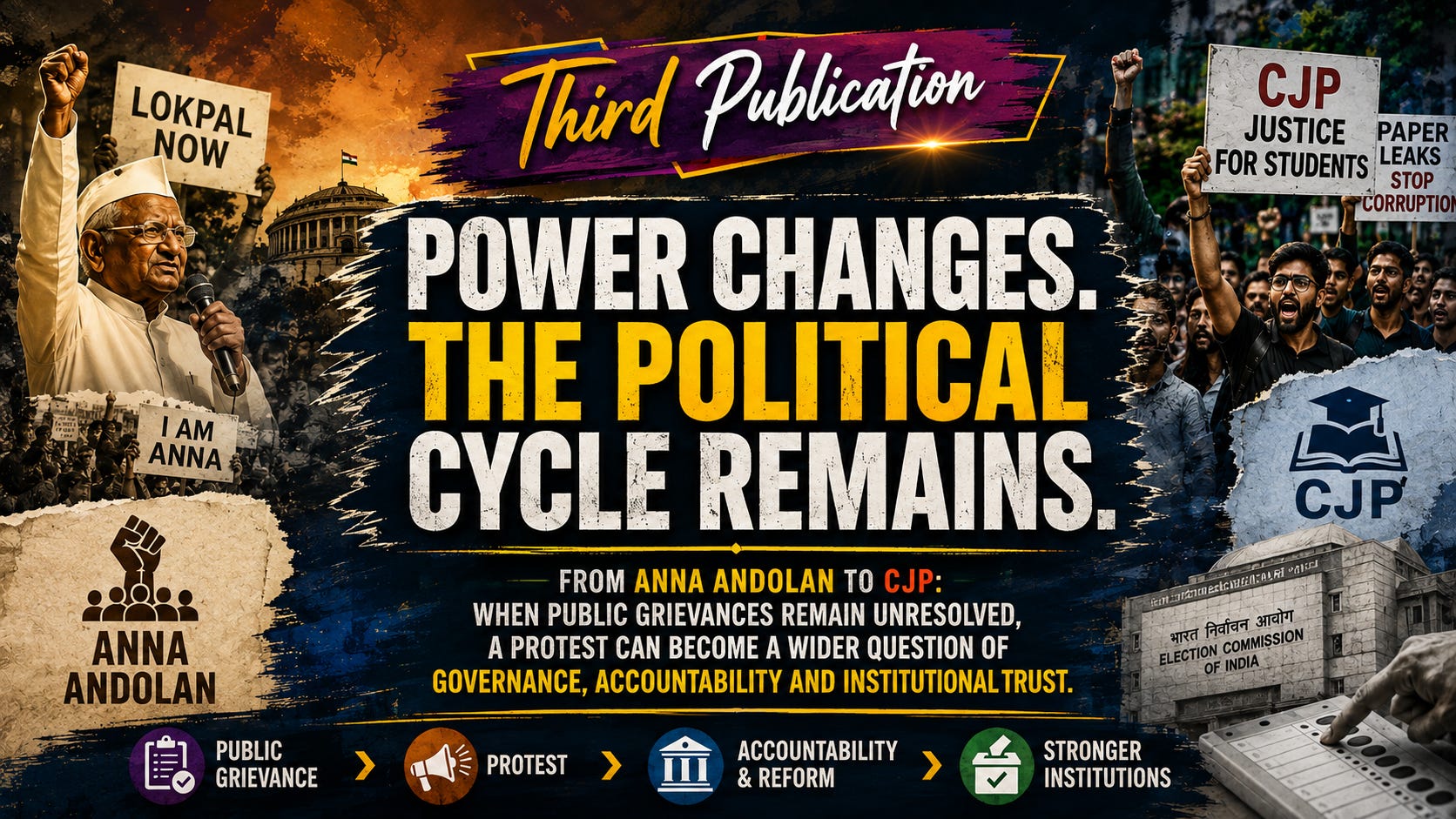
India’s political history is often seen through changing governments—Congress yesterday, BJP today and another party tomorrow. But there is a recurring pattern beneath those changes.
Governments can become powerful and electorally confident, yet gradually lose touch with public grievances. Protests may initially be dismissed as political disruption, only to grow into wider questions of governance and accountability.
The Anna Andolan of 2011 and CJP-led youth agitation of 2026 are not identical; their issues, generations and circumstances are different. But they share a deeper political dynamic:
A specific public grievance can grow into a larger demand for accountability, institutional reform and the right of citizens to be heard.
From Anna Andolan to CJP: Different Issues, Similar Political Dynamic
The Anna Hazare movement began with demands for a strong Lokpal amid corruption controversies and wider concerns over governance and accountability. What started as a specific demand soon became a broader expression of public dissatisfaction, shifting the debate from controlling corruption to holding institutions accountable.
Fifteen years later, the CJP agitation began with student concerns over examination irregularities, paper leaks, recruitment exams and educational opportunity. As the movement grew, its focus expanded from examination reform to wider questions of institutional accountability.
The issues are different, but the underlying dynamic is similar:
A specific public grievance can grow into a much larger demand for accountability, institutional reform and a system that listens to its citizens.
CJP: From Education to a Wider Systemic Question
The CJP agitation sustained momentum around examination and education-related grievances, but its focus gradually expanded from paper leaks and accountability to a larger question: “Why is the system repeatedly vulnerable to such failures?”
For students, a compromised examination can mean a lost year, additional costs, family pressure and uncertainty about employment. When such grievances are shared widely, a personal problem can become a systemic and political question.
In September 2026, CJP announced an “Election Commission Theek Karo” campaign, raising demands concerning the Chief Election Commissioner and the SIR of electoral rolls. These remain CJP’s political claims and demand.
CJP has therefore moved beyond a narrow education protest into a wider debate about accountability, governance and institutions.
The BJP’s Challenge: Listen Before the Street Becomes the Parliament
The CJP episode highlights a broader governance question: how early should governments respond to a growing public grievance?
Early engagement can sometimes prevent a specific grievance from expanding into a broader political movement. This is not necessarily a question of whether a government “listens” or does not listen, but of whether feedback from citizens reaches decision-makers early enough.
Even highly centralised governments can face an information gap. Officials may report implementation, ministers may highlight progress and political organisations may report public support. Yet an individual student may still be asking: “My examination was compromised. Who is responsible?”
When such questions remain unresolved, individual frustration can accumulate and acquire wider political significance.
The lesson from the CJP episode is therefore broader than any single government or political party:
Political authority does not eliminate the possibility of an information gap between government and citizens. The governance challenge is to identify genuine grievances before they become larger movements on the street.
Congress and Chhatron Ki Goonj: Opportunity without an Automatic Dividend
The CJP movement has created political space for the opposition. Congress, through Rahul Gandhi’s Chhatron Ki Goonj, has sought to bring education, examinations, employment and youth concerns into a wider political debate.
But being present at a protest is not the same as owning the grievance—and owning a grievance is not the same as solving it.
The CJP movement also reflects a broader youth concern that does not necessarily translate into support for any particular political party.
Students want to know whether their examinations will be fair, graduates whether years of preparation will lead to genuine opportunities and parents whether they can trust the system with their children’s future. These concerns go beyond party politics. For Congress, the challenge is whether Chhatron Ki Goonj can move beyond political messaging to credible policy proposals on examination security, recruitment, education costs, coaching dependence and institutional accountability. Saying “the system is broken” creates a political narrative; explaining “how we would repair it” creates a policy proposition.
The Word “Arrogance” — A Perception That Can Become Political Reality
The word “arrogance” should be used carefully because it is a political judgment, not an established fact. However, perception can have real political consequences. A government may believe it is delivering more than previous governments, while citizens may simultaneously feel that nobody is listening to them. When this gap widens, communication between government and society can weaken.
This is why “Congress was bad then, BJP is now” misses the broader lesson. Governments and parties change, but the underlying vulnerability can remain.
The political cycle is familiar: confidence fades, grievances build, a trigger sparks protest, political parties step in and the government responds—turning a local issue into a wider debate over institutions and governance.
The CJP agitation illustrates how quickly an issue initially seen as manageable can evolve into a national political conversation. The broader lesson is not about one party, but how public perception, communication gaps and unresolved grievances can reshape the political narrative.
From “Youth Vote” to “Youth Voice”
The most significant feature of the CJP episode is the role of young citizens.
Indian politics often views youth primarily as a voting demographic. The emerging movement suggests a broader role: young people participating in public life beyond election cycles. Students, examination aspirants, parents and young professionals are engaging with questions of education, employment, opportunity and institutional accountability.
The distinction is important: a voter participates periodically, while a citizen participates continuously. A student protesting today may tomorrow become a teacher, doctor, entrepreneur, civil servant, journalist or political leader. Therefore, youth participation should not be viewed only in terms of which political party benefits.
It can represent something broader: Youth Voice → Civic Participation → Nation-Building, which may be one of the most important dimensions of the CJP movement.
The Larger Lesson: India Should Not Repeat the Same Cycle
The comparison between 2011 and 2026 should not simply be framed as “Congress then = BJP now.” The more useful comparison is the political cycle. In 2011, public dissatisfaction and corruption controversies helped fuel the Anna movement, which widened the debate over accountability and eventually had political consequences. In 2026, student grievances and examination protests have contributed to CJP mobilisation, expanding the discussion from education reform to broader questions of institutions and governance.
How the second story ends remain uncertain.
The more important question is whether the agitation produces lasting institutional change—better examination security, stronger accountability, fewer paper leaks and more effective grievance redressal.
Similarly, debates around electoral institutions could lead to greater transparency and scrutiny.
Ultimately, the lasting significance of CJP may be measured less by its electoral consequences and more by whether it contributes to stronger institutions and greater citizen accountability.
Conclusion: Power Changes, the Cycle Remains
India has seen a recurring cycle: public anger leads to protest, political parties step in, the government responds, public trust weakens and eventually a new protest emerges.
The real challenge is to break the cycle.
Anna Andolan showed how a specific grievance could become a national accountability movement. CJP demonstrates how concerns over examinations and education can grow into wider questions about governance and institutions.
Governments have to listen before grievances become movements. Political parties must turn public dissatisfaction into credible policy. And CJP faces the challenge of maintaining accountability without becoming another political establishment.
For India’s youth, the bigger shift may be from “Youth Vote” to “Youth Voice.”
The larger question is simple:
Can governments treat public protest as democratic feedback before it becomes a political crisis?
Power changes. The cycle remains. The challenge is to break it.
Disclaimer
This report is an analytical commentary based primarily on the publicly reported developments referenced therein. It does not endorse or oppose any political party, movement, individual or institution.
The comparison between the Anna Andolan and CJP is analytical and does not imply that the two movements are identical or will have similar political consequences.
Terms such as “arrogance,” “disconnect” and “political distance” of leaders describe perceptions or interpretations, not independently established facts. Claims concerning CJP, the government, political parties or the Election Commission should be considered alongside verified facts and relevant institutional responses.
The report does not predict electoral outcomes or recommend political choices. Its purpose is to examine how public grievances can evolve into broader questions of accountability, governance and institutional reform.