


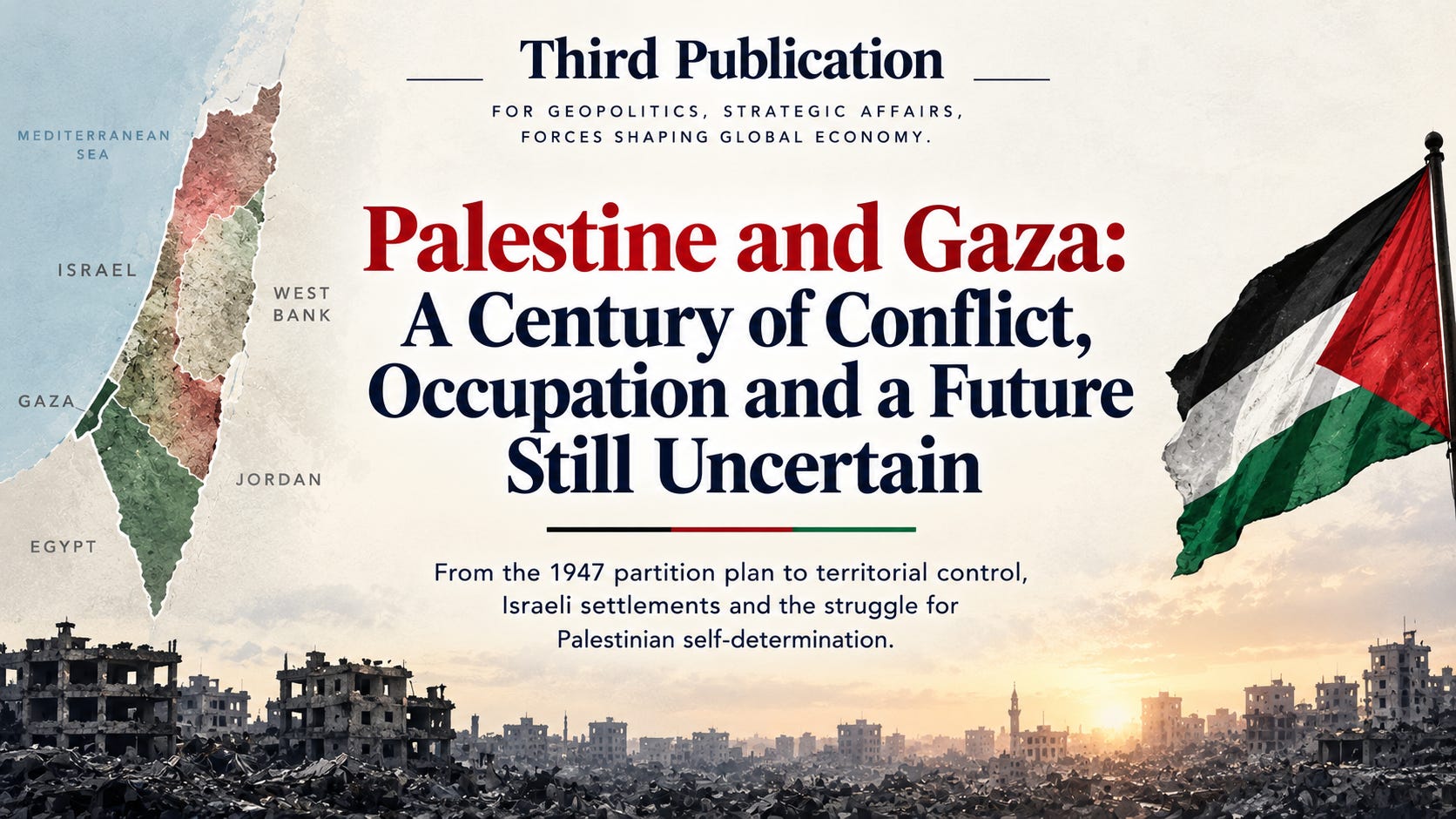
The conflict in Palestine is not simply a dispute over borders. It is the outcome of competing national aspirations, wars, displacement, occupation and failed negotiations.
To understand why peace remains elusive, it is essential to examine not only the history but also the geography: which territories Israel controls, where Palestinians exercise authority and how Israeli settlements are changing the landscape.
From British Rule to the 1947 Partition Plan
Before the First World War, Palestine was part of the Ottoman Empire. Britain assumed control after the war and the League of Nations formalised its Mandate in 1922. While Britain supported a Jewish national home, Palestinian Arabs increasingly demanded independence and opposed losing their right to national self-determination.
In November 1947, the UN proposed partitioning Palestine into a Jewish state an Arab Palestinian state and an internationally administered Jerusalem. The proposed Jewish state was allocated approximately 56% of the territory. Jewish leaders accepted the plan in principle, while Palestinian Arab leaders and neighboring Arab states rejected it.
The plan was never implemented. Following Israel’s declaration of independence in May 1948 and the ensuing war, Israel controlled approximately 77% of former Mandate Palestine. More than 700,000 Palestinians were displaced in what Palestinians call the Nakba.
Palestine’s Geography: Who Controls Which Territory?
The territories envisaged for a Palestinian state are the West Bank, including East Jerusalem, and the Gaza Strip, separated by Israeli territory. Understanding the difference between administrative authority, military control and sovereignty is essential.
Israel: Exercises sovereignty within its internationally recognised territory and occupies the West Bank, including East Jerusalem, under the prevailing international legal position. Final borders remain unresolved.
The West Bank: Located between Israel and Jordan, it includes Ramallah, Nablus, Jenin, Bethlehem and Hebron. The Palestinian Authority administers parts of the territory, while Israel retains extensive military and territorial control.
Under the Oslo II arrangements, the territory was divided into three areas:
Area A: Palestinian civil administration and internal security responsibilities, subject to Israeli military operations.
Area B: Palestinian civil administration, with Israel retaining significant security responsibilities.
Area C: Under Israeli control, including planning and land-use administration; it covers roughly 60% of the West Bank.
These arrangements do not provide full Palestinian sovereignty. Israeli settlements, military operations, checkpoints and movement restrictions also affect territorial continuity.
East Jerusalem: Captured by Israel in 1967 and subsequently annexed, a move not recognised internationally. Israel considers Jerusalem its capital, while Palestinians claim East Jerusalem as the capital of a future Palestinian state.
Gaza Strip: A narrow coastal territory bordering Israel, Egypt and the Mediterranean Sea. Hamas took control in 2007 following its conflict with Fatah. Israel withdrew its settlements and permanent ground forces in 2005 but retained significant control over access, airspace and maritime movement; Egypt controls its side of the border.
The central reality: The Palestinian Authority governs parts of the West Bank, while Hamas has historically controlled Gaza. Neither has exercised unified, full sovereign authority over both territories.
What Was Israel Entitled to—and What Did It Capture?
The distinction between proposed borders, territory acquired in war and internationally recognised sovereignty is central to this question.
The 1947 Partition Plan: The UN proposed separate Jewish and Arab states. Israel’s establishment in 1948 resulted in control over approximately 77% of former Mandate Palestine—more than the area allocated to the proposed Jewish state. The proposed Arab Palestinian state never materialised.
The 1967 War: Israel captured the West Bank, East Jerusalem and Gaza from Jordan and Egypt, respectively, along with the Sinai Peninsula from Egypt and the Golan Heights from Syria. Israel later returned Sinai to Egypt under a peace treaty. Its annexation of East Jerusalem and application of its law to the Golan Heights have not gained broad international recognition.
Gaza after 2005: Israel withdrew its settlements and permanent ground-force presence from Gaza in 2005. However, international bodies have generally continued to regard Gaza as part of the occupied Palestinian territory.
International law generally prohibits acquiring territory through war and Israeli settlements in occupied Palestinian territory are regarded as illegal under the prevailing international legal position. Israel disputes this interpretation and maintains that the territories’ final status should be resolved through negotiations.
Israeli Settlements: Their Purpose and Impact
Israeli settlements are civilian communities established in territories captured in 1967, principally the West Bank and East Jerusalem. They range from large towns to smaller outposts.
Supporters cite historical and religious ties, security needs and national claims. Some Israeli political movements advocate permanent control over much or all of the West Bank, while other Israelis oppose expansion, arguing that it undermines peace and Palestinian statehood.
Impact on Palestinians: Settlement expansion, access roads, security zones and land-use restrictions can fragment Palestinian communities, limit access to farmland and restrict movement. Construction around East Jerusalem also threatens to further separate the city from the rest of the West Bank.
While most settlers live civilian lives, some individuals and groups have been implicated in attacks, intimidation, property destruction and the displacement of Palestinian families.
Scale of the issue: According to an EU report published in July 2026, Israeli authorities approved plans for 54 new official settlements in the West Bank, excluding East Jerusalem, during 2025. The report recorded 1,828 settler attacks causing casualties or property damage, with nine Palestinians killed and 838 injured.
Legal position: The EU and most of the international community consider Israeli settlements in occupied Palestinian territory illegal under international law. Israel disputes this. Settlement expansion is widely viewed internationally as a major obstacle to a viable two-state solution.
The Oslo Promise and Divided Palestinian Governance
The First Intifada (Intifada is an Arabic word for a rebellion or uprising or a resistance movement), which began in 1987, helped create momentum for negotiations. The 1993 Oslo Accords established mutual recognition between Israel and Palestine Liberation Organization and created the Palestinian Authority.
The arrangement was intended as an interim step towards a negotiated settlement addressing borders, Jerusalem, refugees, settlements and security. It created limited Palestinian self-government, not a fully sovereign state.
The 2006 Palestinian legislative elections brought Hamas to victory and the subsequent conflict between Hamas and Fatah led to Hamas taking control of Gaza in 2007. The Palestinian Authority continued administering parts of the West Bank.
This division has weakened Palestinian political representation and complicated negotiations. A lasting settlement would require accountable Palestinian institutions capable of governing both territories, alongside credible security arrangements for Israel.
Yasser Arafat: The Rise, Demise and Palestinian Politics after Him
Yasser Arafat emerged as the most prominent face of the Palestinian national movement through his leadership of Fatah and the Palestine Liberation Organization. From the armed struggle of the 1960s and 1970s to the diplomatic process that produced the 1993 Oslo Accords, he became an internationally recognised symbol of Palestinian aspirations for statehood. In 1994, he shared the Nobel Peace Prize with Israeli leaders Yitzhak Rabin and Shimon Peres for their efforts towards peace.
Arafat’s final years were marked by the collapse of peace negotiations, renewed violence during the Second Intifada and his confinement at his Ramallah headquarters. He died in Paris in November 2004; the precise cause of his death has remained a subject of debate.
After his death on 11 November 2004, Mahmoud Abbas succeeded him as the central figure in the Palestinian Authority, Fatah and the PLO. However, Arafat’s departure left a leadership vacuum that no single successor could fully fill.
Gaza’s Economic Crisis: Recovery on an Enormous Scale
Gaza’s economic collapse reflects repeated wars, infrastructure destruction, restrictions on movement and trade, political division, weak private investment and dependence on external assistance.
Some reports estimate Gaza’s reconstruction and recovery needs at $71 billion, highlighting the enormous scale of the challenge. Unemployment in Gaza was estimated at 78% in 2025, with more than 90% of the working-age population reportedly without a job. The West Bank also faced severe economic distress, with unemployment estimated at 28% in 2025, compared with 13% before October 2023.
These figures illustrate the scale of the challenge. Reconstruction requires more than rebuilding houses and hospitals: it requires functioning infrastructure, access to markets, investment, employment and political stability.
A peaceful Palestinian economy could develop technology and professional services, tourism, healthcare, education, manufacturing and agriculture. Gaza’s reconstruction could create substantial employment, but renewed conflict could destroy these gains.
What Would a Workable Future Require?
A sustainable settlement would need to address several connected challenges:
Unified Palestinian governance: An accountable administration setup with a credible mandate across Gaza and the West Bank.
Israeli security: Effective safeguards against attacks on Israeli civilians.
Palestinian self-determination: A meaningful route towards sovereignty and statehood.
Territorial clarity: Negotiated arrangements for borders, Jerusalem, settlements and refugees.
Economic access: Greater freedom for trade, movement and investment.
Reconstruction and reform: Rebuilding Gaza while strengthening Palestinian institutions, transparency and accountability.
Settlement policy: Addressing settlement expansion and its consequences for Palestinian territorial continuity and any future peace agreement.
None of these issues can be resolved sustainably in isolation. Security without a political settlement leaves Palestinian aspirations unresolved; statehood negotiations without credible security arrangements leave Israeli concerns unresolved.
The Bottom Line
The geography of Palestine explains much of the political deadlock. Israel controls its own territory and exercises extensive control over the occupied West Bank, including East Jerusalem. The Palestinian Authority administers parts of the West Bank, while Gaza’s governance and territorial control have been profoundly affected by successive wars. Israeli settlements add another layer of complexity by changing the physical and demographic landscape of the West Bank.
The 1947 partition plan did not produce two functioning states. The 1948 war left the Palestinian national question unresolved, the 1967 war brought the remaining Palestinian territories under Israeli occupation, and the Oslo process established limited self-government without delivering full sovereignty.
The widening confrontation involving the US-Iran-Israel, alongside regional actors such as Yemen’s Houthis (Ansar Allah) and Lebanon’s Hezbollah, could increase international pressure for a lasting settlement of the Palestinian question. The risk of regional war, disruption to energy supplies and mounting humanitarian costs may encourage major powers to pursue a political solution. However, military escalation could also deepen divisions and prolong suffering. A durable settlement requires more than military pressure: it demands an end to occupation, meaningful Palestinian self-determination, credible Israeli security guarantees and a viable political future for Gaza and the West Bank. The current conflict could become a turning point, but only if diplomacy takes precedence over further escalation.
The central question remains whether Palestinians can achieve meaningful political and economic self-determination while Israelis receive credible security and recognition. Until both requirements are addressed, ceasefires and reconstruction may offer temporary relief without resolving the underlying conflict.
Sources: United Nations; United Nations Office for the Coordination of Humanitarian Affairs (OCHA); World Bank; European Union’s 2025 Report on Israeli Settlements in the Occupied West Bank, including East Jerusalem, published in July 2026.
Disclaimer: This report is intended solely for historical, geopolitical and educational discussion. It summarises a complex and contested issue and does not endorse any government, political party or armed organisation. Legal interpretations, territorial claims and economic estimates may differ across sources. Readers should consult primary documents and multiple perspectives before drawing conclusions.