


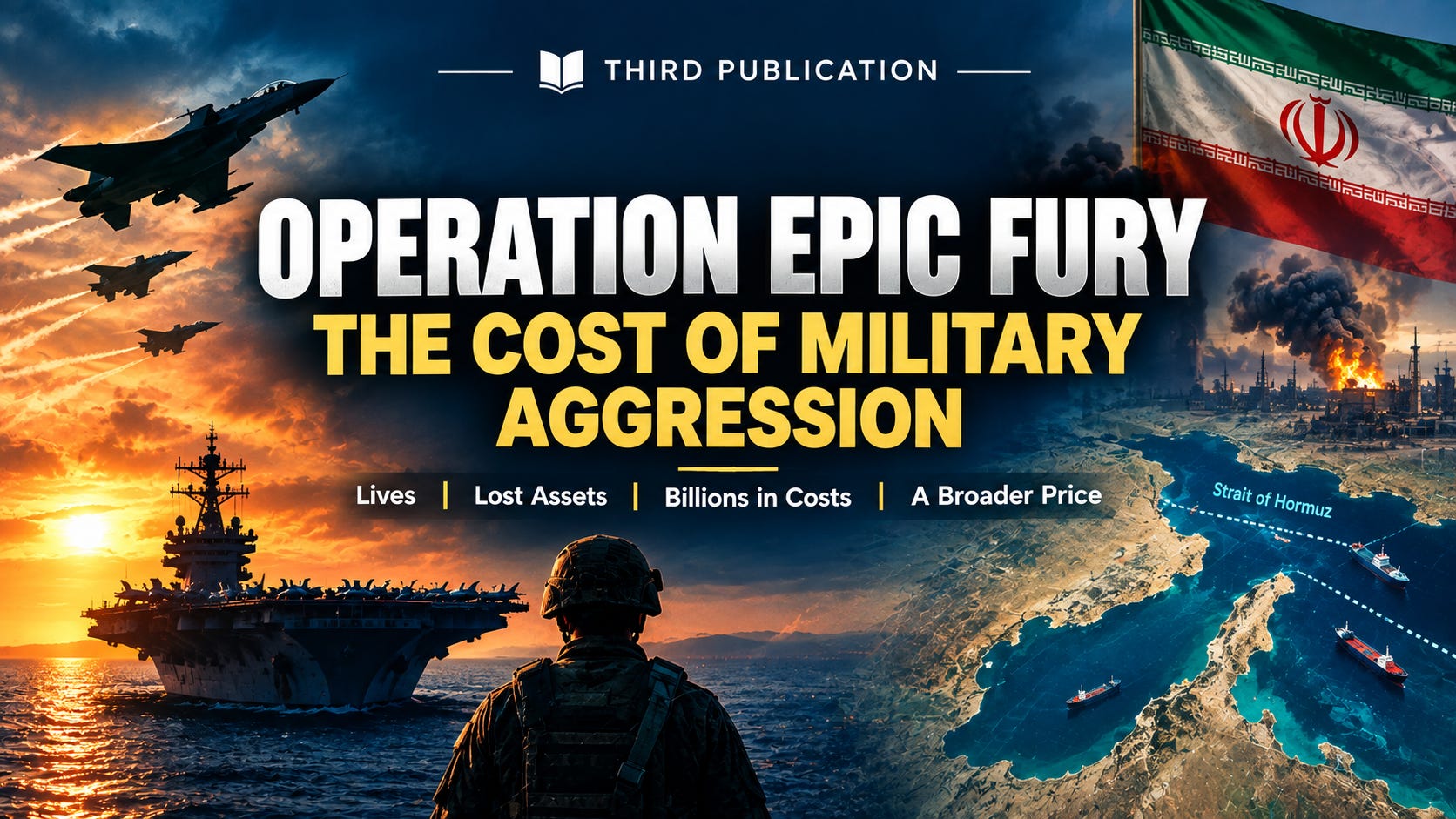
The Lead Inspector General Report on Operation Epic Fury, submitted to the United States Congress by the Department of War Office of Inspector General and partner Lead IG agencies, examines the US-Israeli military campaign against Iran and its wider consequences. Covering the formal period of April 1–June 30, 2026, while noting that the operation began on February 28, the report assesses the military campaign, Iranian response, Strait of Hormuz, casualties, equipment losses, financial costs and diplomatic efforts. Beyond the scale of the offensive, it also highlights a critical dimension of modern warfare: the substantial cost of sustaining military power once a conflict expands across multiple fronts.
The Opening Offensive
The United States had spent months preparing for a major contingency. Thousands of personnel, fighter aircraft, refueling tankers, carrier strike groups, munitions and intelligence assets were repositioned into the region.
When Operation Epic Fury began, the initial campaign focused on four broad categories of Iranian capability:
Nuclear infrastructure
Ballistic-missile forces and production
Naval capabilities
Regime-security infrastructure
Between February 28 and April 7, US conducted a sustained campaign across Iran. The reported figures—13,500 targets, 36,000 combat sorties and more than 1,800 fire missions—demonstrate the extraordinary resources required to conduct a modern high-intensity air campaign.
But they also provide the first indication of the central problem that subsequently emerged. The more sophisticated the military campaign, the greater the consumption of expensive aircraft, missiles, precision munitions, maintenance resources, fuel and logistical capacity.
A war can therefore become expensive even when the attacking force retains battlefield superiority.
The Strait of Hormuz Changes the Character of the War
The conflict soon expanded beyond Iranian military targets.
The Strait of Hormuz, one of the world’s most strategically important maritime corridors, became a central theatre. On April 13, US began a blockade covering maritime traffic entering and leaving Iranian ports and coastal areas.
Between April 13 and June 18, the Lead IG report records:
More than 140 compliant vessels redirected
10 non-compliant vessels disabled through kinetic action
More than 50 humanitarian vessels permitted to pass
The maritime campaign created a new layer of risk.
The United States was no longer simply attacking Iranian military infrastructure. It was attempting to control a strategic waterway while protecting commercial shipping and maintaining pressure on Iran. That meant that every escalation carried potential consequences beyond the battlefield—including energy markets, shipping, insurance, regional economies and global trade.
The Strait consequently became a pressure point connecting military power, economics and diplomacy.
Ceasefire, Diplomacy and the Return of Confrontation
On April 7, the United States announced a ceasefire to facilitate negotiations. But the military posture did not disappear. U.S. forces remained in the region and naval operations continued.
On May 4, three U.S. Navy destroyers—USS Truxtun, USS Rafael Peralta and USS Mason—transited the Strait of Hormuz as part of Project Freedom. The operation was intended to strengthen maritime security, but it was paused the following day amid diplomatic efforts involving Pakistan and expectations of progress with Iran.
A more significant diplomatic opening emerged on June 17.
The Islamabad Memorandum of Understanding, involving President Donald Trump and Iranian President Masoud Pezeshkian, with Pakistan’s Prime Minister Shehbaz Sharif as mediator, included arrangements concerning safe navigation through the Strait and a proposed 60-day negotiating period.
The US ended its blockade of Iranian ports. But the pause proved temporary. On June 25, Iran struck a Singapore-flagged cargo vessel off the coast of Oman. The United States retaliated and maritime tensions escalated.
The Conflict Escalates Again
The subsequent events demonstrated the fragility of the June arrangement. On July 7, Iran attacked three ships in the Strait of Hormuz, saying they had violated Iranian transit rules. The United States responded with counterstrikes. On July 8, President Trump declared the Islamabad MoU over and US strike operations resumed. United States announced that it would resume the naval blockade.
Within a relatively short period, the conflict had moved through:
Blockade → Ceasefire → Negotiations → MoU → Reopening → Maritime confrontation → U.S. strikes → Collapse of the MoU → Renewed blockade.
US could strike Iranian targets. It could impose sanctions. It could deploy naval forces. But converting those capabilities into a durable political settlement proved considerably more difficult.
The Price Paid by U.S. Forces
This is where the Lead IG report becomes particularly significant. From February 28 through June 30, the report records:
7 U.S. service members killed in action
7 deaths from non-hostile events
417 were wounded in action
Later casualty information incorporated into the report brought the listed total to 18 deaths across the relevant OEF/overseas-operation classification as of August 26, although the report notes that casualties after July 7 were classified differently in the Defense Casualty Analysis System. The human cost was accompanied by substantial equipment losses.
The report records:
Four F-15Es destroyed
One F-35A damaged by enemy fire
One A-10 destroyed
Multiple KC-135 aircraft damaged or destroyed
One E-3 aircraft damaged
Helicopter losses
An AH-64 shot down over the Strait
An MH-60 crash
Up to 30 MQ-9 ISR drones destroyed in various circumstances
Iranian attacks ALSO DAMAGED OR DESTROYED HUNDREDS OF STRUCTURES AT U.S. BASES across Kuwait, Bahrain, Qatar, the UAE, Saudi Arabia, Iraq, Oman and Jordan.
This is a critical dimension of the conflict.
The United States possessed vastly greater military capability, but Iran demonstrated that it could still impose costs on a superior military through missiles, drones, maritime attacks and strikes against regional infrastructure.
Military superiority therefore did not translate into immunity from losses.
The Less Visible Cost: Ammunition and Industrial Capacity
Perhaps the most strategically important finding concerns something less visible than destroyed aircraft: U.S. weapons inventories. The operation created significant ammunition consumption and exposed bottlenecks in the U.S. defence-industrial base.
This is an important lesson in modern warfare.
US may possess one of the world’s most sophisticated military-industrial systems, but sophisticated weapons cannot simply be replaced overnight.
A missile fired today must eventually be manufactured again.
An aircraft destroyed today requires replacement or extensive reconstruction.
A drone lost in combat represents not merely the cost of the platform but also the intelligence, surveillance and operational capability it was providing.
Consequently, the true cost of a military operation can be considerably greater than the immediate battlefield expenditure. War consumes industrial capacity as well as ammunition.
$33.4 Billion—and Counting
As of June 29, the estimated cost of Operation Epic Fury had reached approximately $33.4 billion.
Importantly, infrastructure-repair costs were not included.
But the financial burden did not stop there. On June 24, the White House submitted an $87.6 billion supplemental funding request, of which $67.1 billion was requested for the Department of War.
The distinction is important.
The $33.4 billion represents an estimate of the operation’s cost at that point. The much larger supplemental request illustrates the additional resources required to replenish inventories, sustain operations and rebuild capabilities. In other words, the cost of war does not end when the missiles stop flying.
The Human and Diplomatic Cost Beyond the Battlefield
The war also generated a substantial non-military burden.
Approximately 9,000 Americans were assisted in leaving affected areas, with the State Department arranging 56 flights, in addition to buses and other transportation.
At the height of the crisis, approximately 3,500 diplomatic personnel were either on authorised or ordered departure or already outside their posts. U.S. diplomatic facilities in Iraq, Kuwait, Saudi Arabia and the UAE suffered physical damage estimated at approximately $184 million.
The conflict therefore affected not only soldiers and military equipment but also diplomats, civilians, infrastructure and the broader American presence in the region.
Iran’s Asymmetric Response
Iran could not match the United States aircraft-for-aircraft or missile-for-missile. Its ability to impose costs came through a different combination of capabilities. Missiles, drones, maritime disruption and attacks on regional infrastructure offered relatively lower-cost methods of imposing pressure on a much more technologically advanced opponent.
The report states that the regional integrated defence network intercepted more than 6,000 one-way unmanned aircraft and more than 1,500 ballistic missiles aimed at U.S. and partner forces.
Those interception figures reveal another aspect of the cost equation. An attacker does not necessarily need to destroy its opponent’s most sophisticated weapons to create an economic burden. If relatively inexpensive systems require the defender to employ sophisticated and expensive interceptors, the defender can face a difficult cost-exchange problem. This is one of the defining challenges of modern warfare.
The Central Lesson: Military Power Has a Cost
Operation Epic Fury demonstrates a paradox of modern warfare.
The United States was able to project enormous military power into the region. It conducted tens of thousands of sorties, struck thousands of targets and maintained a sophisticated network involving air power, naval forces, missile defence, intelligence, cyber and space capabilities.
Yet the same campaign produced:
Casualties + aircraft losses + infrastructure damage + ammunition depletion + industrial bottlenecks + billions in expenditure + diplomatic disruption
That combination is strategically important.
The lesson is not that military power is ineffective.
Rather, it is that military superiority does not eliminate the cost of exercising that power. A technologically superior military can win individual engagements and still encounter strategic constraints when a conflict becomes prolonged.
The greater the intensity, the faster ammunition is consumed. The greater the geographical spread, the more bases and logistics must be protected.
The greater the maritime exposure, the greater the risks to commercial shipping.
And the longer the conflict continues, the more difficult it becomes to separate military expenditure from economic and diplomatic consequences.
The Strait of Hormuz: Where Military and Economic Costs Meet
The Strait of Hormuz ultimately became the clearest illustration of the conflict’s wider consequences.
Military operations affected shipping.
Shipping disruptions affected energy flows.
Energy risks affected economies.
Economic pressure affected diplomacy.
Diplomacy affected military deployments.
The Strait therefore became more than a geographical location.
It became the point at which military power, energy security, trade, sanctions and diplomacy intersected. This helps explain why the conflict repeatedly returned to the Strait even after ceasefires and negotiations.
Conclusion: Aggression Can Carry a Price beyond the Battlefield
Operation Epic Fury demonstrates the extraordinary reach of modern U.S. military power. The United States was capable of rapidly deploying a massive force, conducting tens of thousands of combat sorties and striking thousands of targets across Iran.
But the Lead IG report also documents another side of the conflict—one that is easier to overlook when military operations are measured primarily by targets destroyed.
United States suffered military deaths and hundreds of wounded personnel, aircraft and drone losses, and damage to regional bases, diplomatic disruption, billions of dollars in direct costs and significant depletion of sophisticated weapons inventories.
The reported $33.4 billion operational cost, dominated by munitions expenditure, is only part of the picture. The subsequent $87.6 billion supplemental request demonstrates how the financial consequences of war extend into replenishment, readiness and future military capacity. Perhaps the most important lesson is therefore not about who possesses greater military power. It is about the price of using it.
A powerful country can initiate an operation, strike deep into an adversary’s territory and dominate the conventional battlefield. But if the confrontation becomes prolonged, the costs begin to accumulate in places that are not visible on a battlefield—weapons inventories, industrial capacity, military bases, shipping, energy markets, diplomatic infrastructure and public finances.
Operation Epic Fury consequently offers a broader lesson about modern warfare: aggression may deliver immediate military effects, but sustaining that aggression can impose costs that grow far beyond the original objectives.
The report’s formal reporting period ends on June 30, 2026, although its supporting material incorporates later July and August updates. The official Lead IG report confirms that this is its first report on Operation Epic Fury and that the formal reporting period runs through June 30.
The unresolved nature of the conflict therefore leaves the central question unanswered:
How much military power can be employed before the cost of sustaining it begins to undermine the strategic objectives for which it was used?
Disclaimer: This report is intended solely for informational and analytical purposes. It is based primarily on the Lead Inspector General Report on Operation Epic Fury and the sources cited therein. It presents documented events and reported assessments without endorsing or opposing any government, political position, military operation, or policy. Some information reflects statements or assessments provided by U.S. government agencies and has not been independently verified or audited by the Lead IG agencies.
Source: Lead Inspector General Report to the United States Congress, Operation Epic Fury, April 1–June 30, 2026, Department of War Office of Inspector General and partner Lead IG agencies. The agencies state that, except for specifically referenced audits, inspections, investigations and evaluations, information supplied by federal agencies was not independently verified or audited by the Lead IG agencies.