


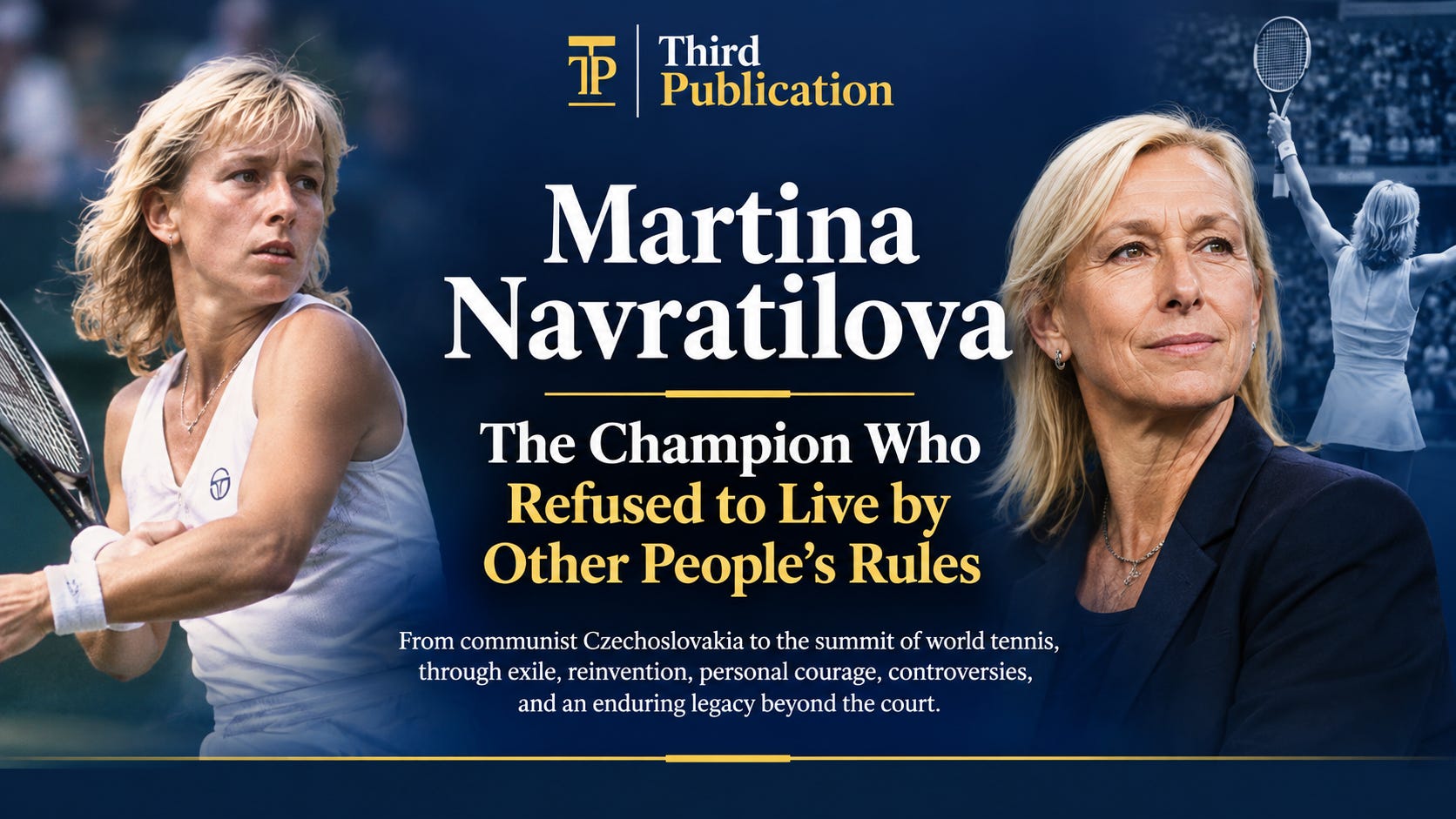
MORE THAN A TENNIS CHAMPION
Martina Navratilova’s story goes far beyond Wimbledon titles and Grand Slam trophies. It is a story of reinvention, courage and controversy—a life shaped by sport, migration, identity, politics and public debate.
She escaped communist Czechoslovakia as a teenager and went on to become one of tennis’s most dominant champions. She also transformed professional fitness, publicly came out as gay when doing so carried significant personal and commercial risks, battled cancer, competed at the highest level into her late forties, and remained an influential voice beyond the court.
Her journey combines extraordinary achievement with difficult choices and controversy.
This report traces her remarkable arc—from childhood and escape to global stardom, personal battles, controversies and the legacy she continues.
THE ESCAPE: A CHILDHOOD BEHIND THE IRON CURTAIN
Born on 18 October 1956 in Prague, then part of communist Czechoslovakia. Raised largely by her mother Jana and stepfather Miroslav Navrátil, she adopted her stepfather’s surname. Miroslav also became her first tennis coach and quickly recognised her exceptional talent.
Tennis soon became more than a sport. Although the communist state supported athletes, it also restricted travel, prize money and career choices.
By 15, Navratilova had won the Czechoslovak national championship and was competing internationally.
But her growing success came with a growing sense of constraint. She increasingly felt that the system was limiting not only her tennis career, but also her freedom and future.
The Defining Decision
In 1975, during the US Open in New York, 18-year-old Martina Navratilova made a life-changing decision: she requested political asylum in the United States.
During the Cold War, leaving Czechoslovakia meant uncertainty, separation from family and the possibility of being unable to return.
The decision transformed Navratilova from a rising tennis star into an international political figure.
She later described it as a choice of freedom over security.
Became a US citizen in 1981 and later regained Czech citizenship after the fall of communism, eventually holding dual citizenship.
THE RISE TO THE TOP OF WOMEN’S TENNIS
Navratilova entered professional tennis during a golden era, competing against champions such as Chris Evert, Billie Jean King, Tracy Austin, Hana Mandlíková, Steffi Graf and, later, Monica Seles.
Building a New Athlete
Navratilova was not initially unbeatable. Early on, she struggled with consistency and fitness against the disciplined baseline game of Chris Evert.
Instead of accepting those limitations, she reinvented her approach to athletic preparation, focusing on Strength and conditioning, Nutrition and recovery, Mental preparation and fitness.
Many of these practices are standard today, but in women’s tennis of the late 1970s they were far less common. Navratilova’s transformation helped redefine what was expected of a physically prepared female professional athlete.
Wimbledon: Her Kingdom
No tournament became more closely associated with Martina Navratilova than Wimbledon. She won nine women’s singles titles, an Open Era record, between 1978 and 1990—a remarkable combination of dominance and longevity.
Records That Still Stand
Martina Navratilova’s career statistics remain extraordinary:
18 Grand Slam singles titles
31 Grand Slam women’s doubles titles
10 Grand Slam mixed doubles titles
59 Grand Slam titles overall
167 singles titles
177 doubles titles
Her 167 singles and 177 doubles titles remain among the most remarkable totals in professional tennis.
A Rivalry That Changed Women’s Tennis
No account of Martina Navratilova is complete without Chris Evert. Their 80-match rivalry became one of tennis’s most celebrated contests. Their contrasting styles captivated audiences: Evert’s precision, patience and consistency against Navratilova’s power, athleticism and attacking play.
Navratilova led their head-to-head 43–37.
Beyond the statistics, their rivalry helped elevate women’s tennis into a major global television sport. Off the court, their competitive relationship evolved into a lifelong friendship that has endured for decades.
REINVENTING WOMEN’S TENNIS
Martina Navratilova’s influence went beyond trophies. She helped bring a new professional standard of fitness, preparation and athleticism to women’s tennis.
The Fitness Revolution
She embraced weight training, sprint conditioning, specialised nutrition, sports psychology, cross-training and flexibility—approaches that later became standard among elite athletes.
The Playing-Style Revolution
Her aggressive serve-and-volley game, relentless movement and attacking approach forced opponents to adapt and helped shape the evolution of power tennis.
Longevity Before It Was Normal
While many players retired in their early thirties, Navratilova remained competitive for decades. In 2006, at 49, she won the US Open mixed doubles title, becoming the oldest Grand Slam champion.
Her career challenged conventional ideas about the limits of age and athletic longevity.
THE PERSONAL COURAGE THAT CHANGED SPORT
Martina Navratilova’s personal life became almost as consequential as her sporting career.
Coming Out in 1981
In 1981, Navratilova publicly acknowledged that she was gay, at a time when professional sport offered far less acceptance of LGBTQ athletes.
She later said that coming out affected her endorsements and sponsorship opportunities, while media attention increasingly focused on her personal life rather than her tennis.
Despite the risks, she chose openness over secrecy, becoming one of the earliest high-profile LGBTQ figures in global sport.
Becoming an Advocate
Over the following decades, Navratilova became an outspoken advocate on issues including LGBTQ rights, equality in sport, HIV/AIDS awareness, women’s athletics and animal welfare.
Her public voice ensured that her influence extended well beyond the tennis court.
THE CONTROVERSIES THAT DEFINED HER PUBLIC LIFE
Navratilova remained outspoken long after retiring, making her a prominent—and sometimes controversial—public figure.
Gender Identity and Women’s Sport
Her most prominent recent controversy concerns transgender participation in women’s sport. Navratilova has argued that elite female categories must protect competitive fairness and has questioned the participation of transgender women who experienced male puberty.
These views have drawn criticism from some LGBTQ advocates, while others—including athletes and sporting commentators—have supported aspects of her position.
Criticism of Sporting Bodies
Navratilova frequently challenged WTA, IOC and other sporting organizations on issues involving fairness, athlete welfare and governance, attracting both support and criticism.
Political Commentary
She has also remained active in political and social debates, expressing views on issues in the US and internationally. Her willingness to engage with controversial subjects has kept her a prominent voice long after her playing career ended.
LIFE BEYOND TENNIS
Retirement didn’t take Martina out of public life. Instead, she built a 2nd career as:
Broadcaster and Analyst
She became a respected tennis analyst, known for her technical insight, tactical understanding and candid commentary during major tournaments.
Author and Speaker
Through books and public appearances, she has addressed sport, leadership, fitness, health, equality and resilience.
A Lasting Cultural Legacy
Her story continues to attract attention through documentaries, biographies and film projects, particularly those exploring her remarkable rivalry and lifelong friendship with Chris Evert.
Her legacy has therefore extended well beyond the tennis court, introducing her extraordinary journey to new generations of fans.
FACING CANCER AND RETURNING TO PUBLIC LIFE
Martina Navratilova’s resilience was tested again by serious illness.
Diagnosed with breast cancer in 2010, underwent treatment and later returned to broadcasting and public advocacy. In 2023, she revealed diagnoses of throat cancer and a recurrence of breast cancer. After treatment, she announced that she was cancer-free.
THE SECOND LIFE: BUSINESS, ADVOCACY AND INFLUENCE
Martina Navratilova’s influence today extends well beyond tennis.
Health and Fitness
She continues to promote lifelong fitness, healthy ageing and athletic longevity, drawing on her own experience.
Women’s Sport
She remains an outspoken voice on equal opportunity, athlete welfare, competitive integrity and the future of women’s sport.
LGBTQ Advocacy
Navratilova continues to support LGBTQ rights and equality, while holding controversial views on transgender eligibility in elite women’s sport.
This distinction is important to understanding both her continued advocacy and the debate surrounding her public positions.
WHY MARTINA NAVRATILOVA STILL MATTERS
Martina Navratilova’s legacy cannot be measured by statistics alone. She helped reshape professional tennis in ways that continue to influence the sport.
She Changed the Athlete’s Body
Modern tennis treats fitness as a science. Martina helped pioneer this approach through strength training, nutrition, recovery and year-round conditioning.
She Redefined Career Longevity
Competing at the highest level into the late thirties and beyond is more common today. Navratilova demonstrated the possibilities of elite longevity decades earlier.
She Changed Public Visibility
By openly discussing her identity despite significant professional and commercial risks, she became an important figure in the history of LGBTQ visibility in sport.
She Kept Challenging the Conversation
Long after retirement, Navratilova has remained an influential—and sometimes controversial—voice on women’s sport, equality and competitive fairness.
Her career therefore represents more than sporting achievement. It reflects reinvention, resilience and a willingness to enter difficult public debates—qualities that continue to make her relevant beyond tennis.
CONCLUSION — THE PRICE OF BEING YOURSELF
Martina Navratilova’s life is ultimately a story of reinvention, courage and conviction. She escaped an authoritarian state in pursuit of freedom, transformed extraordinary talent into sporting greatness, openly acknowledged her identity despite personal and professional risks, survived cancer and continues to engage in difficult public debates despite criticism.
Admired for her courage, celebrated for her achievements, and sometimes criticized for her views, she remains one of the most consequential figures in modern sport.
Her story reminds us that greatness is rarely built on talent alone. It is shaped by difficult choices, relentless adaptation, and the willingness to live according to one’s convictions—whatever the personal cost.
Disclaimer: This report is based on the source note, historical records from official tennis organizations, biographies, and publicly documented interviews and reporting available up to September 2026.
The section on controversies presents major public debates and differing viewpoints for informational purposes and should not be interpreted as an endorsement of any position.
Readers are encouraged to consult official WTA, Grand Slam, IOC and other primary sources for the latest policy developments.