


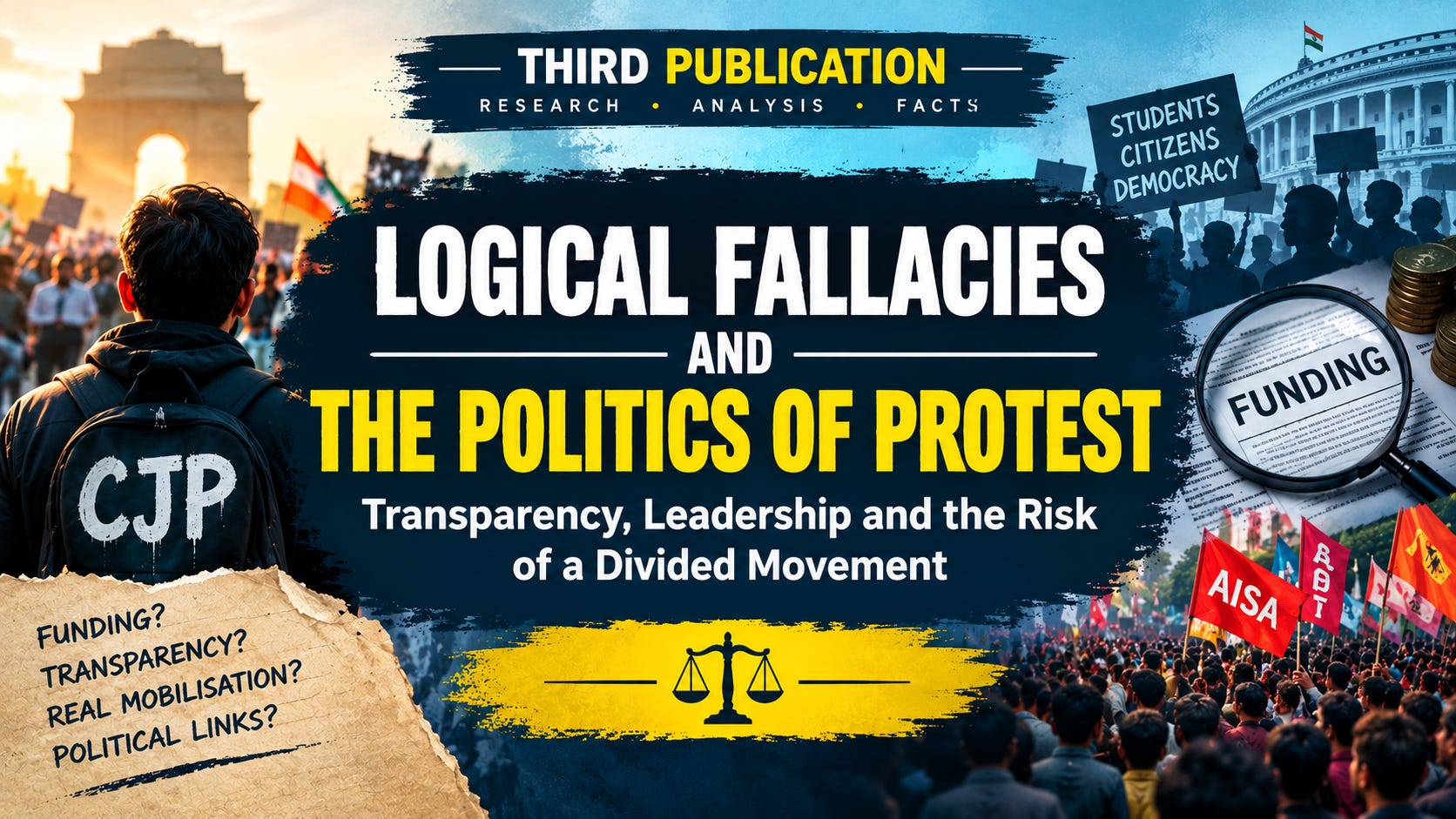
A movement under scrutiny
The Cockroach Janata Party (CJP), associated with activist Abhijeet Dipke, attracted national attention through protests over examination irregularities and government-school conditions. Its subsequent campaigns concerning electoral-roll revisions and accountability from Chief Election Commissioner Gyanesh Kumar have placed it within a wider political contest.
The movement’s rapid growth has raised questions about its financial transparency, organisational independence, leadership decisions and relationship with established opposition parties and student organisations. An India Today investigation published on 21 September 2026 examined allegations of selective activism, including differences between CJP’s confrontational approach in several BJP-governed states and its use of school audits and meetings with authorities in opposition-governed Punjab and Karnataka. The investigation also noted CJP leaders’ earlier association with the Aam Aadmi Party (AAP).
These questions warrant examination, but scrutiny must remain evidence-based. Political associations, separate protests, meetings with ministers or differences in strategy do not independently establish misconduct or collusion.
Funding transparency: Explanation versus disclosure
Nationwide mobilisation entails expenses for travel, accommodation, events and communications, making financial transparency a legitimate concern. In an interview reported by Loksatta on 10 October 2026, CJP founder Abhijeet Dipke said the movement relied on contributions from members and friends, including co-convenor Ashutosh Ranka. He stated that trust registration was underway, online crowd funding was planned thereafter, and no assistance had been received from major industrialists.
While this explanation deserves acknowledgement, details of total collections, donor contributions, campaign expenditure and independent audits remain unclear. CJP spokesperson Vaishnavi Gaur’s reference to the PM CARES Fund when questioned about CJP’s finances also raises the issue of tu quoque, or whataboutism: another institution’s transparency does not answer questions about one’s own. The appropriate response is verifiable financial disclosure—not assumptions of wrongdoing.
(Tu quoque is a Latin phrase meaning “you too”, a logical fallacy when someone deflects criticism by accusing the critic of similar wrongdoing instead of addressing the original issue. Whataboutism is a closely related tactic: rather than answering a criticism, someone responds, “What about this other person or organisation?”)
Digital popularity versus physical mobilisation
CJP reportedly gained millions of social-media followers within a short period, but online reach does not necessarily translate into mass participation. Its initial Jantar Mantar mobilisation was reportedly modest before Sonam Wangchuk’s arrival and subsequent fast drew greater attention. The claim that the initial protest attracted around 4,000–5,000 people, with AISA and SFI participants forming a substantial share, requires independent verification; reliable attendance figures and organisational breakdowns remain unavailable.
The logical fallacy of appeal to popularity lies in equating a large following with genuine public representation. CJP’s strength should instead be assessed through sustained attendance, grassroots participation, volunteer networks, public contributions and the continuity of its campaigns—the same standards applicable to political parties and civil-society organisations.
Leadership accountability: Who bears the cost of protest?
Questions arise when ordinary participants face the physical and legal risks of protests while senior leaders negotiate with authorities or remain away from confrontations. Negotiation is not inherently a weakness; the real test is whether participants are consulted, detained protesters receive legal assistance, decisions are communicated transparently and settlements deliver verifiable results. In an August 2026 commentary published by Nous, Raju Parulekar questioned whether closed-door negotiations had diluted an earlier student agitation that culminated in the education minister’s resignation. This provides a point of comparison, the logical pitfalls are appeal to authority—assuming a negotiated outcome is satisfactory simply because leaders accept it—and guilt by association, inferring misconduct from political connections or a leader’s absence. Ultimately, leadership must be judged by its results, accountability and commitment to the movement’s stated objectives.
Independent agitation or fragmentation?
CJP’s protests over the Chief Election Commissioner and electoral-roll revisions have overlapped with activities by the INDIA bloc, AISA, SFI and other civil-society groups. Writing in The Indian Express on 14 October 2026, Yogendra Yadav argued that these organisations need not merge under one umbrella but should avoid working at cross-purposes. He described their parallel activities as “spontaneous synchronisation” rather than a centrally coordinated campaign.
Independent protests can broaden participation and sustain pressure, but conflicting demands and competition for visibility may fragment a shared cause. The available evidence does not establish that CJP intended to weaken an INC-supported agitation. The key questions are whether coordination was attempted (Attempted by India Block but CJP leadership supported but stayed away), common demands were pursued and separate actions strengthened or diluted collective pressure. Fragmentation can weaken a movement even without deliberate collusion.
Political associations and consistency of standards
CJP’s earlier association with AAP has raised questions about its independence. An India Today investigation on 21 September 2026 noted that Arvind Kejriwal had thanked CJP’s Saurav Das for highlighting Punjab’s government-school shortcomings, while comparing CJP’s approach there with its more confrontational activism elsewhere. These circumstances warrant scrutiny but do not prove AAP controls CJP; differences in tactics require evidence-based explanations.
The relevant fallacy is special pleading—applying different standards to politically sympathetic governments and their opponents without valid justification. The same scrutiny should apply to AAP, Congress and other parties.
CJP’s shift from examination irregularities to School Thik Karo and Adivasi School Thik Karo also raises questions about continuity. Although September 2026 reporting described planned school visits in Maharashtra, Jharkhand and Odisha, claims about its participation in protests in Ranchi, Pana and Ladakh require verification. Similarly, Sonam Wangchuk’s decision not to attend a Delhi CJP protest again, citing responsibilities in Ladakh, does not establish hostility or sabotage.
The false dilemma fallacy suggests CJP must choose between school reform and electoral agitation. A more reasonable expectation is that it explains its priorities, follows through on unfinished commitments and clarifies why it joins some campaigns but not others.
Selective policing and political alignment
Questions have arisen over whether CJP and other protest organisations have faced different policing standards. In July, Delhi Police said permission had neither been sought nor granted for CJP’s proposed Parliament march. In October, restrictions around Jantar Mantar were followed by decentralised AISA and SFI demonstrations elsewhere. Police cited public-order concerns, while protesters challenged the restrictions as excessive.
These reports indicate a contested policing environment but do not establish either blanket protection for CJP or uniform denial of permission to other groups. A fair assessment requires comparing applications, decisions, stated reasons, venue conditions and police actions. The post hoc fallacy lies in inferring favouritism simply because one group held an event while another faced restrictions; equally, a police justification alone does not establish that restrictions were lawful or proportionate.
AISA president Neha Bora’s appearance alongside Congress leaders Rahul Gandhi and Priyanka Gandhi Vadra also sparked debate over the student organisation’s role. However, participation does not automatically make AISA a Congress instrument, just as CJP’s separate identity does not prove freedom from political influence. Similarly, claims that AAP criticises Congress for political gain require evidence from identifiable statements and conduct, not political rivalry alone.
Organisational accountability and the parallel-movement allegation
Comparisons between CJP, RSS and India Against Corruption raise questions about organisational and financial transparency and registrations, but their different structures and legal circumstances must be recognised. The claim that all three are unregistered and lack public profit-and-loss accounts is also there and to be independently established. Abhijeet Dipke’s October statement that CJP was pursuing trust registration reflects its position at that time, not necessarily its current status. Disclosure requirements depend on legal form and applicable law; limited public information alone does not prove illegality.
A credible transparency framework could disclose legal status, governance, donations, campaign expenditure, major institutional contributions where permissible, independent audits and procedures for handling complaints.
The allegation that CJP’s parallel agitation is intended to weaken Congress is there but remains unproven. Possible explanations include genuine political independence, different strategic priorities, competition for visibility, unintended fragmentation or deliberate political strategy.
Analysis must avoid guilt by association (past AAP links do not prove present control), post hoc reasoning (declining protest attendance does not prove CJP caused it), false cause (similar outcomes do not establish common direction) and strawman arguments (neither CJP supporters are necessarily anti-Congress nor Congress supporters opposed to independent activism).
The practical test is whether CJP cooperates where objectives overlap, shares useful information and avoids undermining collective pressure. Repeated refusal to coordinate, if documented, would justify stronger criticism—but assumptions cannot substitute for evidence.
Conclusion:
Transparency is not hostility; coordination is not surrender
CJP’s experience raises important questions about financial disclosure, digital popularity, leadership accountability, political associations and cooperation with other organisations. Abhijeet Dipke has described contributions from members and friends and said trust registration and crowdfunding arrangements were being pursued. This explanation should be acknowledged, while fuller disclosure is needed to clarify the movement’s finances. Similarly, political independence is legitimate, but it need not exclude accountability or coordination on shared public concerns.
As Yogendra Yadav has argued, CJP, opposition parties, student organisations and civil society need not merge, but they should avoid working at cross-purposes. The same standards of transparency and accountability should apply to CJP, AAP, Congress, AISA and SFI. No organisation should claim exclusive ownership of public grievances or exemption from scrutiny.
Ultimately, credibility depends not on followers, media attention or slogans, but on demonstrable conduct: transparent finances, consistent standards, protection for participants, sustained mobilisation and constructive cooperation.
A movement demanding transparency from the state must be willing to practise it internally. One demanding institutional accountability must also answer for its own decisions. Its contribution to the public cause should be judged by evidence and actions, not by claims of popularity or independence.
Selected source reports for further reading
The Indian Express — Yogendra Yadav, “Going forward, all protests must be one, coordinate efforts and energies,” 14 October 2026.
India Today — “CJP’s protest map tells a story of where it raises its voice and how,” 21 September 2026.
Loksatta — Abhijeet Dipke’s statement on CJP’s funding, 10 October 2026.
Nous — Raju Parulekar on the earlier student protest and its outcome, 4 August 2026.
Hindustan Times — CJP’s response to questions about its funding, 3 August 2026.
The Indian Express — Delhi Police’s defence of restrictions on the CJP protest, 15 October 2026.
The Times of India — Reporting on CJP spokesperson Vaishnavi Gaur’s response to funding questions.
Jansatta — Reporting on Neha Bora’s participation in opposition-led demonstrations.
Disclaimer
This report is a critical research analysis based on the public reporting cited therein, reviewed as of 15 October 2026. It distinguishes reported facts from interpretations, unanswered questions and unverified allegations. It does not establish that CJP, AAP, Congress or any other organisation has engaged in covert coordination, unlawful funding, deliberate sabotage or other misconduct.
References to logical fallacies are analytical tools, not findings that any individual or organisation is necessarily acting dishonestly. This publication is intended to encourage evidence-based public debate and is not a legal finding or a substitute for further investigation.
Third Publication — Critical, evidence-led analysis of political movements, public institutions and the forces shaping the society.