


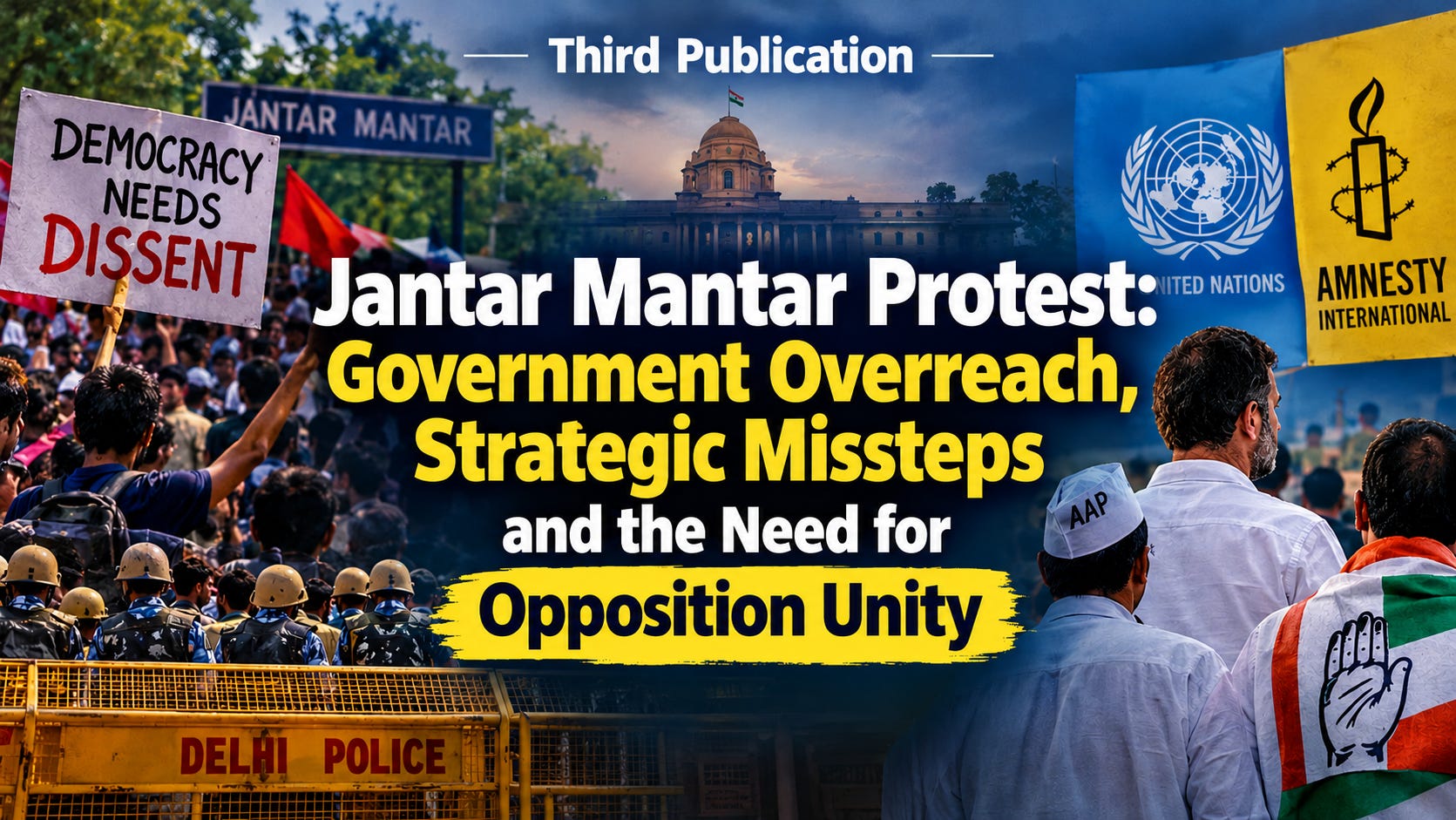
Executive Summary
The reported crackdown surrounding the 10 October 2026 protest at Jantar Mantar raises serious questions about the government’s approach to dissent. Barricading, preventive detentions, restrictions on mobile internet and the disruption of attempts to regroup at Dilli Haat have drawn criticism from the United Nations Human Rights Office and Amnesty International. The government’s rejection of the UN’s concerns as misplaced does little to resolve the fundamental question: whether restrictions on peaceful protest were necessary and proportionate.
The episode also exposes weaknesses within the protest movement itself. CJP’s mobilisation and subsequent attempts to regroup demonstrated determination, but its apparent difficulties with contingency planning, coordination and communication deserve scrutiny. Neha Bora and AISA have contributed to the broader agitation, but an approach that appears insufficiently accommodating towards the principal opposition party risks weakening the possibility of a sustained, collective movement.
AAP’s willingness to engage across political lines, together with Rahul Gandhi and Congress’s more measured approach to opposition solidarity, offers a potentially constructive alternative. A movement demanding democratic accountability must challenge the government firmly while also recognising that lasting political pressure often requires cooperation beyond its original organisers.
The Government’s Response: Order Cannot Become an Excuse to Restrict Dissent
The reported events around Jantar Mantar reveal a troubling imbalance between the state’s security machinery and citizens seeking to exercise their democratic rights. Extensive barricading reported detentions of activists and public figures, and a temporary mobile internet suspension around the protest area severely disrupted the planned demonstration. Attempts to regroup at Dilli Haat was also reportedly interrupted.
Public order is a legitimate responsibility of the state. However, it cannot automatically justify every restriction imposed on political expression. Authorities must demonstrate that their measures are lawful, necessary and proportionate, rather than treating an anticipated protest as a problem to be neutralised before it can gather public support.
The Indian government’s response, was to reject the UN Human Rights Office’s concerns as misplaced interference in India’s internal affairs. That position does not settle the matter. A government confident in the legality and proportionality of its actions should be prepared to explain the necessity of its restrictions and permit appropriate scrutiny.
The UN and Amnesty International: A Serious International Warning
The concerns raised by international human-rights organisations give the episode significance beyond a confrontation between police and protesters.
UN Human Rights Office expressed concern over reported mass detentions involving protesters, protest leaders, civil-society members, lawyers and journalists in Delhi. It called on the authorities to respect the right to peaceful assembly and encouraged meaningful dialogue to address the demonstrators’ concerns.
Amnesty International had also raised concerns and reportedly urged Delhi Police and the central government to facilitate peaceful demonstrations, lift arbitrary restrictions and exercise restraint while maintaining public order.
These interventions should not be mistaken for judicial findings that every detention was unlawful. Nevertheless, they indicate that the reported restrictions were serious enough to attract explicit human-rights scrutiny. The appropriate response is transparency, legal justification and accountability—not simply dismissing criticism as external interference.
CJP: Courage Deserves Recognition, but Strategy Must Face Scrutiny
CJP deserves credit for mobilising around questions of democratic accountability and for attempting to continue the protest despite substantial obstacles. The willingness to regroup after the original plan was disrupted also demonstrated persistence.
However, commitment alone does not make a protest strategy effective. The reported inability to assemble at the intended venue, coupled with detentions affecting prominent organisers, raises questions about contingency planning, alternative meeting arrangements, communication channels and coordination.
If CJP previously suggested that immediate detention indicates a poor protest strategy, its own experience invites a fair examination of that argument. The criticism should not be that its leaders were detained; detention by itself proves neither incompetence nor failure.
CJP’s public communication also deserves examination. Announcing a protest can build legitimacy, attract supporters and make subsequent restrictions more visible. But excessive disclosure of operational details may reduce tactical flexibility.
The shift towards Dilli Haat should therefore be understood as an attempted tactical adaptation, not conclusive proof that the movement failed. The protest was operationally disrupted, but the resulting publicity may have increased public attention to the government’s response. Those outcomes must be assessed separately.
CJP’s next challenge is to move beyond episodic mobilisation towards a more resilient movement—one with clear communication, shared responsibilities, contingency planning and a willingness to recognise the contribution of allies.
Neha Bora and AISA: A Stronger Movement Requires a Broader Coalition
Neha Bora and AISA have played a visible role in the wider agitation, and their efforts to sustain mobilisation deserve recognition. Their contribution also underlines that a protest can grow beyond the organisation that initially gives it direction.
However, the approach attributed to Bora towards Congress and the principal opposition leadership raises an important strategic concern. If the objective is to build a collective democratic movement, treating established opposition parties with excessive suspicion—or delaying recognition of their contribution—can become counterproductive.
Independence from political parties is legitimate. A protest movement should not automatically surrender its identity, demands or decision-making to any political organisation. But independence is not the same as isolation. Nor does cooperation necessarily imply political subordination.
Refers to Bora’s 9 October interview, in which she reportedly welcomed broader opposition unity, including cooperation with Congress, while acknowledging that CJP had not always sufficiently recognised AISA’s contribution during earlier protests. It also describes differences between supporters of CJP and AISA over visibility, methods and organisational roles.
These tensions make a consistent approach to coalition-building especially important. If AISA expects CJP to acknowledge its contribution, it should apply the same principle to other allies. Congress and Rahul Gandhi should be assessed on their actions and their contribution to the common cause, rather than being kept at a distance simply because they represent an established political party.
A broad movement cannot demand recognition for its own participants while treating the contribution of others as secondary. The same standards of fairness, transparency and cooperation should apply to everyone.
Bora’s challenge is therefore not merely to sustain street mobilisation but to create a political environment in which activists, civil-society and opposition parties can work together without competing for ownership of the movement.
Opposition Unity Must Not Become a Contest for Political Ownership
AAP’s support for CJP on issues of civil liberties and democratic accountability is welcome. However, criticising the Congress for supporting the same agitation risks turning a shared democratic cause into a competition for political visibility and credit.
Under Rahul Gandhi’s leadership, the Congress should be allowed to participate without being treated as a rival simply because it is a major political party. Opposition unity does not require parties to abandon their identities; it requires them to place common democratic objectives above narrow political interests.
At the same time, CJP and other civil-society organisations must preserve their independence and resist attempts by any party to appropriate their movements. Activists and political parties can contribute in different but complementary ways, combining public mobilisation with organisational resources and institutional pressure.
Ultimately, the success of a democratic movement matters more than who claims credit for it.
Accountability Must Begin Within the Movement
The Jantar Mantar episode presents two simultaneous tests.
The first is for the government. It must demonstrate that the restrictions on peaceful assembly are legally justified, proportionate and compatible with democratic freedoms. International criticism does not replace a legal determination, but it should prompt a serious and transparent response.
The second is for the movement. CJP and AISA must show that they can coordinate effectively, acknowledge each other’s contributions and work constructively with political allies.
AAP’s willingness to facilitate cooperation with criticism and Rahul Gandhi and Congress’s potential role in a broader opposition effort point towards a more sustainable model: principled independence combined with practical solidarity.
A collective movement does not require uniformity of ideology. It requires agreement on a common objective, mutual respect and the maturity to distinguish political differences from shared democratic responsibilities.
Conclusion
The government’s reported response to the protest raises troubling questions about the space available for peaceful dissent. The concerns expressed by the UN Human Rights Office and Amnesty International deserve a substantive answer, not a reflexive dismissal.
At the same time, CJP’s determination should not exempt its strategy from criticism. Neha Bora and AISA have helped sustain the agitation, but a movement that seeks wider democratic change must be willing to engage constructively with Congress and other opposition forces.
Ultimately, the movement will be judged not only by its ability to confront the government, but also by its ability to organise responsibly, recognise allies and build a durable coalition.
The government must respect dissent; the protesters must strengthen their strategy; and the opposition must place common democratic objectives above competition for political ownership.
A government cannot claim democratic confidence merely by controlling a protest, and a movement cannot claim democratic maturity merely by opposing the government. Both must be judged by how they respect rights, responsibilities and the principle of collective action.
One more question, “What we witnessed in 2011 appears to be getting replicated again. Are we witnessing the early contours of another 2014 moment—or is history taking a different turn?
Disclaimer: This report is an analytical commentary only. Reported events, statements and characterisations have not all been independently verified in full for this publication. Criticisms of government policy, protest strategy and political conduct are editorial assessments, not judicial findings or definitive statements of motive. Readers should consult original reporting and official statements before drawing conclusions.
I don't concur with the points raised by you in your long write up upholding the right of protest by CJP asking for the resignation of CEC for the simple reason that when the matter is sub- judice at the apex court of the country . Congress , AAP and other so called saviours of democracy should have waited for the final verdict from the Hon' ble SC in the matter.
In a democratic country like ours, the only way to come to power is through winning the confidence and vote of the voters, you cannot wrest power by resorting to anarchy in this country.
Regarding huge police bandobast and barricading yesterday, a responsible govt will never give a chance to hooligans to seize the capital, The govt has a bad experience by giving the permission to the same band in July.
Neha Bora is a beautiful girl , she would have rather made a better actor than a failed protester . she does not have any mass impact as she lacks political understanding, first she should win the confidence of her father and family.
CJP and it's leadership does not know how to talk and behave and lacks sincerity and maturity. India will never choose and accept any duffer as it's leader. CJP may be slightly successful in amassing some innocent crowd like any madari does.
Anyone let it be me and you can attract hundred of people if we start doing some nuisance on the roads.
Country presently is in right hands at centre, and it is repeatedly being proved by the people of this country by electing the present govt.