


Winning an Election Does Not Always Mean Governing
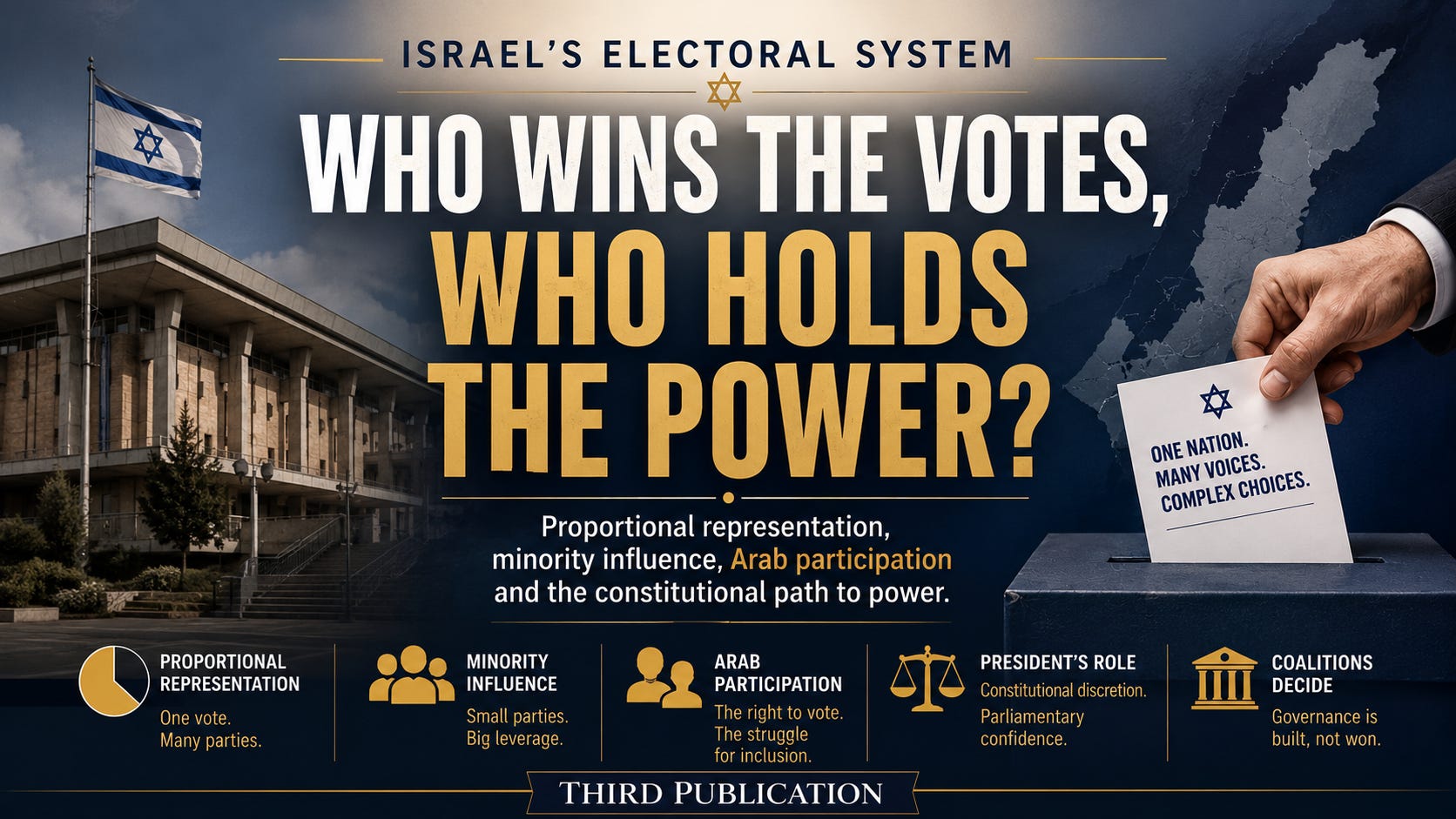
In many democracies, elections produce a relatively straightforward outcome: the party winning the most seats forms the government but Israel presents a more complicated picture. Its 120-member Knesset is elected through nationwide proportional representation, allowing numerous political parties to enter parliament. Yet parliamentary representation does not automatically translate into executive power. A relatively small party can become decisive in government formation, while a party that finishes first may struggle to secure enough support to govern. The distinction becomes particularly important when examining Arab political participation, religious-party influence and the President’s constitutional responsibilities. Understanding Israel’s system therefore requires looking beyond who receives the most votes. The more consequential question is who can assemble a parliamentary majority, on what terms, and with whose interests represented.
How Israel’s Electoral System Works
Israel has a parliamentary system with a 120-member Knesset, elected through nationwide proportional representation. Unlike India or the UK, the entire country forms a single electoral constituency, and voters choose a political party or alliance rather than an individual candidate.
The system has five key features:
National constituency: Votes are counted across the country.
Party-based voting: Voters select a party’s electoral list.
Proportional representation: Seats are allocated broadly according to each qualifying party’s vote share.
Electoral threshold: Parties must secure at least 3.25% of valid votes to enter parliament.
Closed candidate lists: Candidates enter the Knesset according to their pre-determined ranking.
Seats are distributed using the Bader-Ofer method, with surplus-vote agreements allowing parties to pool remaining votes when competing for additional seats.
Consequently, smaller parties can gain parliamentary representation, but the system can also produce political fragmentation and make coalition-building essential.
Who Decides Which Candidates Enter Parliament?
Israel follows a closed-list proportional representation system. Voters choose a party but cannot change the ranking of its candidates. If a party wins ten seats, its first ten eligible candidates enter the Knesset. Vacant seats are normally filled by the next eligible candidate on the list.
The method of selecting candidates varies between parties:
Primaries: Party members select or rank candidates.
Party committees: Internal committees determine the candidate list.
Party leadership: Party leaders exercise control over nominations and rankings.
Religious leadership: Religious authorities influence candidate selection in certain religious parties.
Thus, voters decide which party receives parliamentary seats, but the party’s internal selection process largely determines who occupies them.
This raises an important question: How much influence should party leadership have in deciding who ultimately represents the electorate?
How Does a Government Emerge from the Election?
Winning the largest number of seats does not automatically entitle a party to form Israel’s government. The Prime Minister emerges through negotiations among parliamentary parties and must secure the Knesset’s confidence.
Although 61 seats constitute an absolute majority in the 120-member Knesset, a government can theoretically take office with fewer than 61 affirmative votes if it receives more votes in favour than against, with sufficient members abstaining or absent.
Consider this hypothetical election result:
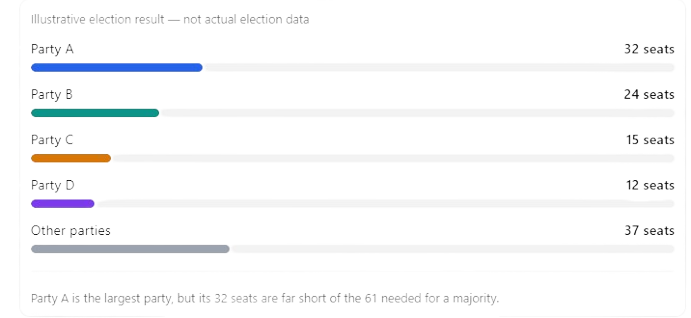
Party A emerges as the largest party but falls well short of a majority. If Parties A, B and C form a coalition, they command 71 seats.
Coalition negotiations typically involve ministerial positions, policy priorities, budget commitments and political concessions.
Consequently, smaller parties can acquire considerable bargaining power when their support is essential to forming or maintaining a government.
The key point: Israeli elections determine parliamentary representation, but coalition negotiations determine who governs.
Arab Political Participation: Representation Without Influence
One of the most important questions raised by Israel’s electoral arrangements concerns the political participation of its Arab citizens.
Arab citizens of Israel have the right to vote, establish or support political parties, contest elections. Arab representatives have participated in Israeli parliamentary politics for decades. However, there are no constitutionally reserved parliamentary seats guaranteeing Arab representation.
This distinction matters: Even when Arab political parties enter parliament, their participation in government depends on coalition negotiations and political acceptability among potential partners.
The significance of the 2021 election: A particularly important development occurred in 2021, when Ra’am (United Arab List), led by Mansour Abbas, joined the coalition supporting the government formed by Naftali Bennett and Yair Lapid.
It was the first time an independent Arab party became a formal member of an Israeli governing coalition. Ra’am won four Knesset seats and became an important component of the coalition’s parliamentary arithmetic.
The development demonstrated that Arab political participation need not remain confined to opposition politics. It also illustrated how a relatively small party could secure influence by becoming an essential coalition partner.
The influence of religious and smaller parties: The position of ultra-Orthodox, or Haredi, parties provides an interesting comparison.
Parties such as SHAS and UNITED TORAH JUDAISM represent specific religious constituencies. Their parliamentary strength may be smaller than that of the major parties, yet they can become decisive coalition partners.
What Role Does the President Play?
President of Israel is the head of state, while the Prime Minister heads the government. President oversees the constitutional process of identifying a candidate capable of forming a government and securing the Knesset’s confidence.
The process broadly involves the following stages:
Consultations: The President consults parliamentary factions to assess which Knesset member has the strongest prospects of forming a government.
First attempt: The nominated candidate receives 28 days, with a possible extension of up to 14 days, to form a government.
Second attempt: If the first candidate fails, another member may be given 28 days, without the same extension provision.
Parliamentary initiative: If the second attempt fails, at least 61 Knesset members can jointly propose another willing candidate, who receives 14 days to form a government.
Fresh elections: If these attempts fail, the legal process provides for the dissolution of the Knesset and new elections. The outgoing government continues in office until its successor takes over.
The key point: The President does not independently select or appoint a government at personal discretion. The role is to facilitate government formation within the constitutional framework, while the ultimate authority rests on parliamentary confidence.
Does the President have complete discretion?
Not quite.
The President has some discretion in deciding whom to nominate initially, because the largest party does not automatically have the right to form the government.
The Israel Democracy Institute provides a useful historical illustration. Following the 2009 elections, Kadima won 28 seats and Likud’s 27 only. President Shimon Peres assigned Benjamin Netanyahu the task of forming the government because he considered Netanyahu more likely to secure parliamentary confidence.
This demonstrates that the President’s responsibility is to identify a viable candidate rather than simply appoint the leader of the party finishing first.
However, this discretion operates within the constitutional framework. The President cannot bypass the parliamentary process or guarantee a candidate’s success.
Is 61 votes always necessary?
This is an important technical distinction that is frequently misunderstood.
Although 61 seats constitute an absolute majority in the 120-member Knesset, the Basic Law does not expressly require 61 affirmative votes in the government’s initial investiture vote.
A minority government can theoretically be approved if it receives more votes in favour than against, with other members abstaining or not participating.
Historical Experiment with Direct Election of the Prime Minister
In 1992, Israel legislated a reform introducing the direct election of the Prime Minister, first implemented in 1996 and continued in 1999.
Voters cast two separate ballots: one for their preferred Prime Minister and another for a political party contesting Knesset elections. This allowed voters to support a Prime Minister from one political camp while voting for a different party in parliament.
The reform aimed to strengthen the Prime Minister’s direct mandate and reduce the influence of smaller parties. However, political fragmentation persisted, and the system was subsequently abandoned.
Is the System Democratic, or give Smaller Parties Too Much Power?
Israel’s electoral system has two sides.
The case for proportional representation
It allows religious, cultural, ideological and economic groups to gain parliamentary representation, making the Knesset more reflective of the country’s political diversity. Coalition-building also encourages parties to negotiate and seek common ground.
The case against excessive fragmentation
Smaller parties can wield influence beyond their vote share when larger parties depend on their support. This can give narrow interests considerable weight in national policy, while prolonged negotiations and fragile coalitions can lead to unstable governments and repeated elections.
The 2021 Bennett-Lapid government illustrates both sides. Bringing together eight factions from across the political spectrum, including Ra’am, it demonstrated the possibilities of coalition-building as well as the compromises and fragility involved.
The central challenge is to balance political representation with government stability, accountability and effective decision-making.
What the Evidence Establishes—and What It Doesn’t
A careful assessment must distinguish established facts from political interpretations and future possibilities.
What the evidence establishes
Israel has a 120-member Knesset elected through nationwide proportional representation.
The electoral threshold is 3.25% of valid votes.
Voters choose closed party lists, not individual constituency candidates.
The largest party does not automatically form the government; coalition support and parliamentary confidence determine who governs.
Arab citizens can vote and elect representatives, but no reserved-seat quota guarantees their representation.
Ra’am’s participation in the 2021 coalition demonstrated that an Arab party could become part of the governing arrangement.
The President has a defined constitutional role in government formation.
What cannot be assumed
That the largest party has an automatic right to govern.
That every small party enjoys influence beyond its electoral strength.
That parliamentary representation guarantees participation in executive decision-making.
That exclusion from a coalition necessarily violates voting rights.
That proportional representation automatically ensures fairer politics or better governance.
What the system reveals
Israel’s electoral framework creates a continuing tension between political inclusion and governmental stability.
Smaller parties gain opportunities for representation and, depending on coalition arithmetic, can influence government policy.
Arab and ultra-Orthodox political participation also shows how alliances, ideological differences and negotiations shape access to executive power.
What remains uncertain
The system’s future effectiveness will depend on political fragmentation, possible electoral reforms, the participation of Arab parties in governing coalitions and the ability of governments to maintain parliamentary support. These remain possibilities, not predictable outcomes.
Conclusion: The Real Election Is About Who Can Govern
Israel’s electoral system shows that democracy is not just about which party wins the most votes, but how votes translate into representation and, ultimately, governing power.
Proportional representation gives smaller political groups a voice, but coalition politics can also give pivotal parties considerable influence and leave other represented communities outside government.
Ra’am’s participation in the 2021 coalition demonstrated that political barriers can be crossed. Yet recurring coalition challenges highlight the difficulty of balancing inclusion with stability.
Israel’s model is therefore neither simply a system of minority empowerment nor one dominated by small parties. It is a parliamentary system in which electoral choices, party structures and political negotiations determine who governs.
The fundamental question remains: Can a system that accommodates diverse political interests also ensure fair representation, stable government and effective decision-making?
Disclaimer
This report is intended for informational, educational and analytical purposes. It reflects independent research and interpretation of publicly available information and is not legal advice or a definitive determination of disputed political or constitutional claims. Readers should independently examine the evidence, verify the cited sources and form their own conclusions.
Beyond the headlines. Follow the evidence. Understand the consequences.