


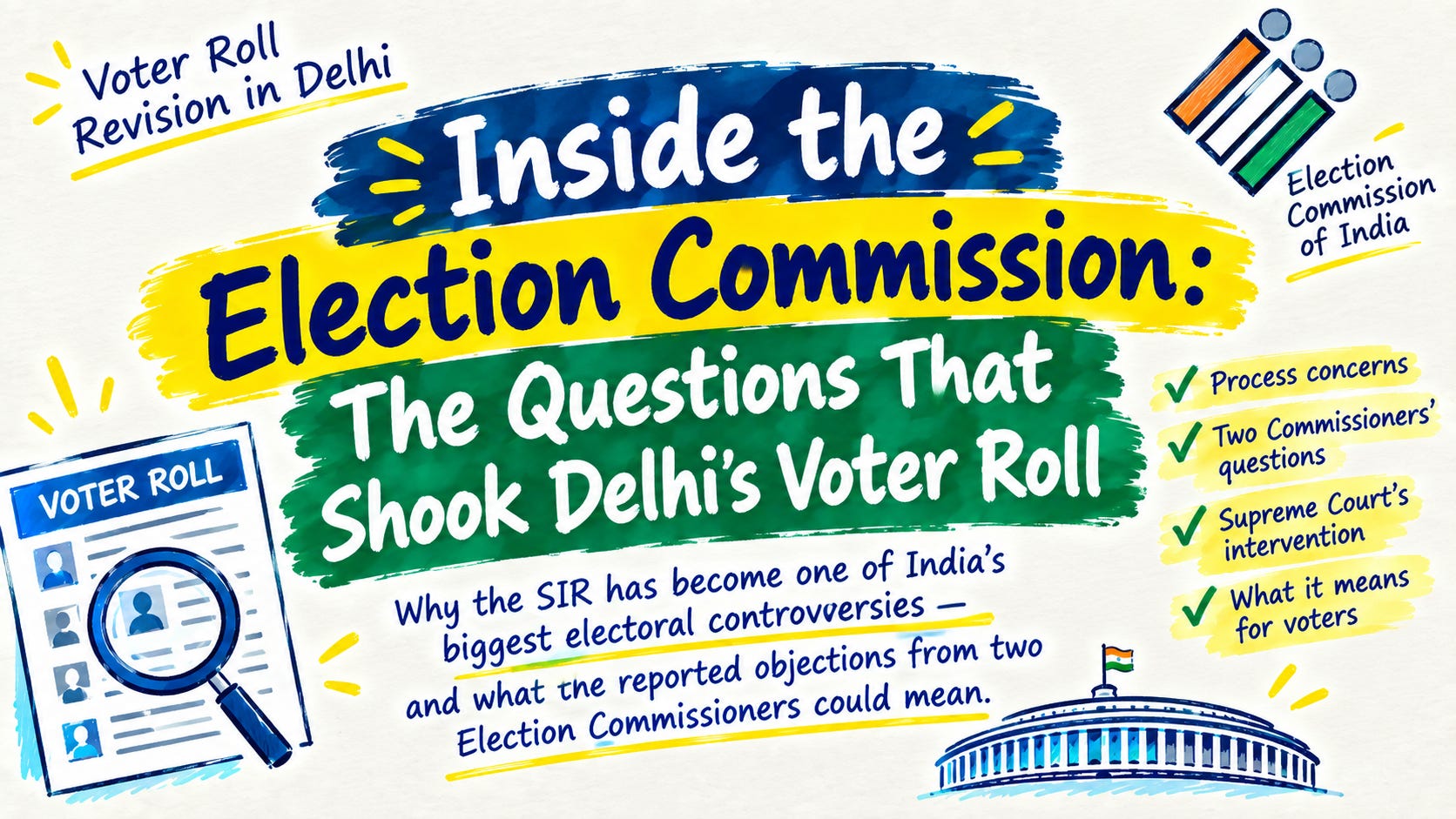
India’s Election Commission is facing unusually intense public and judicial scrutiny over the Special Intensive Revision of electoral rolls in Delhi. What began as a voter-verification exercise has evolved into a wider debate over transparency, due process and voter rights.
The controversy intensified after reports that two Election Commissioners had raised internal questions about aspects of the SIR process before millions of notices were issued. The Supreme Court subsequently questioned the manner in which notices were generated and served, including those classified as “logical discrepancy.”
This report examines the reported developments, the concerns surrounding the SIR process, and the broader institutional questions they raise.
The Internal Questions Raised by Two Election Commissioners
Reports suggest that the concerns did not come only from outside the Election Commission. Before the exercise was rolled out, Election Commissioners reportedly questioned aspects of its implementation during internal deliberations. Importantly, there is no public evidence of a formal dissent note, but multiple reports indicate that both Commissioners sought clarifications before the Commission proceeded with the exercise.
Sukhbir Singh Sandhu’s Reported Concerns
Sukhbir Singh Sandhu’s reported questions focused on the methodology behind SIR notices, particularly the definition and reliability of a “logical discrepancy.”
He reportedly questioned whether such discrepancies are clearly defined under election law, whether software-generated mismatches alone can justify notices, and whether records were physically verified by BLOs before notices were issued.
The concerns are significant because spelling, age, address and mapping errors could create mismatches involving genuine voters.
The issue drew further attention after Sandhu was reportedly served a notice over a “self-name mismatch” in Delhi Cantt, which was later corrected following verification.
Vivek Joshi’s Reported Concerns
Vivek Joshi’s reported questions focused on the scale, implementation and communication of the SIR exercise.
He reportedly sought clarity on how the millions of flagged voters were categorised—duplicates, unmapped records and logical discrepancies.
He also questioned whether voters would clearly understand why they received notices, which documents were required and how to respond.
Another concern was the administrative burden: the large volume of notices could potentially overwhelm election officials and Booth Level Officers while creating difficulties for ordinary voters.
The Supreme Court’s Intervention
The Supreme Court’s scrutiny brought the SIR controversy into the judicial arena, focusing on how notices were issued and how voters could respond.
The Court questioned whether some notices were issued “mechanically”, without sufficient individual verification or clear reasons, and sought clarity on the basis for classifying voters under “logical discrepancy.”
It also suggested making the verification process more accessible through WhatsApp, email and other digital options, stressing that procedural requirements should not become barriers for genuine voters.
These observations broadly echo the implementation concerns reportedly raised within the Election Commission.
Why “Logical Discrepancy” Has Become the Central Issue
The phrase “logical discrepancy” has become central to the SIR controversy because questions remain over:
Whether it is a legally defined category or an administrative filter.
What types of mismatches qualify.
How much human verification should precede a software-generated notice.
The lack of clear public explanations has made the category a key focus of political and judicial scrutiny.
The Constitutional Questions
The SIR controversy raises a broader constitutional question: how to maintain accurate electoral rolls without unfairly excluding eligible voters.
Under Article 324, the Election Commission oversees elections and electoral rolls, while Articles 325 and 326 support the principles of equal electoral participation and voting rights for eligible citizens.
The legal debate is therefore less about whether verification should occur and more about how transparently and fairly it should be conducted.
Why This Story Matters
The reported questions from two Election Commissioners do not establish a formal split or dissent within the Commission. They indicate that implementation concerns were reportedly discussed internally before the exercise proceeded.
Together with the Supreme Court’s observations, the controversy has focused attention on transparency, technology-driven verification, safeguards for genuine voters, and administrative accountability.
The Election Commission’s explanation of the “logical discrepancy” process and its response to the Court’s questions will be important to the next stage of the debate.
Conclusion
The Delhi SIR controversy has moved beyond routine voter verification to a broader debate over institutional process, transparency and electoral confidence. Reported questions from Election Commissioners followed by the Supreme Court’s scrutiny of “mechanical” notices, have intensified attention on the exercise.
The central issue is not whether electoral rolls should be updated, but whether the process follows clear standards, remains transparent and adequately protects eligible voters. The Election Commission’s response to the Supreme Court will be important in clarifying these concerns.
Disclaimer
This report is prepared for educational and informational purposes only. It is based on publicly reported information, court proceedings, and media reports regarding the Election Commission’s Special Intensive Revision. Reports about internal discussions within the Election Commission remain publicly reported accounts and should not be interpreted as official dissent unless confirmed through official records or documents. Readers should follow subsequent court proceedings and official Election Commission statements for the latest developments.