


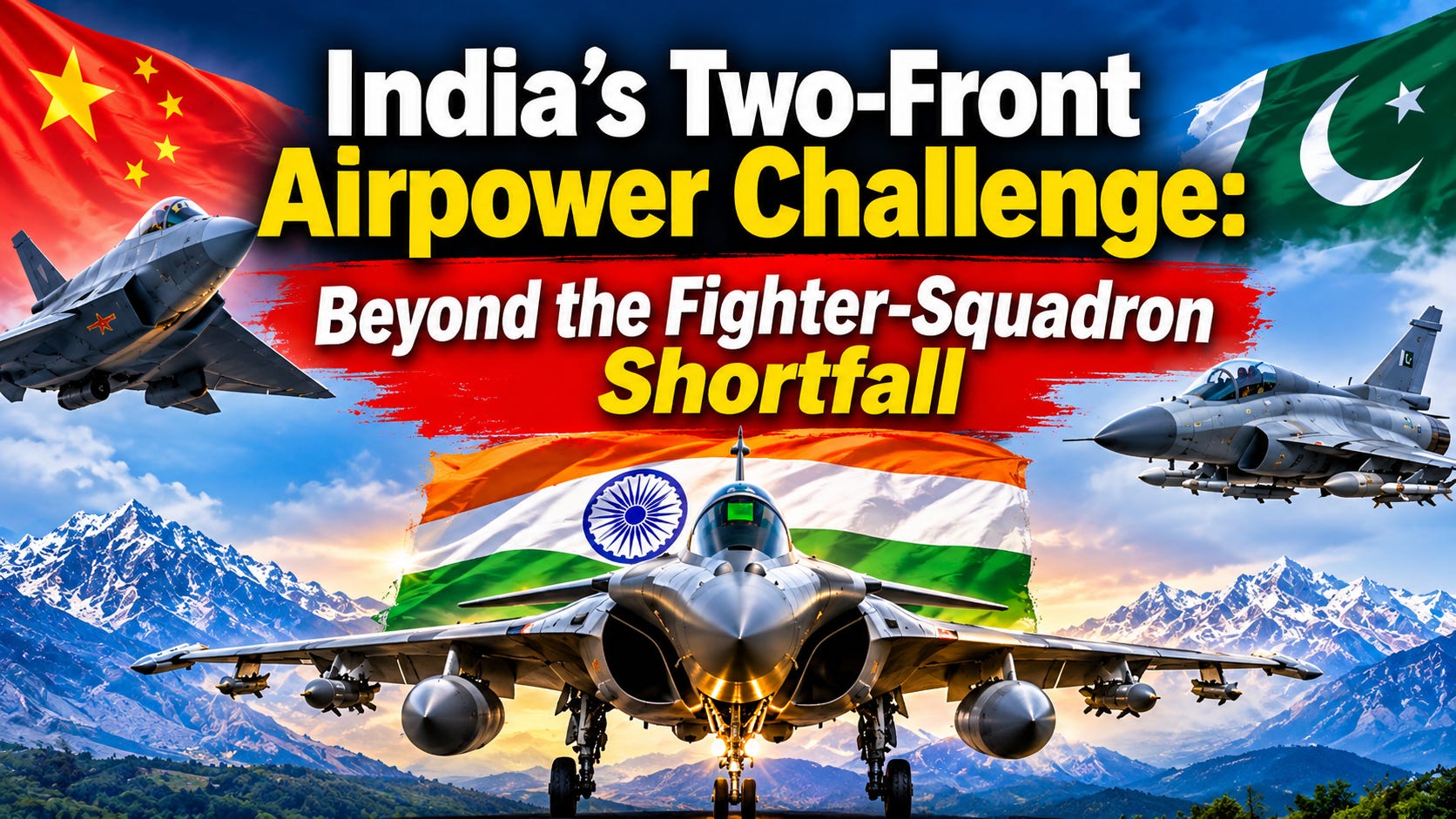
The challenge is bigger than fighter numbers
India’s airpower challenge is no longer defined by the number of fighter aircraft it can deploy. It is increasingly about whether the country can build an integrated combat capability capable of operating effectively against two technologically advancing neighbours. China is expanding its stealth-fighter fleet while investing in the supporting architecture of modern air warfare. Pakistan, meanwhile, is upgrading its capabilities through access to Chinese aircraft, weapons and military technology. Their growing defence cooperation adds another dimension to India’s two-front security challenge.
For the Indian Air Force, the pressure is particularly significant. Its fighter-squadron strength remains below the authorised level, while the development and induction of an indigenous fifth-generation fighter will take time. Yet simply adding more aircraft will not, by itself, address the changing nature of aerial warfare. Modern air combat increasingly depends on the ability to detect threats early, share information across platforms, disrupt an opponent’s systems and engage targets with precision. Radar networks, airborne early-warning aircraft, electronic warfare, long-range missiles, drones and secure communications are becoming as important as the fighters themselves.
The real question, therefore, is not merely how quickly India can increase its fighter numbers. It is whether New Delhi can develop a balanced, technologically connected and sustainable airpower ecosystem before the regional capability gap widens further. That requires not only accelerating aircraft procurement and indigenous development, but also strengthening the systems that allow different platforms to operate as one coordinated force. In the emerging contest, the advantage may belong not simply to the side with more fighters, but to the side that can see first, decide faster and strike more effectively.
China: building an integrated air-combat system
China’s advantage lies not in one aircraft or missile, but in the combination of platforms, weapons and surveillance.
The Chengdu J-20 is the country’s principal operational stealth fighter. A mid-2026 estimate by Chinese military aviation analyst Andreas Rupprecht, reported by The War Zone, suggested that around 500 J-20s may have been delivered. This is an open-source estimate—not an official Chinese inventory figure or a verified count of operational aircraft. The UK-based RUSI had earlier estimated roughly 300 in service by mid-2025, illustrating how quickly estimates can change as production expands.
China’s long-range PL-15 air-to-air missile adds another layer to the challenge. Its export variant is associated with Pakistan’s J-10C fleet, while the domestic Chinese version is understood to be more capable. In modern engagements, missile range is only part of the equation: airborne early-warning aircraft, ground radar and other sensors can help locate and track targets, allowing fighters to operate with information gathered beyond their own onboard systems.
China has invested heavily in airborne surveillance, ground-based radar, satellites, electronic warfare and integrated command systems. Its emerging J-35 programme adds to the longer-term stealth challenge. The strategic point is clear: China is building a connected combat architecture, not merely adding aircraft to its inventory.
Pakistan: a more capable western-front challenge
Pakistan’s air force remains smaller than India’s, but its modernisation deserves close attention. The J-10C, paired with the PL-15E beyond-visual-range missile, has become a prominent part of the discussion following the May 2025 confrontation.
Reuters reported on 8 May 2025, citing two US officials, that Pakistani J-10s had fired air-to-air missiles and brought down at least two Indian aircraft; one was reported to be a Rafale. India did not confirm the losses at the time, and the precise circumstances and wider claims by both sides remain disputed. The report should therefore be attributed to Reuters and its cited officials—not presented as an uncontested official account.
Pakistan’s possible access to Chinese stealth and surveillance platforms also needs precise wording. On 6 June 2025, Pakistan’s government said China had offered 40 J-35 stealth fighters, KJ-500 airborne early-warning aircraft and the HQ-19 air-defence system. An offer is not the same as a signed contract, delivery schedule or operational induction. As of the sources reviewed for this report, these should be described as proposed or potential acquisitions, not capabilities already fielded by Pakistan.
Pakistan already operates airborne early-warning aircraft, including the Chinese-origin ZDK-03 and Swedish Saab 2000 Erieye. These platforms can improve surveillance and coordination with fighters and ground-based radar. India must consequently prepare for engagements shaped by sensors, electronic warfare and long-range weapons—not just direct fighter-versus-fighter encounters.
India’s immediate constraints
The IAF’s fighter-squadron shortage is a serious structural concern. In October 2026, Air Chief Marshal A. P. Singh said the force had fallen to 29 squadrons against an authorised strength of 42.5. He said the IAF needed to induct 36–40 fighter aircraft annually to stop the decline and begin rebuilding its strength. These are the Air Chief’s stated figures and requirement; they should be dated rather than presented as timeless numbers.
The Su-30MKI remains central to the combat fleet, supported by Rafale, Mirage 2000 and upgraded MiG-29 aircraft. Tejas is essential to renewal, but delays in production and delivery have slowed the replacement process. More aircraft are needed, but numbers alone will not close the technological gap.
India has no operational fifth-generation stealth fighter. The Advanced Medium Combat Aircraft (AMCA) is intended to provide stealth, advanced sensors and modern combat capability, but it remains a future programme. Until it enters service, India must manage the gap through a combination of fleet upgrades, timely induction of new aircraft, improved weapons and stronger surveillance.
The two fronts also pose different operational demands. Pakistan’s airfields and infrastructure are relatively close to India’s western border; the China-facing theatre is shaped by the Himalayas and high-altitude conditions. Geography matters, but it cannot substitute for adequate aircraft numbers, reliable logistics and modern support systems.
What the May 2025 air confrontation revealed
The four-day confrontation highlighted several lessons, although the fog of war and competing claims mean that individual events should be treated cautiously. The Australian Air and Space Power Centre’s analysis describes a conflict in which airborne early-warning systems, ground radar, long-range missiles, drones and electronic warfare all played important roles. It also notes that the initial understanding of events was affected by disinformation and incomplete information.
Three broad lessons stand out. First, beyond-visual-range weapons can threaten aircraft well before visual contact, making reliable tracking and targeting critical. Second, electronic warfare and surveillance networks can shape the outcome as much as the performance of an individual fighter. Third, expensive combat aircraft remain vulnerable if they lack timely intelligence, protection and coordinated support.
The lesson is not that one aircraft type has conclusively proved superior to another. It is that air operations now depend on the quality of the entire system—and on the ability to adapt when the first plan fails.
What India should prioritise
India needs a coordinated modernisation programme rather than a single headline procurement. Five priorities deserve urgency:
• Rebuild squadron strength. Accelerate Tejas Mk1A deliveries, keep follow-on programmes on schedule and upgrade existing aircraft where this delivers meaningful capability. Any additional foreign purchase should be judged against cost, delivery time and operational need.
• Make AMCA achievable. Give the programme clear milestones, stable funding and accountability. Develop domestic expertise in stealth, avionics and propulsion. If an interim foreign platform is considered, assess lifecycle costs, readiness and genuine technology transfer—not just the advertised performance.
• Strengthen surveillance and electronic warfare. Expand airborne early-warning capacity and connect airborne and ground-based sensors. Improve jamming, electronic protection and the ability to operate when communications and radar are disrupted.
• Develop missiles and unmanned systems. Build on the Astra programme, improving range, seeker performance and resistance to countermeasures. Accelerate unmanned systems for surveillance, electronic warfare and combat support, with affordable drones complementing crewed aircraft.
• Build industrial depth. Prioritise engines, AESA radars, missile seekers, mission software, stealth materials, maintenance and spare-parts capacity. Private-sector participation and foreign partnerships should create durable design and manufacturing capability—not just local assembly.
The 500 Su-57 proposal: a warning, not a plan
The widely reported suggestion that India should acquire around 500 Russian Su-57 fighters comes from the Centre for Analysis of World Arms Trade (CAWAT), a Russian arms-trade research body, as reported by Defence Security Asia on 31 October 2026. The proposal described an initial purchase of 50 Su-57E aircraft followed by licensed production of another 450 in India. It is an advocacy proposal by CAWAT—not an official Indian government recommendation, an approved procurement plan or evidence that India has decided to buy the aircraft.
A programme on this scale would involve enormous financial, industrial, maintenance and integration demands. It should not distract from the need to restore squadron strength, deliver existing programmes and develop domestic technologies. India should assess any foreign fifth-generation option on its merits, but an imported fleet cannot substitute for a sustainable national aerospace and defence-industrial base.
The real test: control of the air, not a headline number
India retains experienced pilots, capable aircraft and a growing defence industry. But China’s production capacity and Pakistan’s access to Chinese systems are changing the strategic equation. The challenge is to respond before the gap widens further.
The next air conflict will be shaped by stealth, missiles, drones, electronic warfare, surveillance and the ability to sustain operations. India does not need to chase an arbitrary number of imported fighters. It needs sufficient aircraft, effective sensors and weapons, resilient command systems and the industrial capacity to keep them operational.
The measure of airpower is not how many fighters a country owns, but whether its forces can work together to control the skies when it matters.
Sources and further reading
1. The War Zone, “How Many J-20 Mighty Dragon Fighters Does China Actually Have?” (2026). Open-source estimate of around 500 delivered by mid-2026. Direct link
2. Royal United Services Institute (RUSI), “The Evolution of Russian and Chinese Air Power Threats” (9 February 2026). Earlier estimates of J-20 production and in-service strength. Direct link
3. Reuters, “Pakistan’s Chinese-made jet brought down two Indian fighter aircraft, US officials say” (8 May 2025). Attribution and caveats on reported aircraft losses. Direct link
4. Janes, “Pakistan announces Chinese J-35 aircraft offer” (6 June 2025). Pakistan government announcement of Chinese offers, including J-35 and KJ-500; not proof of completed procurement. Direct link
5. The Indian Express, “IAF needs 36-40 jets annually; Pakistan’s fifth-gen jet plan worrying: Air Chief” (4 October 2026). Air Chief’s statement on squadron strength and annual induction requirement. Direct link
6. Peter Layton, Australian Air and Space Power Centre, “The Four-Day Near-Peer Air War” (17 November 2025). Analysis of the May 2025 conflict and its operational implications. Direct link
7. Defence Security Asia, “India Needs About 500 Su-57 Fighters to Counter External Threats — CAWAT” (31 October 2026). Reports the CAWAT proposal; distinguish the research body’s recommendation from Indian government policy. Direct link
8. PRS Legislative Research, “Demand for Grants 2026–27: Defence”. Background on defence allocations and parliamentary analysis. Direct link
Disclaimer
This report is for educational and informational purposes only. It does not constitute defence procurement or strategic policy advice. It is based on publicly available sources, some of which contain estimates, reported claims or proposed acquisitions that have not been independently confirmed.
Military capabilities and procurement positions can change. Readers should consult the original sources and verify material claims before relying on or republishing them. Research and analysis were assisted by AI.