


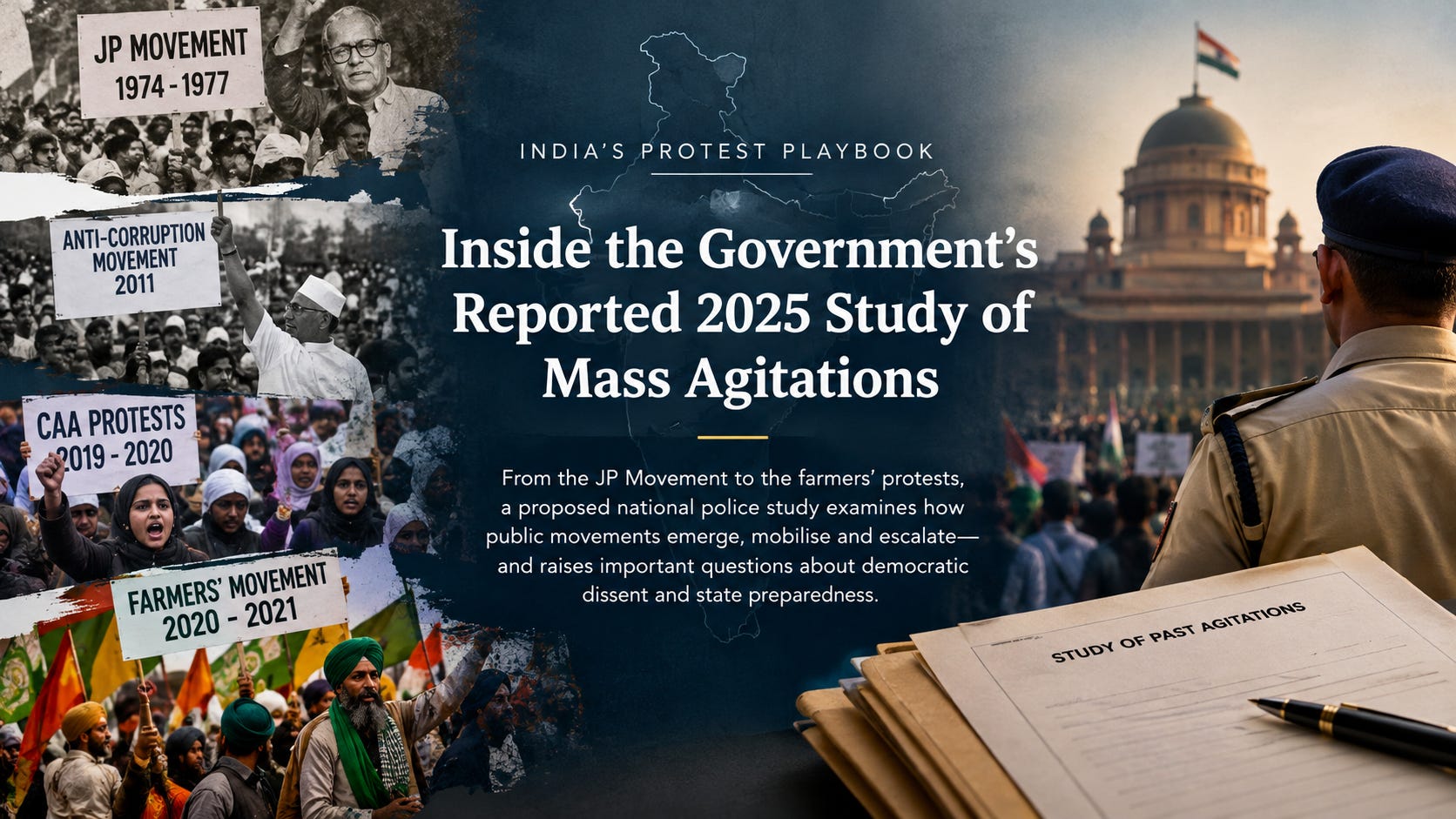
A National Study of India’s Protest History
In 2025, Union Home Minister reportedly directed the Bureau of Police Research and Development (BPR&D), under the Ministry of Home Affairs, to study major post-Independence protests, particularly those since 1974 and develop an SOP for managing future agitations.
In December, BPR&D reportedly asked state and Union Territory police chiefs to submit protest records through a 13-question questionnaire covering causes, leadership, mobilisation, escalation, casualties, damage and outcomes.
The study also reportedly envisaged examining protest financing, potentially involving the Enforcement Directorate (ED), FIU-India and the Central Board of Direct Taxes (CBDT).
The stated aim was to draw lessons from past movements to improve preparedness for future agitations.
Four Major Agitations That Offer Important Lessons
These four movements provide contrasting examples of how public grievances develop into mass mobilisation. Their inclusion is for historical analysis, not an allegation of suspicious activity or illegal financing.
The JP Movement, 1974–1977: From Student Anger to a National Political Challenge
Triggered by student protests over corruption, inflation and unemployment, the movement expanded under Jayaprakash Narayan’s call for Sampoorna Kranti. The declaration of Emergency in 1975, accompanied by arrests, press censorship and restrictions on civil liberties, intensified the political confrontation. The movement culminated in a major electoral defeat for Indira Gandhi’s government in 1977.
Why it matters: It shows how local grievances can become a national movement and how government responses can shape its course.
The Anti-Corruption Movement, 2011: Public Anger and the Demand for Accountability
Led by Anna Hazare, the movement demanded a stronger Jan Lokpal framework to investigate corruption. Hunger strikes, mass demonstrations and extensive media coverage transformed public frustration into a nationwide campaign. The Lokpal and Lokayuktas Act was enacted in 2013, although the movement’s original demands were not implemented in their entirety.
Why it matters: It demonstrates how focused demands, public communication and civil-society networks can drive mass participation and influence legislative debate.
The CAA Protests, 2019–2020: Citizenship, Constitutional Rights and Public Space
The Citizenship (Amendment) Act, 2019, sparked nationwide protests over its religious criteria and their implications for equality and secularism. Delhi’s Shaheen Bagh sit-in became a prominent example of sustained civilian mobilisation, particularly by women. The wider unrest also raised questions about peaceful assembly, policing, public-space restrictions and episodes of violence.
Why it matters: It highlights the importance of distinguishing peaceful dissent from violence and ensuring that restrictions and policing are proportionate.
The Farmers’ Movement, 2020–2021: A Sustained Agitation That Changed Government Policy
Farmers, particularly from Punjab and Haryana, opposed three agricultural laws enacted in 2020, fearing threats to existing market arrangements and minimum support price (MSP) protections. Prolonged demonstrations around Delhi and repeated negotiations followed. In November 2021, Prime Minister Narendra Modi announced the repeal of the laws; Parliament subsequently enacted the repeal, and the principal protesting unions ended their year-long agitation.
Why it matters: The movement illustrates how organised groups, shared economic concerns and sustained mobilisation can force major policy reconsideration.
What Do These Movements Have in Common?
Despite their differences, these four agitations reveal common patterns.
First, movements often begin with specific grievances—corruption, economic insecurity, citizenship policies or agricultural reforms—but expand when wider sections of society identify with their concerns.
Second, leadership and organisation facilitate mobilisation, but mass participation does not necessarily imply centralised control. Diverse groups may unite around shared demands while retaining different objectives.
Third, government responses—from negotiations and concessions to restrictions and arrests—can shape a movement’s trajectory, either easing tensions or intensifying resistance.
Finally, outcomes vary, ranging from policy changes and electoral consequences to institutional reforms and constitutional debates. Understanding these movements requires examining their distinct causes, dynamics and consequences rather than assuming a common pattern.
Preparation for Unrest—or Greater Scrutiny of Dissent?
The reported objective was to develop an SOP to prevent future agitations attributed to “vested interests” by examining how past movements began, evolved and concluded.
Such research can help authorities manage crowds, protect public safety and coordinate emergency responses. However, studying a protest’s funding, leadership or organisation does not prove illegal financing, external orchestration or criminal conspiracy. Such allegations require evidence.
In a democracy, peaceful protest is a legitimate means of expressing grievances and demanding accountability. Treating mobilisation itself as suspicious risks blurring the line between dissent and unlawful conduct.
Any credible framework must distinguish peaceful assembly from violence, ensuring that restrictions and enforcement remain lawful, necessary and proportionate.
What Does This Mean for Delhi Police?
The reported national study should not be mistaken for a newly established secret Delhi Police strategy. Existing BPR&D guidance already covers crowd control, advance planning and mass-gathering management, alongside applicable laws governing demonstrations.
However, these existing practices do not establish that every measure discussed in the 2025 initiative was adopted.
The key question is whether any resulting SOP will distinguish peaceful dissent from genuine threats to public order while ensuring proportionality, accountability and respect for fundamental rights.
What Remains Unknown?
The available reporting establishes that the study was announced and that state and Union Territory police forces were subsequently asked to provide historical protest records. However, the sources reviewed for this report do not establish that a final research report or a definitive SOP arising specifically from the 2025 initiative has been publicly released.
Nor do the reports establish that the four historical movements discussed above were individually designated by the government as suspicious or improperly funded.
Until the underlying instructions, findings and final policy documents are publicly available, conclusions about the government’s precise intentions, the study’s findings or changes to operational policing would be premature.
Conclusion: The Difference Between Understanding Protest and Treating It as a Threat
India’s history demonstrates that mass agitations can emerge from genuine grievances, bring together diverse participants and produce consequences ranging from institutional reform to major policy reversals.
The JP Movement, the anti-corruption campaign of 2011, the CAA protests and the farmers’ movement each offer different lessons about mobilisation, leadership, public participation and the state’s response. Their histories cannot responsibly be reduced to a single explanation or assumed to share a common hidden design.
The government has a legitimate interest in preparing for public disorder and preventing violence. But the credibility of any national protest-management framework will depend on whether it distinguishes evidence from suspicion and peaceful democratic participation from unlawful conduct.
Understanding how movements emerge is not the same as proving that they were engineered. That distinction is central to ensuring that public-order preparedness strengthens, rather than undermines, democratic accountability.
One Last Comment
Every agitation emerges from a specific set of grievances, frustrations or a perceived failure of accountability. The emergence of the latest agitation involving CJP, AISA, the INC and civil-society groups raises a broader question: have the government and Delhi Police understood that studying past movements cannot, by itself, prevent future protests? Historical analysis and preparedness may help manage demonstrations, but lasting resolution requires addressing the concerns that bring people onto the streets. Agitations cannot be prevented merely by studying how they unfold; their underlying causes must be understood and grievances addressed through dialogue, accountability and meaningful corrective action. Otherwise, one movement may subside only for another to emerge from unresolved anger.
Disclaimer
This report is prepared for informational, research and public-interest discussion purposes. It draws on the supplied research document and additional published reporting identified in the sources below. Historical descriptions are concise summaries and are not intended to provide an exhaustive account of each movement. Reported government objectives, historical interpretations, allegations and established facts should not be treated as interchangeable. The inclusion of a protest as a case study does not imply illegal funding, criminal conspiracy or deliberate orchestration. The final report and SOP arising specifically from the reported 2025 initiative could not be independently verified from the sources reviewed. Readers should consult the original reports and official documents before drawing further conclusions. This publication does not allege wrongdoing by any individual, organisation or institution.
Sources of Information
Reporting on the 2025 government study
The Indian Express, 15 September 2025
The Indian Express, 29 December 2025
The Indian Express, 28 December 2025
Historical movements and comparative context
The Indian Express — Farm laws repealed: A look at why and how the government pushed the laws and why it withdrew them.
UK House of Commons Library — Farmers’ protests in India and agricultural reforms.
The Indian Express — Farmers end year-long protest: A timeline of how it unfolded.
The Indian Express — From Irom Sharmila’s fast to NEET stir: Jantar Mantar, a site of many protests.
Institutional references identified in the supplied document
Bureau of Police Research and Development (BPR&D) — Comprehensive Guidelines on Crowd Control and Mass Gathering Management, and related studies or standard operating procedures.
Ministry of Home Affairs (MHA) — Official press releases and institutional material relating to police research and public-order administration.
Delhi Police — Official circulars and orders relating to demonstrations, processions, routes and public-space management.