


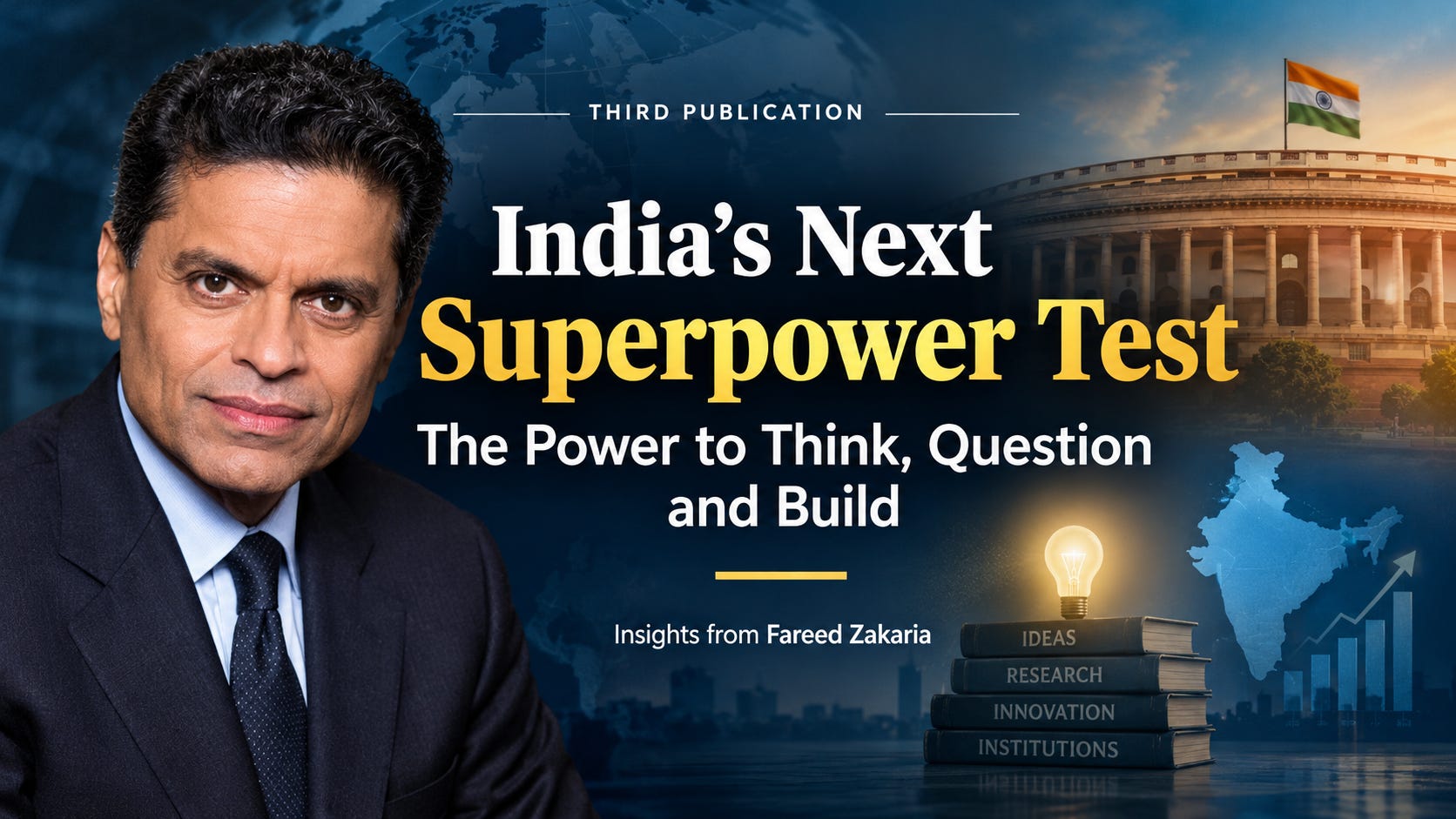
Beyond Fareed Zakaria’s Global Perspective
Fareed Zakaria, the Indian-born American journalist and host of CNN’s Fareed Zakaria GPS (Global Public Square), examines geopolitics, political institutions and the shifting balance of global power. His broader arguments offer an important perspective on why some societies sustain their influence long after their initial economic or military advantages begin to fade.
The West’s historic strength lies not merely in its military power or democratic elections, but in its ability to generate ideas, question established beliefs, and turn intellectual discoveries into powerful institutions and technologies. Its rise was also shaped by industrialisation, commerce, finance and imperial exploitation; intellectual strength alone does not explain Western dominance.
The central lesson, however, extends well beyond the West: a nation’s lasting power depends on how effectively it converts knowledge into institutions, innovation and national capability.
India’s Challenge: from Intellectual Potential to National Power
India has no shortage of intellectual talent. Its achievements in mathematics, pharmaceuticals, space exploration, information technology and digital infrastructure demonstrate its capacity to innovate. Yet producing talented individuals is different from building a society that consistently converts talent into original research, globally competitive technologies and strong institutions.
Universities must move beyond examination-driven learning and encourage independent thinking, experimentation and open debate. Research must travel from laboratories to factories, markets and public services. Businesses need incentives to invest in deep technology, while scientists and entrepreneurs need credible opportunities to build ambitious careers in India.
This requires more than increased funding. It demands institutional autonomy, transparent recruitment, predictable research support and a culture that rewards questioning rather than conformity. India must also retain and attract talent by providing the freedom, infrastructure and professional opportunities that ambitious minds require.
Can India Strengthen the Institutions Behind Its Democracy?
India’s intellectual rise cannot be separated from its political development. Elections are essential to democracy, but electoral competition alone does not guarantee institutional strength. Independent courts, a professional civil service, a credible press, academic freedom and effective checks on executive power help create the conditions in which ideas can be challenged and mistakes corrected.
For us, the challenge is not simply to govern decisively, but to build institutions that remain trustworthy, competent and accountable regardless of which party holds power.
A confident democracy should be able to accommodate dissent without treating criticism as disloyalty. Political parties should compete through the quality of their ideas, policy execution and institutional reforms—not merely through electoral mobilisation. Parliament should enable serious scrutiny, public administration should reward competence, and policymaking should be informed by evidence rather than political convenience.
This is not an argument for importing a Western political model wholesale. Western democracies themselves face serious institutional challenges, and India’s own constitutional experience offers valuable lessons. The objective is to strengthen India’s democratic foundations while adapting institutions to its social diversity and developmental needs.
Build a Nation That Can Learn and Reinvent Itself
India’s next transformation should rest on three connected priorities: intellectual freedom, institutional strength and technological innovation. Universities must generate original knowledge; industry must convert discoveries into productive capacity; and political institutions must protect the openness, accountability and stability that make both possible.
India should invest in research, reform universities, support deep-tech entrepreneurship and create pathways for global talent to contribute to domestic progress. Equally important, it must cultivate a public culture that values evidence, tolerates disagreement and recognises that no institution or leader is beyond scrutiny.
The political reward for such reforms could be profound: more productive industries, better public services, stronger strategic autonomy and greater influence in shaping international rules and technologies.
The Power to Define the Future
The ultimate lesson of the West’s historical experience is not that one civilisation possesses an inherent intellectual advantage over another. It is that societies gain lasting power when they create systems that allow ideas to emerge, survive criticism, spread and become practical achievements.
India has the population, talent, economic potential and democratic experience to become a major intellectual and technological force. But potential is not destiny. Its rise will depend on whether it can build institutions stronger than individual personalities, encourage independent thought beyond political and academic boundaries, and turn scientific capability into national progress.
India’s greatest ambition should not be merely to become powerful within the existing world order, but to develop the intellectual and institutional capacity to help shape what comes next.
Disclaimer: This article is an independent analysis of intellectual power, democratic institutions and India’s development prospects. It presents a policy perspective rather than an endorsement of any political party, ideology or individual. The discussion of Fareed Zakaria reflects the broader themes associated with his work and should not be interpreted as a verbatim quotation or a claim about a specific programme episode.