


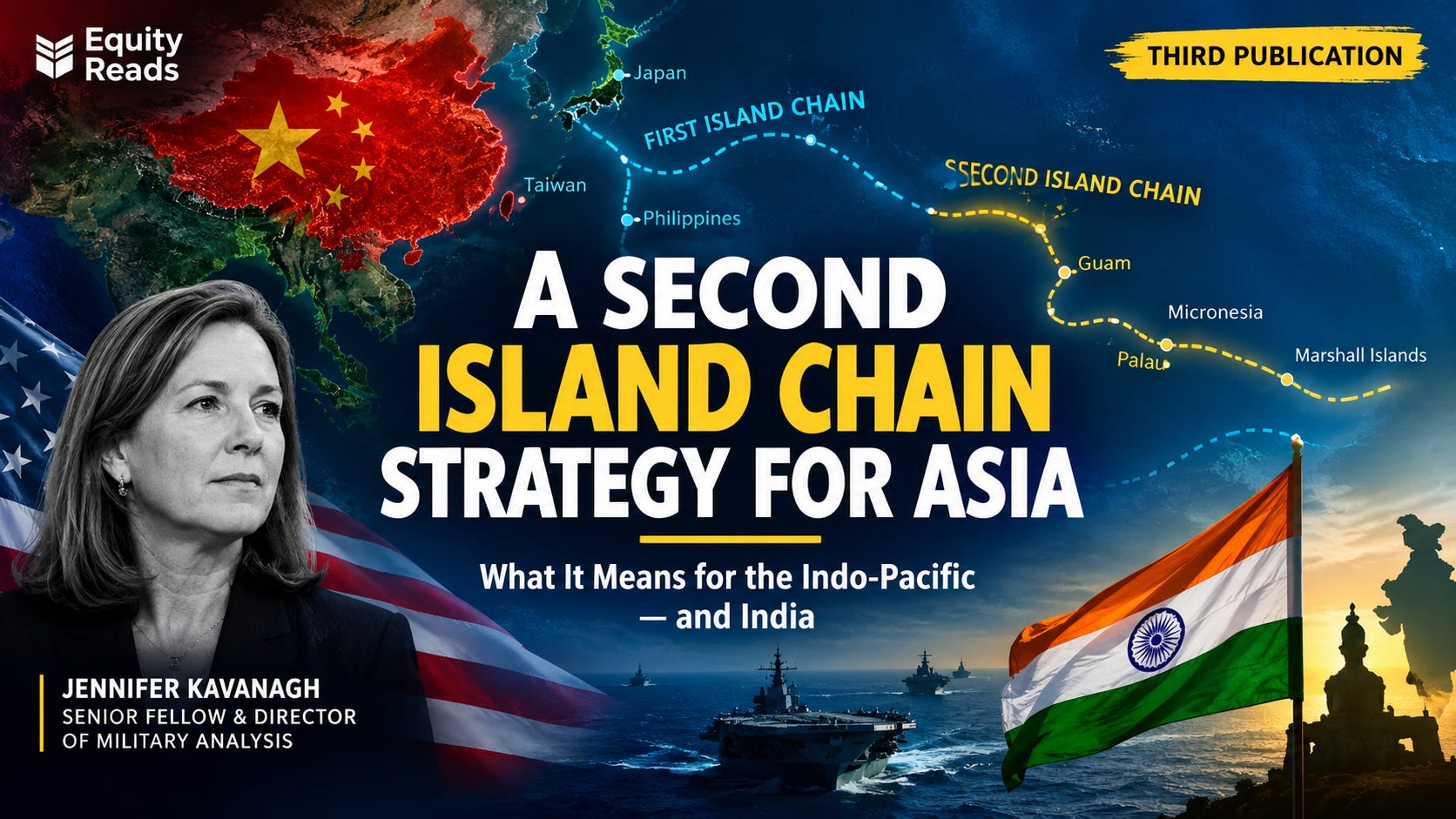
The Paper & Its Writer
JENNIFER KAVANAGH is a US political scientist and military-strategy specialist. She is Senior Fellow and Director of Military Analysis at Defense Priorities and has previously worked with RAND and the Carnegie Endowment. Her broader body of work reflects a philosophy of strategic restraint — distinguishing America’s vital interests from overseas military commitments that may carry disproportionate costs and risks.
Her paper, “A Second Island Chain Strategy for Asia,” proposes a substantial rethink of the American military presence in Asia.
What Is Kavanagh Proposing?
The central idea is simple: Move the centre of gravity of US military power away from China’s immediate coastline.
Instead of concentrating forces around Japan, Taiwan, South Korea and the Philippines — the First Island Chain — Washington would rely more heavily on the Second Island Chain, including Guam, the Northern Mariana Islands, Palau, Micronesia and the Marshall Islands.
Kavanagh argues that the United States has only two core interests in Asia: protecting the American homeland and maintaining access to important markets and trade routes.
Her recommendations include:
a clear US non-intervention policy on Taiwan;
ending existing defence alliances with Japan, South Korea, the Philippines and Australia; replacing them with narrower and more flexible security partnerships;
substantially reducing Army and Marine deployments;
reducing vulnerable forward air and naval deployments;
concentrating remaining forces farther from China’s coast;
completing the transition progressively, largely by 2030 and fully by 2035.
The strategic logic is that America can protect its economic interests without maintaining a military posture that could itself become the trigger for a direct US-China war.
The Biggest Strategic Argument
Kavanagh challenges the assumption that more American military presence automatically means greater American security.
Her argument is particularly controversial on Taiwan.
She contends that the military and economic consequences of Chinese control over Taiwan would be serious but manageable, whereas a full-scale US-China war could produce enormous military, economic and potentially nuclear risks.
The paper therefore recommends moving from America’s existing strategic ambiguity toward explicit non-intervention in a Taiwan conflict.
How Are the Countries Reacting?
Japan: What Happens If Washington Really Pulls Back?
Japanese commentary has viewed the proposal with considerable concern. The Japan Times commentary cited in the research material argued that moving US forces from the First to the Second Island Chain could undermine the military foundation of the existing regional security architecture.
Other Japanese analysis has focused on a more practical question: If Washington actually followed this philosophy, how would Japan reshape its own defence strategy?
The significance is that Kavanagh does not expect Japan automatically to move into China’s orbit. She instead expects Japan to take greater responsibility for its own security.
Taiwan: The Most Sensitive Issue
Taiwan is directly affected because Kavanagh advocates abandoning strategic ambiguity in favour of explicit US non-intervention.
Taiwanese commentary has therefore been substantially critical, with one analysis arguing that abandoning the First Island Chain could strengthen China’s regional position.
South Korea: The Nuclear Question
For South Korea, the proposed end of the US-ROK alliance raises questions extending beyond conventional defence.
Security analysts cited in the research have raised concerns about the future of American extended nuclear deterrent and whether Seoul could rapidly replace important US enabling capabilities.
This is one of the strongest challenges to Kavanagh’s assumption that regional powers can simply take greater responsibility for their own security.
Philippines: The South China Sea Problem
Kavanagh does not propose abandoning the Philippines completely. Her proposal would retain the possibility of access to ports and airfields and limited military assistance, but remove the broad mutual-defence commitment.
The concern in Philippine and regional commentary is straightforward: Would Manila have less leverage against China if Washington were no longer treaty-bound to respond?
Australia: Partner, But Not Necessarily Ally
Australia presents a more complicated case. Kavanagh proposes ending the formal mutual-defence commitment but retaining Australia as an important strategic partner through defence cooperation, intelligence, logistics and access.
Thus, Australia could remain important to the Second Island Chain architecture even while the formal alliance is narrowed.
Pacific Islands: Less US Presence — but More Strategic Importance?
This is perhaps the most intriguing paradox. Guam, the Northern Mariana Islands, Palau, Micronesia and the Marshall Islands could become more strategically important, not less.
The proposal envisages dispersing military capabilities across these locations to make them harder for China to target.
But Pacific commentary raises another set of questions: Who carries the burden of America’s strategic retrenchment?
And What about China?
This is where the debate becomes most consequential. Kavanagh’s argument is not that America should simply hand Asia to China. Her objective is to prevent Chinese domination while accepting that the United States does not need military dominance to achieve that objective.
Critics see the calculation differently.
If Washington retreats from the First Island Chain, China could acquire greater political, diplomatic and military space in the Western Pacific.
Japanese commentary cited in the research has warned that such a vacuum could be exploited by China and, to a lesser extent, Russia. So the central disagreement is not about whether China matters. It is about how much American military power is necessary to constrain China.
The India Angle: The Most Interesting Part
For India, the proposal is potentially significant even though India is not the principal focus of the paper.
The immediate question is: If America reduces its military role in East Asia, what happens to the China-India strategic balance?
More Space for China — and More Responsibility for India
A US pullback could give Beijing greater strategic bandwidth in the Western Pacific and potentially allow China to devote more diplomatic, economic and military attention to the Indian Ocean.
That could increase pressure on India. But there is another possibility.
If Japan, South Korea and Australia respond by strengthening their own capabilities rather than accommodating China, India could become more important as an autonomous Asian power. That would fit India’s long-standing preference for strategic autonomy.
The Quad Could Change
The Quad — India, the United States, Japan and Australia — could also evolve.
A reduction in US military commitments could make the Quad less of a predominantly US-led balancing mechanism and more of a diplomatic, technological, maritime and economic grouping.
India could consequently acquire greater diplomatic weight.
But there would be a price: India could be expected to contribute more hard power.
That means greater emphasis on the Indian Navy, submarines, maritime surveillance, Andaman & Nicobar infrastructure, anti-submarine warfare, space surveillance, unmanned systems and logistics.
India sits at the western end of this maritime corridor.
A reduced US presence around the First Island Chain could therefore increase the relative strategic importance of the Andaman & Nicobar Islands as a surveillance and maritime-security position.
It does not mean India would seek to block China. It means India’s geography could become more valuable in a more multipolar Indo-Pacific.
The Risk: China Looks South
There is, however, a significant downside.
If China faces less US pressure in the Western Pacific, Beijing could potentially devote more resources and attention to the Indian Ocean.
That places greater importance on India’s monitoring of the wider chain stretching from Gwadar and Hambantota to the Maldives, Seychelles, East Africa and the Andaman Sea.
Taiwan Matters to India Too
A Taiwan crisis would not remain a distant East Asian issue for India.
It could affect: semiconductors, shipping, energy prices, global trade, Japanese security, ASEAN and India’s own exports and imports.
Avoiding a direct US-China war could reduce one category of risk for India.
The Larger Geopolitical Shift
The most interesting way to read Kavanagh’s paper is not simply as an American withdrawal from Asia.
It represents a possible strategic shift from forward deterrence toward offshore balancing, in which America reduces its role, regional powers take on greater responsibility, India becomes relatively more important and China gains some additional strategic space while facing stronger autonomous regional powers. Over time, this could contribute to the Indo-Pacific evolving from a largely US-centred security architecture toward a more multipolar one.
Therefore, this paper should be read as part of an ongoing strategic debate, not as evidence that Washington has adopted the Second Island Chain strategy.
Final Takeaway
Jennifer Kavanagh’s proposal challenges one of the most fundamental assumptions of post-war American strategy in Asia: Does America need to defend Asia militarily in order to protect its own interests there? Her answer is increasingly no. Instead, she envisages a more limited American military role, with greater responsibility shifting to the countries of the region.
For Japan, Taiwan, South Korea and the Philippines, that would raise difficult questions about security guarantees, self-reliance and their future strategic choices. For China, it could create additional strategic space. For the Pacific island nations, it could bring greater strategic importance—but potentially also a greater military and geopolitical burden.
For India, however, the implications could be particularly significant. A smaller American military footprint in East Asia could mean greater Chinese strategic freedom on one side and greater Indian strategic relevance on the other.
The larger story, therefore, may not simply be about an American retreat. It could mark the beginning of a different Indo-Pacific—one in which India, Japan and Australia carry greater strategic weight, China has more room to manoeuvre, and Washington seeks to influence the regional balance from farther offshore.
For New Delhi, that would bring opportunity and responsibility together: greater strategic space, but also a greater expectation that India will shape—and help secure—the emerging Indo-Pacific order.
Disclaimer
This article is based primarily on Jennifer Kavanagh’s A Second Island Chain Strategy for Asia, published by Defense Priorities on September 10, 2026. The proposal represents the views of its author and should not be treated as an announced US government policy.
Geopolitical conditions in the Indo-Pacific are fluid and can change rapidly. The analysis and potential implications discussed here are therefore subject to change. This publication is intended solely for informational and educational purposes and should not be construed as a prediction, investment advice or a definitive assessment of future government policy.
