


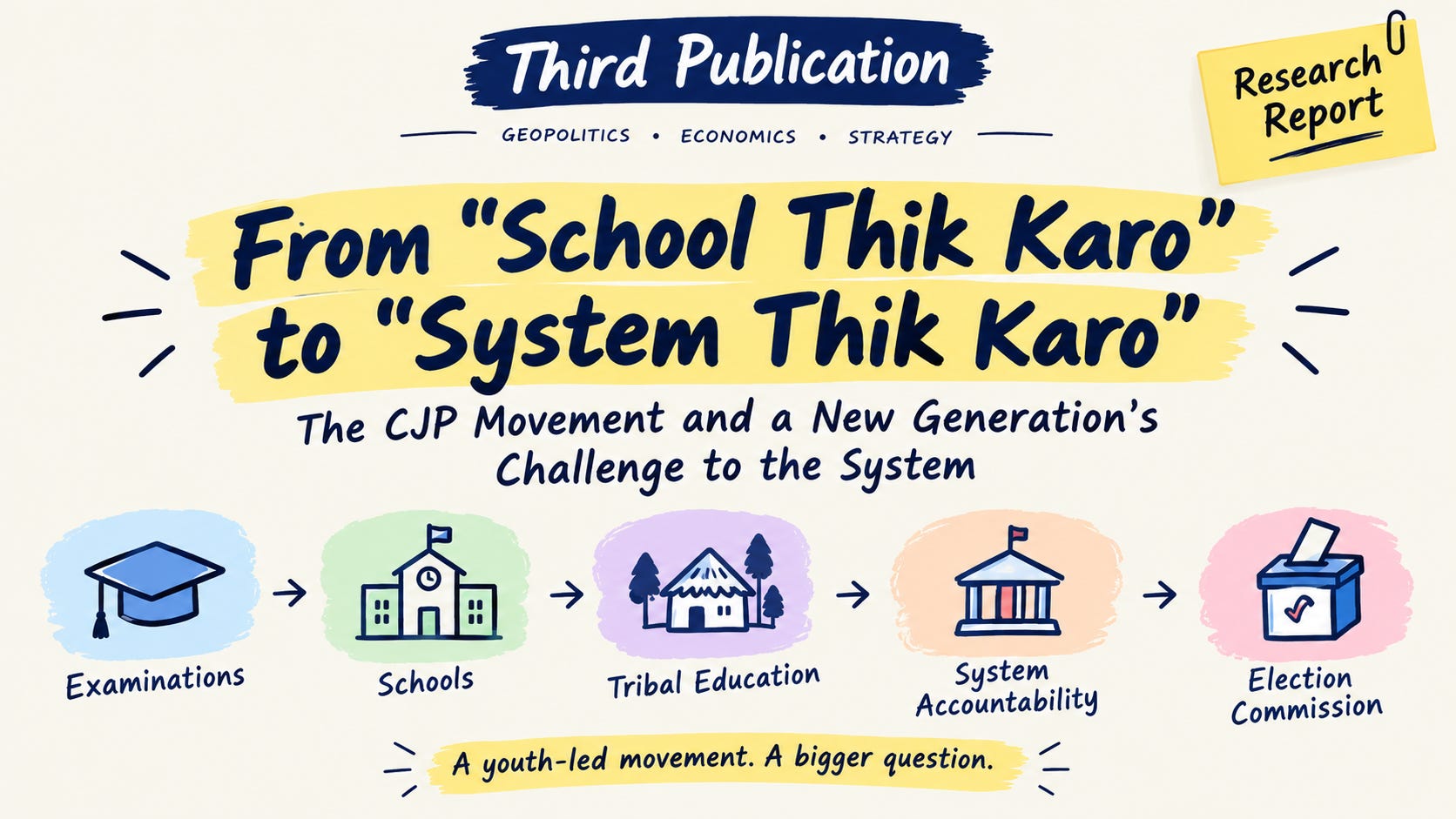
A Movement That Refused to End
What began as a youth mobilisation over examination irregularities became a 49-day agitation, negotiations with senior ministers and the resignation of Dharmendra Pradhan.
But CJP did not stop there. From “School Thik Karo” to “System Thik Karo,” its focus moved from individual grievances to institutional accountability.
On September 24, it launched “Election Commission Thik Karo,” demanding CEC Gyanesh Kumar’s resignation and threatening wider mobilisation.
The question now is whether CJP can evolve from a protest movement into a sustained civic-pressure force.
The Original CJP Movement: From Student Anger to National Attention
CJP began with examination irregularities but quickly raised a larger question: Can students trust a system that determines their future?
Its Jantar Mantar agitation led to negotiations with Union ministers JP Nadda and Jitendra Singh and was followed by Education Minister’s resignation.
The episode established CJP as a youth-led pressure movement capable of taking student grievances into the national arena.
From Jantar Mantar to Parliament
CJP’s pressure strategy also moved beyond Jantar Mantar. Its earlier “Sansad Chalo” mobilisation took protesters toward Parliament and was followed by government assurances and judicial intervention concerning cases against protesters.
That experience now forms part of the context for its confrontation with the Election Commission.
CJP Did Not Stop After the Resignation
The Education Minister’s resignation did not end the movement. CJP broadened its focus through “School Thik Karo,” moving from examination protests to ground-level inspections of government schools.
Classrooms, toilets, drinking water, furniture and other basic facilities became visible and documentable issues, giving the movement an activism model beyond street protest.
From Protest to Public Audit
CJP increasingly shifted from protest to direct documentation—examining not only what governments claim, but what citizens can see on the ground.
Through “Adivasi School Thik Karo,” the campaign expanded into tribal areas, with inspections planned across several states. Reports from Rajasthan cited alleged deficiencies in infrastructure, water and school facilities, though these remain CJP team findings rather than independently established conditions across all schools.
The larger significance lies in the method: turning public-service claims into evidence that can be examined and challenged.
The First Evidence of Administrative Response
The school campaign also began producing administrative responses. In Maharashtra, the rural development department reportedly directed urgent repairs to Zilla Parishad schools following CJP’s campaign, with other states also responding.
If sustained, the model could move CJP beyond conventional protest toward civic monitoring: identifying problems, documenting them, demanding action and tracking the response.
From Gen Z to a Wider Social Constituency
CJP’s early constituency was largely students and examination aspirants. “School Thik Karo” broadened its reach to parents, teachers, rural communities and administrators, while the electoral campaign potentially engages an even wider adult constituency.
The shift toward the Election Commission therefore represents a much broader stage in CJP’s evolution.
The Election Commission Becomes the New Battlefield
On September 24, CJP launched its nationwide “Election Commission Thik Karo” campaign, demanding CEC Gyanesh Kumar’s resignation within 48 hours and warning of wider agitation, including “Jantar Mantar 2.0.”
Its demands also cover the Special Intensive Revision (SIR) of electoral rolls and the Election Commission’s appointment framework.
Unlike a routine administrative dispute, these issues concern electoral-roll integrity and institutional independence, making evidence and verification especially important.
The SIR Controversy: Facts, Allegations and Institutional Responses
The SIR process has become a major point of controversy. Reports have described objections raised by Election Commissioners Sukhbir Singh Sandhu and Vivek Joshi, including concerns over large-scale deletions from draft rolls. The Election Commission has said that differing views are part of institutional deliberation and that final SIR decisions were unanimous.
The crucial distinction is between internal disagreement, evidence of unlawful conduct, and legitimate questions about transparency, accuracy and correction.
CJP’s allegations remain allegations unless independently established, while the underlying electoral-roll issues continue to face public, institutional and judicial scrutiny.
The New-Voter Question
The SIR debate also raises a question about young and first-time voters.
CJP argues that linking new applicants to earlier electoral-roll records, including those of their parents, could create difficulties in enrolment. EC disputes that interpretation, saying discrepancies trigger verification rather than automatic exclusion and that applicants can respond.
The broader question is whether eligible first-time voters can enter the electoral roll without unreasonable administrative barriers.
Judicial Scrutiny Adds another Dimension
The SIR controversy has also reached the Supreme Court. The Court has questioned aspects of Delhi’s process, including notices issued for “logical discrepancies,” and sought explanations from the Election Commission.
In West Bengal, the Court is examining electoral-roll revisions; the Election Commission told it that more than 22 lakh of 27.16 lakh deleted voters had appealed for reinstatement.
These developments do not establish CJP’s broader allegations, but they show that electoral-roll accuracy, deletion procedures and avenues for appeal are genuine issues under scrutiny.
Centralisation and the Role of BLOs
CJP has also questioned whether electoral-roll decisions are becoming more centralised and whether this could reduce the role of local officials and Booth Level Officers.
The core institutional question is simple: Who decides whether a voter is added, removed or retained—and can that decision be traced, challenged and corrected?
That question becomes especially important when decisions affect large numbers of citizens.
Why “System Thik Karo” Is a Different Proposition
The shift from School Thik Karo to System Thik Karo is more than a change in slogan.
It moves CJP from fixing specific service failures to questioning how the institutions responsible for them function—and how citizens can hold them accountable.
That turns individual campaigns into a broader argument about institutional functioning.
The Movement’s Biggest Test May Be Its Own Credibility
As CJP demands greater accountability from institutions, the same standards will increasingly apply to the movement itself.
Its credibility will depend on verifiable evidence, consistent standards, transparency, peaceful mobilisation and a willingness to correct errors. Most importantly, it must clearly distinguish verified facts from allegations and political claims.
What Happens After the 48-Hour Ultimatum?
As of September 25, 2026, the immediate question is what follows CJP’s 48-hour ultimatum. It has warned of nationwide agitation from October 2 and further mobilisation in Delhi if its demand for the CEC’s resignation is not met.
CJP has also appealed to political parties to unite over the issue and questioned participation in elections that its leadership alleges are being “rigged.” That remains CJP’s political position.
The challenge is now considerably broader: electoral rolls, SIR, voting rights and institutional independence have replaced the movement’s earlier focus on examinations and student grievances.
For CJP, the test is whether it can explain these issues without oversimplifying them. For institutions, transparency and verifiable records will matter. For citizens, the essential distinction remains between established facts, disputed issues and political allegations.
Politics beyond Traditional Parties
CJP’s broader significance may lie in a model of civic participation that does not require joining a political party.
Young citizens can document failures, organise campaigns, inspect public infrastructure, seek information, protest peacefully and monitor implementation.
That is citizenship beyond voting.
Whether CJP itself expands or changes remains uncertain, but this model of youth-led, digitally organised and evidence-driven civic engagement can exist beyond any single organisation.
The Government and Institutions Also Face a New Environment
CJP’s evolution could increase scrutiny of government departments and institutions.
Infrastructure claims, policy promises and institutional decisions can increasingly be documented, checked and shared by citizens.
That does not make every activist allegation correct; it makes transparency and verifiable information more important.
The broader effect could be behavioural: greater scrutiny of officials, increased attention to youth concerns and more citizens questioning public institutions.
The Road Ahead
CJP has expanded from examinations and students to schools, public infrastructure, governance and now the Election Commission.
Each expansion widens its constituency—but also raises its burden of proof. Its next phase will therefore depend not only on mobilisation, but on evidence, consistency, institutional response and credibility at scale.
Conclusion: From Protest Movement to Institutional Accountability?
CJP has moved from student protests and examinations to schools, public infrastructure, governance and the electoral system.
Its 49-day Jantar Mantar mobilisation, Parliament campaign, school inspections and electoral-roll campaign show a movement continually expanding its field of action.
The shift from School Thik Karo to System Thik Karo captures that evolution—from protesting individual failures to examining how institutions function.
The central question is no longer simply, “Is the government delivering?”
It is increasingly: “Can citizens verify how institutions function—and have the means to influence and hold them accountable?”
The next phase will determine whether CJP remains primarily a protest movement or develops into a sustained civic-pressure organisation. Its lasting significance may lie in creating a model where citizens move from complaining about institutions to systematically examining them.
Disclaimer: This report is for informational and analytical purposes only and reflects publicly reported developments available up to 25 September 2026. Political allegations and claims are presented as such and should not be treated as established facts without independent verification. Readers should consult primary documents, official records, court proceedings and multiple reliable sources before reaching their own conclusions.