


Executive Take
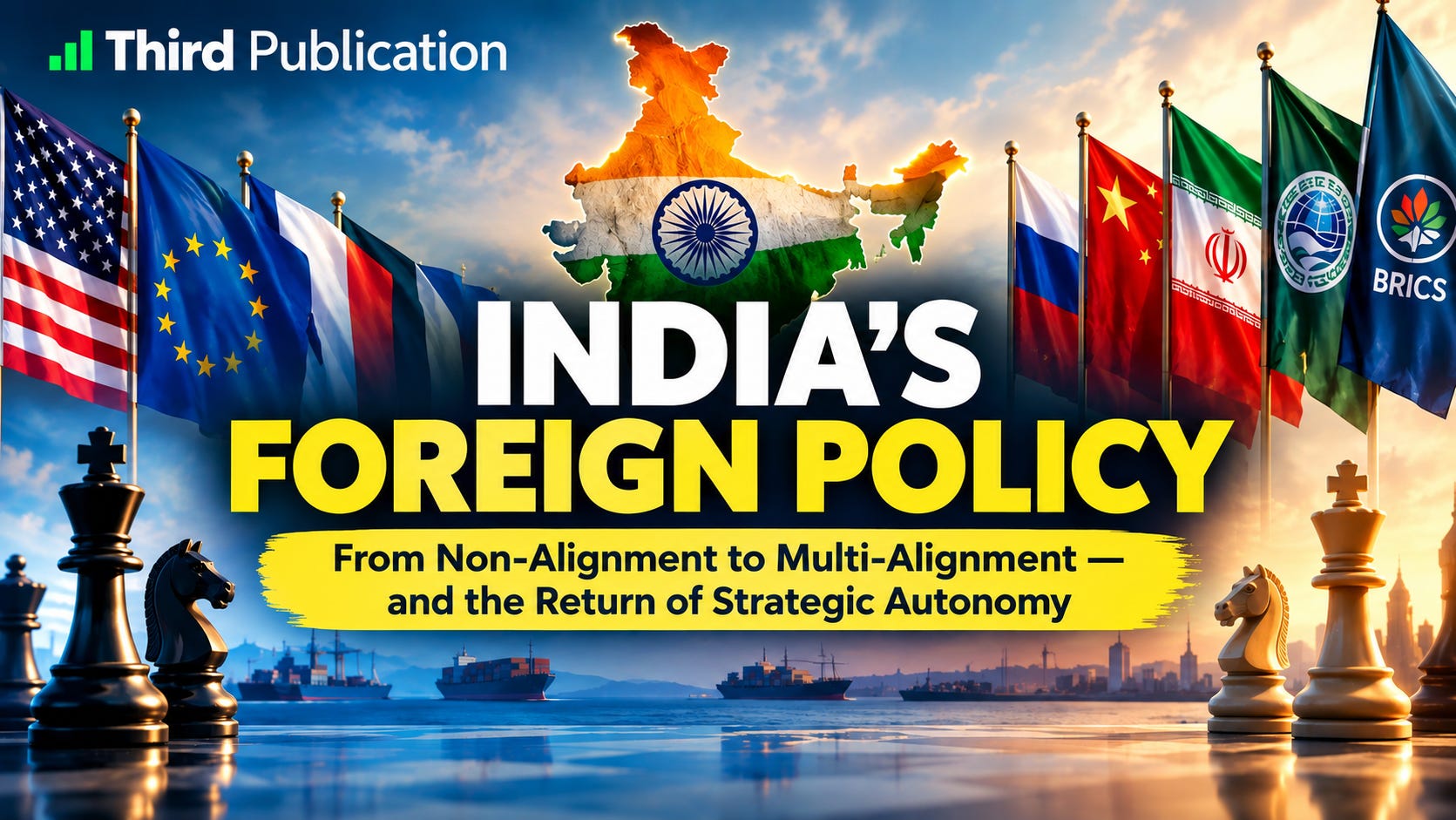
India’s foreign policy under the present leadership appears to have moved through three phases: From the traditional doctrine of non-alignment to a much closer strategic partnership with the United States, and then to a deeper relationship with Israel. There were clear reasons for this shift — China’s rise, defence modernisation, access to technology, maritime security and changing geopolitical realities in West Asia.
However, closer alignment also brought new constraints. As India moved deeper into the US strategic orbit, Washington gained greater influence through tariffs, sanctions, technology controls and pressure over issues such as Russian oil purchases. The question is no longer whether India needs the US — it undoubtedly does — but whether India allowed a valuable partnership to reduce the strategic flexibility that had long been a strength of Indian foreign policy.
The SCO summit in Bishkek and the 2026 BRICS summit in New Delhi suggest that India is now trying to rebuild that flexibility. By endorsing language on sovereignty, diplomacy, opposition to unilateral economic pressure, and greater use of national currencies and alternative payment systems, India appears to be widening its options once again with Russia, China, Iran and the wider BRICS world.
This report takes a deliberately independent view. Its central criticism is that India may have moved too far from strategic autonomy towards a Western and Israel-centric orientation without adequately preserving diplomatic and economic room for manoeuvre. The current outreach through SCO and BRICS may therefore represent not a change of ideology, but an attempt to restore balance after an earlier over-correction.
The Original Departure: From Non-Alignment to a Western Tilt
For decades, India’s foreign policy was built around non-alignment — not neutrality, but the freedom to avoid permanent blocs. After 1991, that doctrine evolved into strategic autonomy. India opened its economy, improved relations with the United States and simultaneously retained important relationships with Russia, Iran and the wider developing world.
The major transformation came during the Modi years. Washington became increasingly important to India’s defence, technology and Indo-Pacific strategy. LEMOA, COMCASA and BECA deepened military interoperability; the Quad expanded strategic coordination; and cooperation increasingly covered semiconductors, critical minerals, supply chains and advanced technology.
There was logic in this shift. China was becoming the principal strategic challenge in Asia, while the US offered capital, technology, markets and geopolitical weight. Yet the cost of strategic closeness is often visible only when interests diverge.
Israel: Strategic Partnership — but at What Cost?
India’s relationship with Israel also moved from pragmatic cooperation to a much more visible strategic partnership. Defence, intelligence, agriculture, technology and security cooperation expanded substantially. The relationship was valuable, particularly as India modernised its armed forces and sought technological alternatives.
But Israel also complicated India’s balancing act in West Asia. India has enormous interests in the Gulf, maintains relations with Iran, depends on energy imports and has a large diaspora in the region. Gaza added a humanitarian and diplomatic dimension that made an increasingly close India-Israel relationship harder to separate from wider regional politics.
The criticism is not that India should have abandoned Israel. It is that foreign policy becomes less autonomous when one relationship begins to constrain the language India can use on another conflict.
The US Partnership and the Tariff Problem
The most important test of the US relationship is not defence cooperation. It is what happens when Washington’s economic interests collide with India’s own choices.
The repeated use of tariffs and trade pressure has exposed this vulnerability. The dispute over India’s purchases of Russian oil is especially revealing. From India’s perspective, buying energy at commercially attractive terms is a sovereign economic decision. From Washington’s perspective, continued Russian purchases can be treated as support for Moscow. The result is pressure on Indian trade.
That is where the strategic calculation becomes uncomfortable. If a partner can use tariffs to influence India’s energy sourcing, trade policy or relations with another major power, then the partnership contains an element of dependence. India should therefore ask whether its earlier alignment with Washington created expectations that Washington now believes it has the right to enforce.
The lesson is not to become anti-American. It is to ensure that partnership does not become permission for another country to dictate India’s economic choices.
Russia: The Relationship India Could Not Afford to Abandon
Russia remained embedded in India’s defence, nuclear energy, space, hydrocarbons and fertiliser ecosystem even after India moved closer to the US. The Ukraine conflict made this contradiction more visible. India refused to join Western sanctions and continued purchasing Russian energy, while simultaneously expanding its strategic relationship with Washington.
The Indian position was frequently described as balancing. A more critical reading is that India had underestimated how difficult it would become to maintain old relationships after moving closer to the US-led security architecture.
The 2026 SCO and BRICS engagements underline the continuing importance of Russia. The Prime Minister’s meeting with President Putin in Bishkek and again in New Delhi reaffirmed cooperation across political, economic, defence, energy and space sectors. India therefore appears unwilling — and arguably unable — to replace Russia with the West.
China: From Strategic Rival to Necessary Engagement
China is the most difficult part of the equation. India has genuine security competition with Beijing, including the border, technology, trade imbalance and influence across the Indian Ocean. Yet China is also one of India’s largest trading partners and a central component of global manufacturing and supply chains.
That makes a permanent anti-China alignment strategically expensive. India needs to compete with China without allowing Washington to define every aspect of that competition.
The present movement towards greater engagement through BRICS and the SCO is therefore rational. It does not mean trusting Beijing. It means recognising that strategic autonomy requires the ability to talk to a rival while simultaneously maintaining partnerships with its competitors.
Iran: The Relationship India Cannot Lose
Iran is another relationship that was squeezed by India’s closer alignment with the US and Israel. Yet geography makes Iran strategically important. Chabahar offers connectivity to Afghanistan and Central Asia; the International North-South Transport Corridor provides a route towards Russia and Europe; and Iran remains central to the security architecture of the Gulf and the Strait of Hormuz.
India cannot afford a foreign policy in which its relationship with Iran is permanently constrained by US sanctions or Israeli preferences. The current re-engagement should therefore be seen not as an ideological turn towards Tehran, but as an overdue restoration of strategic balance.
The larger point is simple: a country seeking strategic autonomy cannot outsource its West Asia policy.
The Two Events That Matter: SCO and BRICS
The SCO summit in Bishkek and the BRICS summit in New Delhi are important signals that India may be widening its strategic options after years of moving closer to the US and Israel. At both forums, India joined statements emphasising sovereignty, diplomacy, restraint and opposition to unilateral economic pressure — positions that indirectly challenge the idea that Washington can dictate India’s external economic choices.
BRICS also pushed greater use of national currencies and alternative payment mechanisms. This does not mean an immediate BRICS currency or a break with the dollar. It does, however, indicate India’s growing interest in reducing excessive dependence on a financial system that can also become a tool of geopolitical pressure.
Taken together, the two events suggest a recalibration rather than a new alliance. India is not turning anti-American; it is reminding Washington, Beijing, Moscow and Tehran alike that its partnerships do not come with a surrender of strategic choice. In many ways, this may be India’s attempt to rebuild the diplomatic space that its earlier tilt towards the US and Israel had gradually narrowed.
Is This a Return to Non-Alignment?
Not exactly. The world of 2026 is fundamentally different from the Cold War. India today has a much larger economy, a deeper global footprint, major defence capabilities, a technology sector and a broad network of partnerships.
What appears to be emerging is better described as Strategic Autonomy 2.0: cooperation with the US where interests converge; continued ties with Russia where dependence remains; engagement with China despite competition; restoration of Iran connectivity; strong but more carefully managed relations with Israel; and an active role in BRICS, SCO, G20, Quad and other forums.
The irony is that India may be rediscovering the logic of strategic autonomy only after discovering the limits of alignment.
The Government Deserves Credit — But Also Criticism
A fair assessment should acknowledge that the shift towards the US was not irrational. China’s rise, border tensions, technology competition and the need for capital and advanced defence capabilities made closer US ties strategically useful. Israel too brought tangible defence and technology benefits.
The criticism is about sequencing and overreach. India appears to have moved from diversified engagement towards a stronger Western tilt, only to encounter pressure when its independent interests — particularly Russian energy, Iran connectivity and trade policy — conflicted with US preferences.
If strategic autonomy is the desired end-state, then the government should have preserved greater balance throughout rather than having to rebuild it under pressure. The recent outreach to BRICS, SCO, Russia, China and Iran may therefore be interpreted partly as correction, not merely as grand strategic design.
What the BRICS Declaration Really Signals
The New Delhi BRICS declaration is significant because it brought together countries with very different interests — including China, Russia, Iran, India and Gulf partners — around a broad language of sovereignty, diplomacy, restraint and economic cooperation. It also criticised unilateral tariffs and coercive economic measures without turning BRICS formally into an anti-American alliance.
That distinction matters. India is unlikely to benefit from replacing one dominant bloc with another. Its advantage lies precisely in being able to speak to Washington, Moscow, Beijing, Tehran, Gulf capitals and Europe simultaneously.
The more useful interpretation is therefore that India is attempting to make BRICS a pressure-release mechanism: a platform through which emerging economies can resist excessive external pressure without necessarily dismantling the existing global economic system.
The Risk: India Could Again Go Too Far
There is a danger in the opposite direction as well. If India reacts to US tariffs by moving too quickly towards Russia, China and Iran, it could repeat the same mistake in reverse. China remains India’s strategic competitor; Russia is increasingly dependent on China; Iran has its own regional agenda; and BRICS itself contains major contradictions.
Strategic autonomy is not about choosing the opposite camp. It is about refusing to become dependent on any camp.
India should therefore avoid replacing one alignment with another. Its foreign policy should be measured by outcomes — energy security, trade access, technology, defence capability, connectivity and diplomatic freedom — rather than by ideological labels.
Three Possible Futures, 2026–2035
The first is a renewed Western tilt. India could deepen its relationship with the US, Europe, Japan, Australia and Israel if China becomes more threatening. This would bring technology and investment benefits but could again increase vulnerability to political and economic pressure.
The second is Strategic Autonomy 2.0. India maintains close ties with Washington while simultaneously deepening BRICS, SCO, Russia, Iran and selected engagement with China. This is the most difficult path, but potentially the most beneficial.
The third is a sharper multipolar turn, in which India actively helps build alternative financial, trade and diplomatic institutions. This could increase autonomy but would also risk provoking unnecessary confrontation with the US and Europe.
Third Publication View
India’s foreign policy appears to be entering a correction phase. After moving from traditional non-alignment towards a much closer relationship with the US and Israel, India now seems to be rediscovering the value of keeping multiple strategic options open.
Repeated tariff pressure from Washington and attempts to influence India’s trade and energy choices have exposed the downside of getting too close to any one power centre. Against this backdrop, the SCO and BRICS statements look less like diplomatic routine and more like an effort to reclaim strategic space.
India is not abandoning America — but it may be realising that being close to America is not the same as being aligned with America. Likewise, Israel remains an important partner but cannot define India’s entire West Asia policy. Russia remains indispensable, China cannot be ignored, Iran cannot be sacrificed, and BRICS and SCO offer useful platforms to preserve India’s room for manoeuvre.
The real test now is whether India can avoid simply shifting from one alignment to another. Strategic autonomy means having the freedom to work with Washington, Moscow, Beijing, Tehran and others when India’s interests demand it — without allowing any of them to dictate the terms.
If the recent SCO and BRICS moves mark the beginning of that recalibration, India may finally be returning to the core principle that once defined its foreign policy: not anti-American, not pro-Russian, not pro-Chinese — but simply pro-India.
Disclaimer
This report is intended solely for informational and educational purposes and reflects the author’s independent analysis of the source material reviewed and relevant current developments. It does not constitute investment, legal, geopolitical or financial advice.
The views expressed are analytical opinions and may change as circumstances evolve. References to allegations or disputed matters should not be treated as established legal findings unless expressly stated.
Readers should independently verify information and make decisions based on their own assessment. The author and publisher accept no responsibility for any loss or consequence arising from reliance on this report.
“Beyond the Headlines. Beneath the Surface.”