


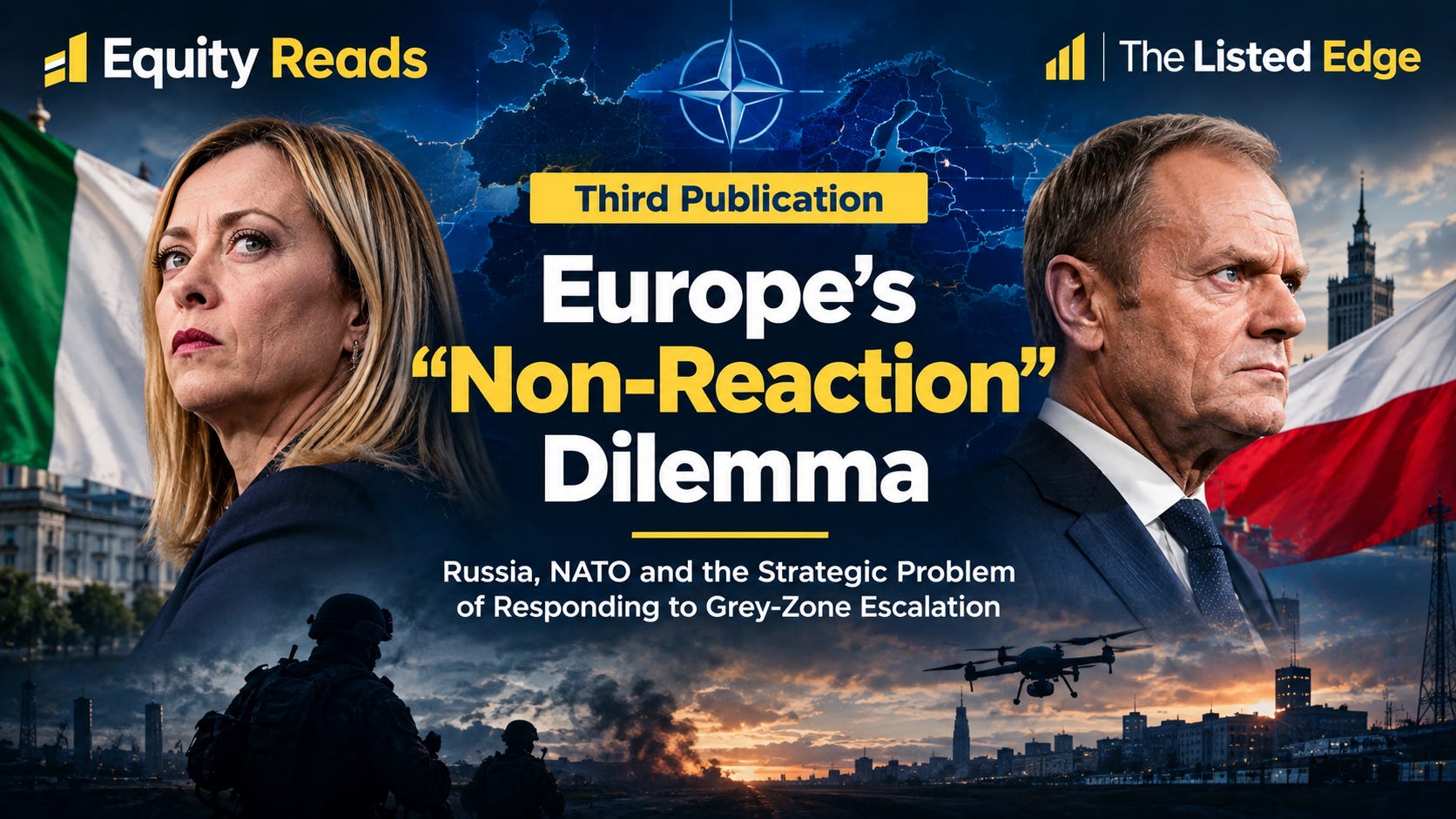
TWO COMPETING THEORIES ABOUT RUSSIA
The debate inside Europe over Russian drone incursions, sabotage and other hybrid activities reflects two competing theories of how escalation works.
The first, associated in the supplied material with Italian PM GIORGIA MELONI, argues that some Russian provocations may be designed to draw NATO into an unnecessary military escalation.
The second, associated with Polish PM DONALD TUSK and several eastern European governments, argues that failing to respond effectively may itself encourage further Russian pressure.
TWO COMPETING STRATEGIC LOGICS
The “non-reaction” approach views provocations as potential strategic bait: Russia could seek to force NATO into a choice between appearing weak and taking military action that risks wider escalation. Restraint therefore preserves escalation control.
The opposing “prepare for defence” approach sees repeated incidents as possible tests of NATO’s cohesion and the credibility of Article 5. Donald Tusk warned of the risk of Russian drones or missiles entering NATO territory and being portrayed as accidental to weaken allied resolve.
These approaches are not necessarily incompatible. NATO can avoid this uncontrolled escalation while strengthening surveillance, air defence, civil preparedness and deterrence.
THE GREY-ZONE THEORY
Grey-zone conflict operates below the conventional threshold of war, using tools such as cyberattacks, sabotage, information manipulation, coercion and ambiguous military activity. NATO includes deception and sabotage among the hybrid methods used to destabilize adversaries.
Its strategic advantage is ambiguity. When responsibility is unclear, an alliance faces a difficult choice: respond forcefully and risk escalation or respond cautiously and potentially encourage further activity.
This creates what some analysts call tacit coercion—where ambiguity can prevent immediate conflict but, if prolonged, may also normalize sub-threshold aggression.
WHAT CURRENT EUROPEAN EVIDENCE SUGGESTS
Europe increasingly treats drones, airspace violations, cyberattacks, sabotage, infrastructure disruption and information operations as part of a broader hybrid-threat environment.
The EU has also condemned what it described as a Russian-linked sabotage attempt at Leipzig/Halle airport and warned of increasingly frequent hybrid activities.
However, the evidence does not establish that every incident is part of a deliberate Russian attempt to test NATO’s Article 5. Tusk’s assessment is an intelligence-based warning, while Moscow rejects claims of aggressive intentions toward Europe. Putin has denied such intentions while warning that Russia would respond to perceived threats and continuing military modernisation.
DETERRENCE VERSUS ESCALATION CONTROL
The deeper issue is a classic deterrence dilemma.
If NATO responds to every ambiguous incident with major military action, an adversary could manipulate it into escalating on its terms. But if NATO avoids meaningful consequences, hostile actors may conclude that grey-zone activities carry limited costs.
This is the central challenge of grey-zone deterrence: ambiguity can preserve flexibility, but too much ambiguity can weaken credibility.
This is why resilience has become increasingly important. Rather than choosing simply between retaliation and inaction, NATO increasingly emphasizes societies and infrastructure that can withstand, absorb and recover from hybrid or armed attacks—strengthening deterrence without automatically escalating every incident.
THE EMERGING MIDDLE GROUND
A possible middle ground between Meloni’s and Tusk’s positions is controlled deterrence: avoid automatic escalation while making European territory, infrastructure and institutions harder to intimidate or disrupt.
This means stronger air and drone detection, clearer attribution, critical-infrastructure protection, cyber resilience, intelligence sharing, civil preparedness and proportionate diplomatic or economic responses.
The objective is to raise the cost of hostile activity without turning every incident into a conventional military confrontation—while reducing the divisions that Russia could exploit within Europe.
CONCLUSION
The debate is not about peace versus war, but about how Russia’s intentions should be interpreted and how deterrence should work below the threshold of open conflict.
Giorgia Meloni argues that NATO must avoid letting provocations dictate its escalation decisions, while Donald Tusk warns that repeated ambiguous incidents can gradually erode confidence in collective defence. NATO and the EU are increasingly pursuing a middle path—strengthening resilience, preparedness, and proportionate responses without automatically escalating every incident into direct military confrontation.
The central challenge for European security is therefore not whether to react, but how to deny an adversary the advantage of ambiguity while maintaining control over escalation.
Disclaimer: This report is for informational and research purposes only. It draws on the supplied document and publicly available reporting and institutional research available as of September 21, 2026. Statements by political leaders reflect their stated positions and should not be treated as independently verified assessments of their motives. Intelligence assessments and claims about Russian strategy may remain contested or incomplete. The report does not predict outcomes or advocate any particular policy. Readers should independently verify important facts and consult multiple primary and reputable sources before drawing political, security or geopolitical conclusions.