


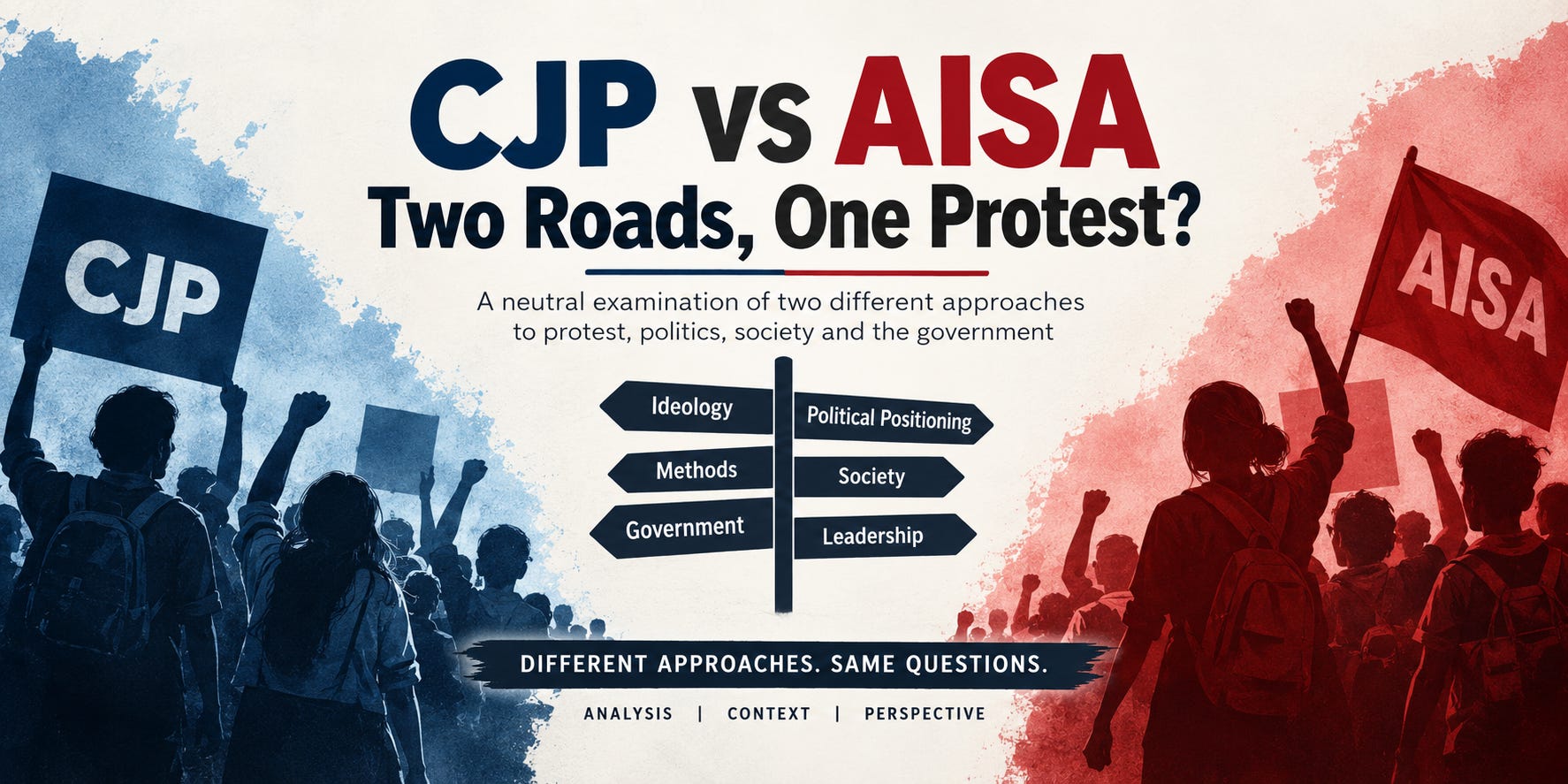
The recent protests surrounding CJP, AISA and other student and civil-society groups present an unusual political picture. The central issue is not simply who is right or wrong. A more interesting question is: why have groups protesting against many of the same government decisions adopted such different methods, political positions and relationships with the opposition?
This report examines that difference without endorsing or opposing any organisation.
From Student Anger to a National Movement
The origins and ownership of the movement itself have become contested.
One account attributes an important early role to IYC/NSUI mobilisation and Rahul Gandhi’s participation, arguing that the initial student protests subsequently acquired a much larger national character. Another narrative places the youth themselves at the centre and presents CJP as the organisation that gave the movement a broader national platform.
This dispute over ownership eventually became almost as significant as the original demands. Congress, AAP, CJP, Left organisations and student groups all appeared at different stages, creating overlapping claims over who actually drove the movement.
Two Very Different Political Identities
The most obvious difference is ideological identity.
AISA is openly ideological. Its Left orientation and political lineage are clearly identifiable. Its participation therefore comes with an understood political framework.
CJP presents itself differently: as a youth-driven, non-party and non-traditional movement. That distinction has advantages and complications.
A clearly ideological organisation is easier to understand politically. A non-party movement can attract people from very different backgrounds—but its political direction, organisational structure and sources of influence can become harder for outsiders to assess.
This was the basis of an important question:
if a movement is politically consequential but describes itself as non-political, who determines its political direction?
That is a question—not proof of any hidden affiliation.
Opposition to the Government, But Not Necessarily Alignment with the Opposition
Perhaps the most distinctive feature of CJP has been its apparent attempt to remain outside the conventional BJP-versus-Congress framework.
The movement has criticised the Modi government, ministers and the Election Commission, while at the same time publicly criticising Congress and questioning the role of opposition parties. This creates an interesting political position:
Opposing the government does not necessarily mean joining the opposition.
CJP’s criticism of Congress has sometimes been particularly sharp. At the same time, its representatives have maintained that both major political parties can employ similar political methods.
This can be interpreted in two completely different ways.
One interpretation is that CJP is genuinely trying to prevent political parties from taking over a youth movement. Another is that persistent criticism of opposition parties can fragment the anti-government space and indirectly benefit the incumbent.
Neither interpretation, by itself, establishes political coordination.
AISA’s Approach: Confrontation and Continuity
The AISA-led approach has looked considerably more conventional in political terms. Its leaders openly identified with the Left/student movement and remained physically involved in protests, hunger strikes and subsequent demonstrations.
The continued participation of Neha Bora and other activists—despite detention and police action—represents a different philosophy: Stay on the streets, maintain pressure and continue the movement even after the headline event has passed.
AISA’s activity continued beyond the major Jantar Mantar episode, including further mobilisation in Uttar Pradesh and Delhi and now suddenly, she is in West Bengal.
CJP, meanwhile, adopted a more episodic strategy, combining mass mobilisation, public campaigns, negotiations and pauses between major actions. Neither approach automatically makes one side more legitimate than the other. They represent different theories of how political pressure works.
Protest Versus Negotiation
Another major difference concerns the relationship with the government.
CJP representatives met Union ministers when the government opened a channel for negotiations. The movement subsequently claimed progress on its demands and at various points altered or paused its agitation.
The government therefore became not only the opponent but also a negotiating counterpart. That is politically significant.
For supporters, negotiation can mean that a protest is producing results. For critics, negotiations conducted by a limited group can raise the question of whether the wider movement and all participating organisations were adequately represented. This disagreement became part of the wider dispute over who had the authority to speak for the movement.
The Wangchuk–Dipke Sequence
The transition from Sonam Wangchuk’s fast to Dipke’s subsequent fast also illustrates the changing faces of the movement. Wangchuk was removed from Jantar Mantar and subsequently hospitalised. Dipke began a fast, later ended it after Wangchuk asked him to conserve his strength, and then joined the parliamentary march.
The episode did not necessarily indicate a withdrawal from the movement. But it did raise a broader question: Who was the principal face of the movement at different stages—and how did that leadership evolve?
The Delhi–Mumbai Contrast
The events of October 2 provide perhaps the clearest illustration of the different approaches. In Delhi, AISA, AAP and other student and civil-society organisations were prominent and visible and participation and support by IYC which was neither claimed nor visible through Banners. Detentions were extensive and the police response was confrontational.
In Mumbai, CJP organised a large gathering at Shivaji Park despite the earlier denial of permission. The police response was comparatively restrained, and the movement’s leadership publicly described its interaction with Mumbai Police positively. (Changed the stand now)
Following the detention and subsequent release of Mr. Ashutosh Ranka, some confrontational statements were exchanged between the INC and CJP. However, CJP later softened its stance somewhat, stating that no senior INC leader had publicly criticised CJP.
This difference is worth examining—creating doubts—but does not establish government protection or an RSS/BJP connection.
Police strategy can vary because of local political circumstances, crowd behaviour, venue, traffic considerations and administrative calculations. The available material itself notes that the Maharashtra government appeared to prefer a less confrontational approach.
The Politics of “Who Gets Credit?”
A fascinating secondary battle developed around the protests.
Congress supporters emphasised the early role of students, IYC/NSUI and Rahul Gandhi. AAP became highly visible in Delhi.
CJP argued that the achievement belonged primarily to the youth rather than political parties. The Left and AISA continued to highlight their own sustained participation. Thus, the conflict gradually became two-dimensional:
Protesters versus government and simultaneously One protest group versus another over ownership of the protest narrative.
That second contest may be just as important for understanding the politics surrounding the movement.
The Thackeray Factor
Mumbai added another layer.
Uddhav Thackeray and Raj Thackeray publicly supported the CJP mobilisation, although they did not necessarily share its platform. Two days later, the Thackeray brothers held their own much larger mobilisation, with Congress and other opposition leaders participating.
This does not establish an organisational connection with CJP.
But it demonstrates how different political forces can amplify, intersect with or benefit from the same public movement without necessarily controlling it.
The October 2 and October 4 events therefore deserve to be viewed as part of a broader contest for political visibility in Maharashtra.
The “Invisible Hands” Question
One of the more provocative arguments concerns the possibility of an organisational support structure behind CJP.
The comparison with AISA is important here. AISA’s ideological identity is visible. CJP’s claimed independence makes its political positioning less immediately identifiable.
This led to questions about its organisational backing, public faces, political relationships and the networks surrounding the movement.
However, an important distinction must be maintained:
Questioning an organisation’s political ecosystem is legitimate. Declaring who controls it requires evidence.
The material as of now points towards BUT does not establish that CJP is controlled by the RSS, BJP or AAP (However, the visibility of AAP in Delhi, its ongoing tussle with the INC over certain issues, and the past associations of some CJP leaders may raise questions or create some doubts about the situation here also).
In fact, CJP has itself directly confronted the government and criticised senior government figures.
Also, the publicly available observations and criticism of many political analysts like Raju Parulekar and senior journalist Shravan Garg, expressed through X, YouTube, and various podcasts, also raise certain questions about the broader situation. Some of the issues and observations they have placed in the public domain may prompt questions about the relationships and alignments involved—and, more importantly, who influences whom and who may ultimately be controlling the narrative or direction of these developments.
Another Interpretation: The Anna Movement Parallel
A separate critique compares CJP with the 2011 Anna Hazare movement.
The concern is not necessarily that such movements are secretly controlled by one political organisation. Rather, the question is whether a movement that describes itself as non-party, grassroots and youth-led can gradually develop an internal leadership structure that becomes insufficiently accountable to the wider group.
This raises questions about transparency, representation, funding and decision-making.
The comparison is particularly relevant because the critic drawing it has previously been involved with the Anna movement and had raised similar questions about its internal functioning.
The Election Boycott Question
Another issue deserves separate attention: the reported advocacy for opposition non-participation in future elections until the existing Election Commission arrangement changes.
This creates a strategic dilemma and raises some more doubts about the alignment.
Would an election boycott create sufficient pressure on the government to force institutional change—or could it simply allow the incumbent to win with less competition?
History provides a cautionary example in Punjab, where the Akali Dal’s election boycott during the militancy period was followed by an easier Congress victory.
The lesson is not that a boycott can never work. Rather, boycotts carry a potentially asymmetric risk: the party refusing to participate may lose political representation while the incumbent continues to exercise power. Therefore, non-participation is not merely a protest tactic. It can fundamentally alter the electoral balance.
Why the Post-October Strategy Matters
Another difference is visible in what happened after the October 2 mobilisation.
CJP indicated another gathering for October 10 and appeared to reduce the intensity of some activity, including the “school thik karo” campaign, despite unresolved questions around compensation and FIRs.
By contrast, AISA/Neha Bora and associated activists continued street-level mobilisation.
This produces two distinct models:
CJP: large mobilisation → negotiation → pause/reassessment → next major mobilisation.
AISA: continuous street pressure → repeated mobilisation → sustained confrontation.
Again, neither strategy guarantees success. One seeks to combine mass visibility with negotiation, while the other places greater emphasis on continuous pressure and persistence.
A Question of Representation Again
There is another sensitive issue raised by the events.
When representatives of different organisations participate in a common movement, who has the authority to negotiate on behalf of everyone?
The material describes concerns that some participants or allied organisations appeared to have limited information about discussions taking place with ministers.
Whether this resulted from ordinary negotiation strategy, confidentiality or inadequate coordination cannot be conclusively determined.
But the underlying democratic question is important: Who authorised the negotiators, what mandate did they possess, and how was the wider movement informed afterwards?
That question applies equally to CJP, AISA, political parties and civil-society groups.
Society, Government and the Protester
At a deeper level, the CJP–AISA contrast represents two different relationships with society. One model seeks to create a broad umbrella, bringing together people who may disagree ideologically but agree on particular demands.
The other begins from an identifiable ideological and political tradition and seeks to mobilise society through that framework.
The first can potentially become broader.
The second can potentially become clearer.
But both face risks.
A broad movement can suffer from ambiguity over leadership and political direction. An ideological movement can struggle to attract people who reject established political identities.
What Can Actually Be Established?
The observations in the public domain support several points, while also leaving some questions unresolved:
CJP and AISA have both participated in the wider protest ecosystem, although their political identities, organisational approaches and methods are different.
CJP has criticised the government while maintaining a degree of distance from established opposition parties, whereas AISA has maintained a more openly oppositional and continuous street presence.
Broadly, CJP appears to have attracted participation or support from sections of the film industry, while maintaining some distance from AISA. AISA, on the other hand, has received wider participation from sections of civil society and has also maintained a degree of distance from CJP.
This separation, however, is not absolute. There has been limited cross-participation, interaction and involvement of individuals associated with both groups, as well as with other organisations and outfits.
Congress, AAP, Left organisations and various civil-society actors have played visible roles at different stages, creating an overlapping network of political and social participation.
There has been a substantial dispute over who initiated the mobilisation, who represented it, and who ultimately gained political visibility or benefit from it.
The Delhi and Mumbai protests were handled differently, while political figures outside the core movement—including the Thackeray brothers—also amplified parts of the mobilisation.
CJP has engaged directly with the government, adding another layer to the debate over its organisational positioning and political relationships.
Public criticism and observations by figures such as Raju Parulekar and Shravan Garg, expressed through X, YouTube and various podcasts, have also raised questions about the relationships and alignments involved. These observations are part of the public discourse, rather than conclusive evidence of organisational control.
Consequently, questions such as “who influences whom?” and “who ultimately controls or shapes the direction of the movement?” remain part of the broader debate.
Most importantly, the information and reports available so far do not establish that CJP is controlled by any organisation. At the same time, the absence of such evidence does not necessarily eliminate legitimate questions about CJP’s organisational structure, its various associations, its interactions with political actors, and the overlapping participation of people from different political and civil-society networks.
The distinction, therefore, is between what can be documented, what can reasonably be questioned, and what remains unproven.
The Bigger Question
Perhaps the most useful way to understand these developments is to move away from the question:
“Whose movement is CJP?” and instead ask: “How do modern movements acquire legitimacy, leadership, public visibility and political influence?”
A movement can begin with genuine public anger and still attract competing political interests.
Political parties can participate without controlling it.
Governments can negotiate with protesters without endorsing them.
Opposition parties can support a movement while simultaneously competing for its political credit.
And a supposedly non-political movement can become deeply political through the consequences of its actions even without becoming a political party.
That complexity is what makes the CJP–AISA story worth studying.
Bottom Line
The evidence points less towards a simple “CJP versus AISA” or “BJP versus opposition” story and more towards a complicated contest involving youth mobilisation, ideological identity, political parties, civil society, government negotiation, media visibility and ownership of the protest narrative.
The most responsible conclusion is neither to endorse nor dismiss allegations of hidden political influence.
It is to keep asking the harder questions:
Who organised?
Who mobilised?
Who negotiated?
Who represented the wider movement?
Who received the political credit?
Who benefited from the fragmentation?
And, ultimately, who was able to convert public anger into political influence?
Those questions may reveal considerably more than simply identifying which political flag appeared at a protest.
Disclaimer
This report is an independent analytical examination based primarily on the material provided/available online/offline, and the viewpoints and events documented within. It does not endorse or oppose the organisations or any individual mentioned. Allegations, interpretations and political inferences have been distinguished from observable events wherever possible. The available material does not establish organisational control by any particular political organisation. Readers should independently verify developments, statements and claims before drawing conclusions.
This report is for educational and analytical purposes only and is not intended as political advocacy.