


EXECUTIVE SUMMARY
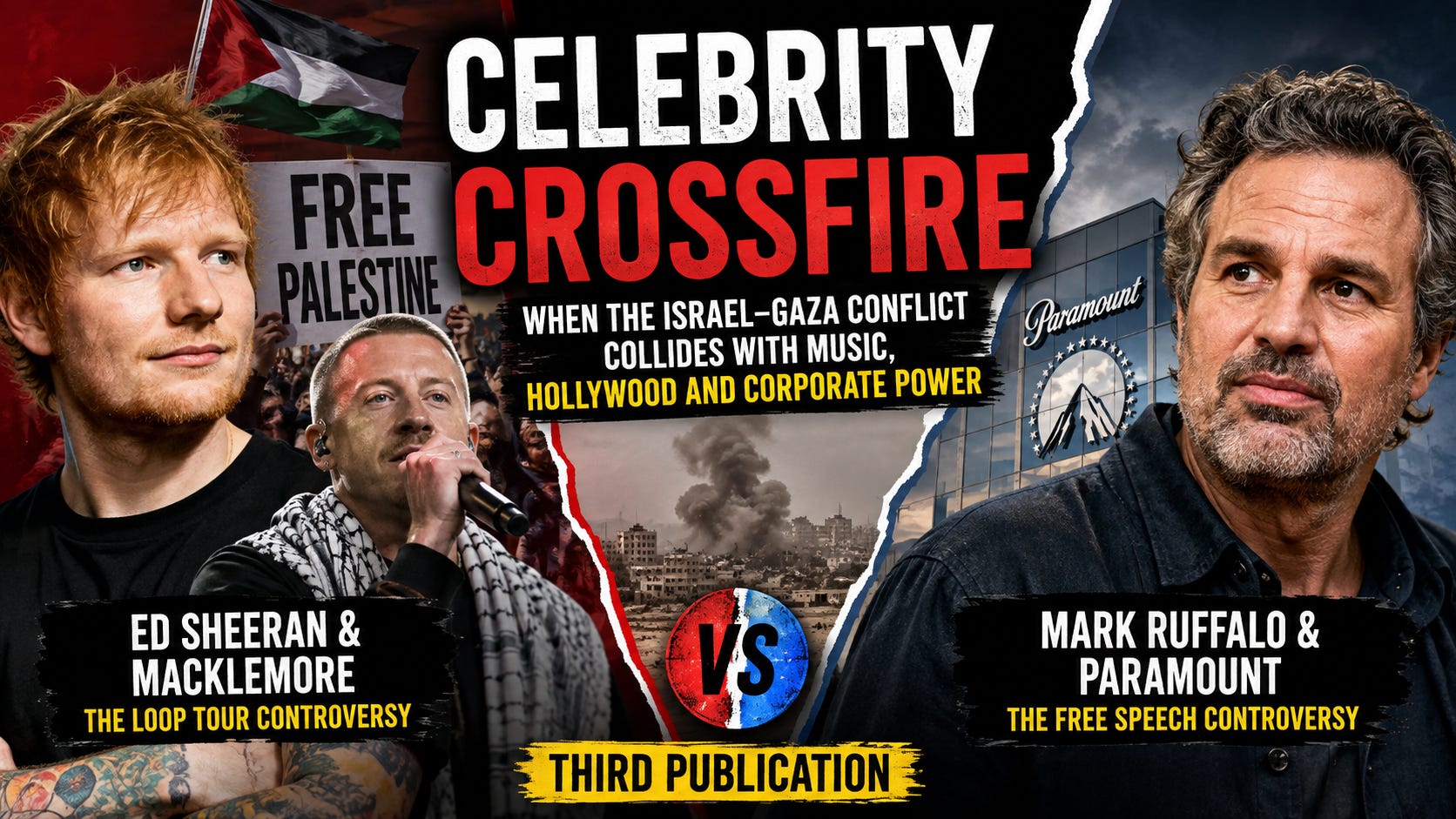
Israel–Gaza conflict is increasingly influencing debates far beyond traditional geopolitics. In September 2026, two controversies involving Ed Sheeran and Macklemore, and Mark Ruffalo and Paramount Skydance, brought the conflict into music, Hollywood and corporate affairs.
The incidents were unrelated, but both raised a similar question: When does criticism of Israeli government policy or business relationships remain political expression, and when do critics or corporations regard it as antisemitic?
The two cases also highlight the growing influence of celebrities, corporations, promoters and media organisations in shaping the boundaries of public political expression.
THE PEOPLE BEHIND THE HEADLINES
Ed Sheeran is one of the world’s best-selling singer-songwriters and has generally kept political messaging out of his concerts, arguing that his performances should focus on music.
Mark Ruffalo, the American actor known globally for portraying Bruce Banner/The Hulk, has also been active on environmental and human-rights issues and has publicly criticised Israel’s military campaign in Gaza.
ED SHEERAN, MACKLEMORE AND THE LOOP TOUR
During Ed Sheeran’s 2026 Loop Tour, rapper Macklemore appeared as an opening act. At MetLife Stadium in New Jersey, he used the stage to express support for Palestinians, wearing a keffiyeh, chanting “Free Palestine” and performing Hind’s Hall, his protest song addressing the Gaza conflict.
The performances triggered criticism from pro-Israel organisations. The Israeli-American Council launched a petition seeking his removal, arguing that the concerts had become platforms for polarising political messaging.
MACKLEMORE’S REMOVAL
Messina Touring Group subsequently removed Macklemore from the remaining tour dates. According to Sheeran, venue owners had indicated that concerts might not proceed if Macklemore remained on the lineup.
Sheeran publicly distanced himself from the decision. He said he had personal views about the humanitarian situation in Gaza but deliberately avoided political statements during concerts, adding that the removal decision was made by promoters and venues rather than by him.
Several other artists later withdrew from remaining tour in solidarity with Macklemore, turning the dispute into a wider debate over censorship, artistic freedom and commercial control.
WHY THE MACKLEMORE CONTROVERSY BECAME SO DIVISIVE
Supporters of Macklemore argued that his performances were political advocacy for Palestinians and should not automatically be equated with hostility toward Jewish people. They viewed his removal as a potential chilling effect on artists discussing humanitarian issues.
Those supporting his removal argued that commercial concerts are not necessarily political forums and that promoters and venues have legitimate authority over the content presented at their events.
The dispute therefore became larger than one performer: it raised the question of whether political expression at commercial entertainment events should be treated differently from political speech elsewhere.
MARK RUFFALO VS. PARAMOUNT SKYDANCE
A second controversy emerged around actor and activist Mark Ruffalo and the proposed Paramount Skydance–Warner Bros. Discovery merger.
Ruffalo criticised the transaction after sharing material concerning Oracle’s technology contracts with Israel. He questioned the use of technology in connection with Israel’s military operations in Gaza and raised concerns about business relationships involving the Ellison family and Paramount Skydance.
Paramount Skydance responded by accusing Ruffalo of invoking antisemitic tropes by linking Jewish-founded companies and executives with Israel.
Ruffalo rejected the accusation, arguing that criticism of Israeli government policy, military technology contracts or corporate relationships is fundamentally different from hostility toward Jewish people.
HOLLYWOOD RESPONDS
The controversy quickly spread across Hollywood. More than 170 Jewish artists, writers, filmmakers and public figures signed an open letter defending Ruffalo, arguing that criticism of Israel’s government or business relationships with Israel should not automatically be characterised as antisemitism.
MORE THAN CELEBRITY CONTROVERSIES
The two cases brought together three increasingly interconnected issues:
• The Israel–Gaza conflict and its political consequences
• Technology companies and their relationships with governments and military activity
• The growing concentration of corporate power in global entertainment
What began as disputes involving a concert and a proposed media merger therefore became a broader debate about political speech, corporate gatekeeping, artistic freedom and the boundaries of criticism of Israel.
THE COMMON THREAD
Despite their different origins, the two controversies reveal several common developments.
Entertainment has become a political battleground. Concerts, films and celebrity platforms increasingly serve as spaces where geopolitical issues are debated.
Corporate gatekeepers have growing influence. Promoters, venues and media companies can determine how political expression is presented—or whether it is presented at all.
The boundary between criticism and antisemitism remains contested. The central disagreement is whether criticism of Israeli government policy, military conduct or corporate relationships constitutes legitimate political expression or crosses into antisemitic rhetoric. The competing interpretations remain disputed rather than settled.
Even neutrality can attract controversy. Sheeran attempted to keep politics out of his concerts but still faced criticism, while Ruffalo‘s openly political position generated a direct corporate response.
THIRD PUBLICATION TAKEAWAY
The Ed Sheeran–Macklemore and Mark Ruffalo–Paramount controversies are ultimately about more than celebrities.
They show how the Israel–Gaza conflict has moved into music, Hollywood, corporate boardrooms and social discourse, forcing artists and companies to navigate increasingly difficult questions about political expression, commercial interests and accusations of antisemitism.
The larger issue is not simply who said what, but who gets to define the limits of acceptable speech when geopolitics enters popular culture and business.
Disclaimer: This report has been prepared by Third Publication for informational and analytical purposes. It is based on the source material and publicly reported information available.
The report does not endorse or oppose any individual, organisation, government, political position or advocacy campaign discussed. Statements and allegations attributed to the parties involved are presented as reported or contested claims, rather than as independently established conclusions.
Terms including “genocide,” “apartheid” and “antisemitism” are used only in the context in which they were employed by the individuals, organisations or sources discussed. Their inclusion does not represent the position of Third Publication.
Readers should consult primary sources and multiple perspectives before drawing their own conclusions.