


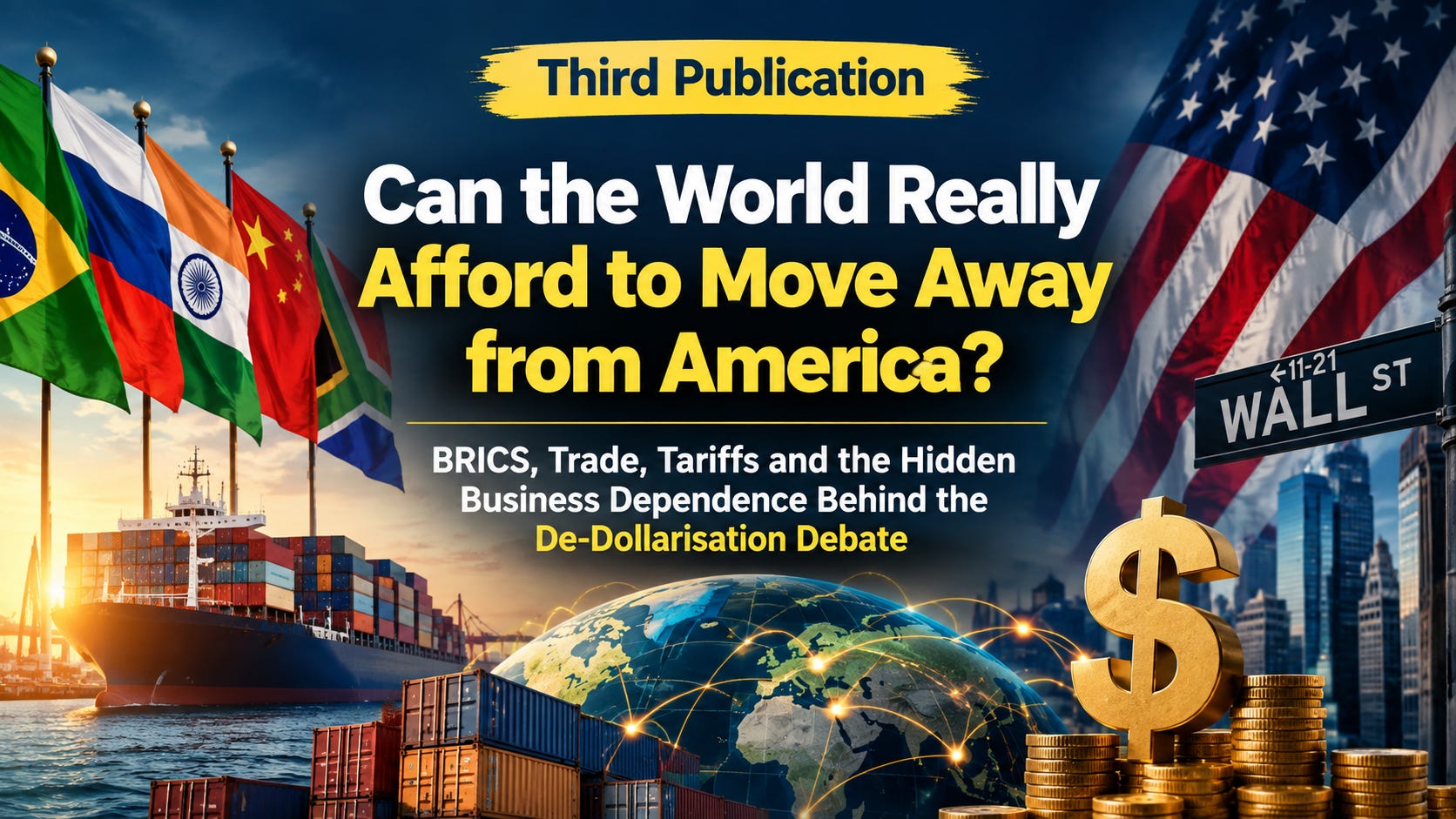
The Question Behind the Headlines
The global economic order is changing.
BRICS is expanding, China and Russia are challenging the established US-led system, while India is seeking greater strategic autonomy. Across the Global South, countries are exploring local-currency trade, alternative payment systems and new economic partnerships.
The message is increasingly clear: reduce dependence on Washington.
But political independence and economic independence are two different things.
The real question is not simply whether countries can reduce their dependence on America.
It is whether they can do so without paying a significant economic price.
And there is another question: how much does America itself depend on the rest of the world?
The trade numbers reveal a far more complicated picture than the geopolitical headlines suggest.
The Trade Reality
The 2025 trade numbers reveal why there is no single “BRICS versus America” equation.
China accounted for the largest imbalance, with US goods imports of $308.7 billion against $106 billion of exports. India recorded $103.8 billion of US imports and $45.4 billion of exports.
Russia was almost negligible by comparison, while Brazil actually ran a US trade surplus. South Africa and the UAE present yet different relationships, reflecting the importance of strategic resources, energy, capital and services alongside conventional goods trade.
The broader point is more important than any individual number:
America’s economic relationships with BRICS countries are highly unequal—but also deeply interconnected.
That makes a simple break from America far more difficult than the political rhetoric sometimes suggests.
China: Mutual Dependence, But Changing
China remains the biggest test of any attempt to reduce dependence on America.
The bilateral relationship has already changed significantly, with US imports from China falling sharply from the previous year. Yet China remains deeply embedded in global manufacturing—from electronics and machinery to batteries, solar equipment and critical-mineral processing.
The dependence therefore runs both ways.
China needs access to American consumers, while American businesses and consumers remain connected to Chinese manufacturing and supply chains.
Both sides can diversify. Neither can replace the other overnight without substantial economic cost.
Decoupling may be possible. Rapid decoupling is expensive.
India: The Most Interesting Case
India may be the most interesting case in the entire debate.
Unlike the China relationship, economic ties between India and America have been expanding. India supplies America with pharmaceuticals, engineering goods, electronics, textiles, chemicals, machinery and IT services, while America supplies India with energy, aircraft, technology and other high-value products.
That makes the relationship increasingly two-way.
India can—and does—diversify its economic relationships. But America is also becoming an important market, technology partner and destination for China+1 manufacturing.
For India, therefore, strategic autonomy need not mean choosing one side.
It may mean keeping several doors open.
Russia: The Exception
Russia demonstrates that direct economic dependence on America can be reduced dramatically.
But it also illustrates an important distinction: reducing dependence on one economic centre does not necessarily eliminate dependence itself.
Russia has redirected much of its trade and economic engagement towards China, India, Central Asia, Iran, Turkey, the Gulf and other BRICS economies.
The lesson is straightforward:
De-Westernisation is not the same as economic independence. Dependence can disappear in one direction while emerging in another.
Brazil & South Africa: Two Different Forms of Dependence
Brazil presents a relatively balanced economic relationship with America, giving it considerable room to diversify without necessarily breaking with Washington.
South Africa is different
Its importance extends beyond headline trade numbers because of its reserves and supply of strategically important minerals, including platinum-group metals, chromium, manganese and palladium.
This highlights a broader point:
Strategic dependence can be far greater than trade dependence.
In a world increasingly shaped by supply-chain security, critical minerals and energy, what a country controls—or needs—can matter as much as the value of its trade.
The Dollar: Decline Is Not Collapse
This is where trade meets de-dollarisation.
One distinction matters: reducing dollar usage is not the same as replacing the dollar.
Countries can increase local-currency settlements, accumulate gold, diversify reserves and build alternative payment systems while continuing to use the dollar.
The numbers underline the challenge. The dollar’s share of global official reserves has declined substantially over the long term, yet it remains deeply embedded in international finance and foreign-exchange markets.
So, this is not a story of collapse.
It is a story of gradual diversification around a still-dominant dollar system.
De-dollarisation is real. Dollar replacement is a much bigger claim.
BRICS Is Building Alternatives
BRICS is moving beyond simply discussing alternatives.
Local-currency settlement is expanding, alternative payment infrastructure is being developed, and institutions such as the New Development Bank are placing greater emphasis on local-currency financing.
But creating alternatives is easier than creating a replacement.
A global reserve currency requires deep capital markets, liquidity, convertibility, trusted assets, payment infrastructure and international confidence.
The more realistic objective, therefore, is not: Replace the dollar.
It is: Reduce vulnerability to the dollar.
The Tariff Paradox
Tariffs, sanctions and export controls give America considerable economic leverage. But leverage can create its own counter-reaction.
Countries facing repeated restrictions on markets, technology or financial infrastructure have an incentive to develop alternative suppliers, markets, currencies, payment systems and sources of capital.
That creates a paradox:
Greater the use of economic leverage, the stronger the incentive to reduce exposure to it.
Yet diversification takes time and carries costs.
China cannot quickly replace American demand. India cannot ignore the importance of the US market. Russia has reduced Western dependence but created new economic linkages elsewhere.
The broader trend, therefore, may not be economic separation. It is risk diversification.
Can the World Really Afford to Move Away?
The answer is: partly—but not completely, and certainly not quickly.
Countries can reduce their exposure to America. Some already have. Others are actively building alternative markets, suppliers, payment systems and sources of capital.
But there is a crucial difference between surviving without America and prospering without America.
America is not merely a market. It is a technology ecosystem, a deep capital market, a major investment destination and a central financial hub.
At the same time, America cannot instantly replace what it receives from the rest of the world—from Chinese manufacturing and Indian services to strategic minerals, commodities, energy and capital.
The emerging equation is therefore unlikely to be America → No America
It is more likely to be America-centric → Multi-centred
The New Global Equation
The debate is often framed as America versus BRICS. The economics suggest something more nuanced.
Countries are not necessarily trying to eliminate their economic relationship with America. They are trying to ensure that dependence on any single power does not become a vulnerability. That means more local-currency trade, alternative payment systems, diversified supply chains, gold reserves and multiple sources of capital and technology.
This is better understood as: Diversification as insurance.
The objective may not be to destroy the dollar or replace America. It may simply be to make America less indispensable.
Final Take
The most important question is not: “Can the world live without America?”
It is: “How much dependence on America can the world remove without imposing a greater economic cost on itself?”
That contest will not be fought only in currency markets. It will unfold across trade, technology, supply chains, capital, energy, critical minerals and financial infrastructure. The dollar may lose share. BRICS may gain influence. Local currencies may become more important. But none of this automatically signals the end of the American economic system.
The more plausible direction is:
Less dependence.
More diversification.
Greater bargaining power.
A more multi-centred world.
The world may not be preparing for a divorce from America. It may simply be building the ability to say:
“We still need you—but we no longer want to depend on you alone.”
Disclaimer: This article is intended solely for information, education and analytical discussion. The trade and monetary figures are based on as available online and the official US government, IMF and BIS data cited therein for the periods specified.
Economic and geopolitical conditions can change rapidly, and historical data should not be interpreted as a forecast. This is not investment, financial, political or policy advice. Readers should conduct their own research and consider multiple sources before making any investment or other decision.
Explore our research notes and investing frameworks and subscribe to Equity Reads for in-depth market insights. If you enjoy broader perspectives on TSX and US markets, businesses, subscribe to TheListedEdge as well.