


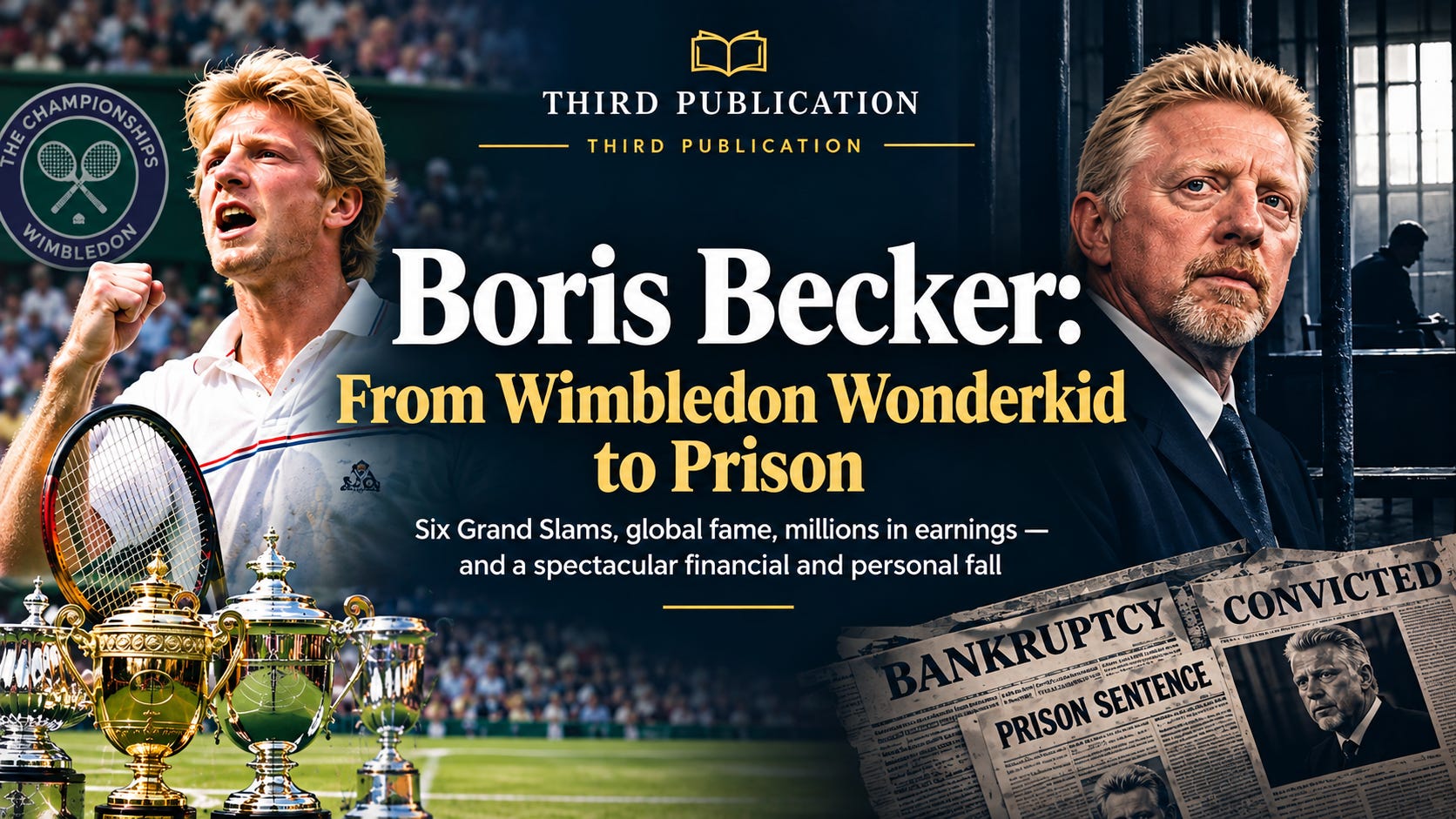
At just 17, Boris Becker achieved what most tennis player’s dream of — he won Wimbledon.
As an unseeded teenager, he became the youngest men’s Wimbledon champion at the time and the first German to win the title. Almost overnight, a boy from Leimen became a global sporting sensation.
But the story went far beyond trophies.
It became a journey through fame, wealth, relationships, financial mistakes, accountability and rebuilding — offering lessons that extend well beyond tennis and into the world of wealth creation.
The Boy from Leimen
Boris Franz Becker was born on 22 November 1967 in Leimen, West Germany. His father, Karl-Heinz Becker, designed and built a tennis centre there, giving Boris an early introduction to the sport.
He quickly developed into an aggressive, fearless player, known for his powerful serve, attacking game and spectacular net play. But his greatest strength was perhaps his ability to perform under pressure.
He turned professional in 1984.
A year later, everything changed.
Wimbledon at 17
In 1985, Becker arrived at Wimbledon ranked No. 20 and unseeded. He left as champion.
He defeated Kevin Curren in the final, becoming the first unseeded Wimbledon men’s champion and, at 17 years and 227 days, the youngest at the time.
Germany, sponsors and the world embraced “Boom Boom Becker.” Almost overnight, the teenager became a global celebrity.
But fame at 17 came with a heavy price. Becker later reflected on the enormous pressure of becoming wealthy and famous before he had truly experienced adult life.
From Champion to Superstar
Becker successfully defended Wimbledon in 1986, won it again in 1989, and added the US Open that year. He later claimed the Australian Open twice, in 1991 and 1996.
By the end of his career, he had won six Grand Slam titles, 49 singles titles and spent 12 weeks as world No. 1.
His rivalry with Stefan Edberg became one of tennis’s defining rivalries of the era.
Becker had reached the summit of professional tennis.
The Money Arrives
Becker’s sporting success brought substantial financial rewards. He earned more than $25 million in official ATP Tour prize money, excluding sponsorships, endorsements and other commercial income.
But his story highlights an important distinction:
Making money and preserving wealth are two different skills.
High income can create wealth quickly, but protecting and compounding it requires discipline, sound decisions and the right financial systems. For investors, entrepreneurs and professionals, that distinction can matter as much as earning the money itself.
Life beyond Tennis
Becker retired from professional tennis in 1999, but remained active in business, media and tennis. From 2013 to 2016, he coached Novak Djokovic, helping guide him through a highly successful period.
Away from tennis, Becker’s personal life also attracted intense media attention. He married actress and designer Barbara Feltus in 1993, and they had two sons, Noah and Elias, before divorcing in 2001.
His daughter Anna Ermakova was born in 2000 following an encounter with model Angela Ermakova in London, a story that became an international media sensation.
Becker later had another son, Amadeus, with his second wife, Sharlely “Lilly” Kerssenberg. That marriage also ended in divorce.
For someone who became famous at just 17, maintaining a boundary between private life and public celebrity was never easy.
When Personal and Financial Worlds Collide
Over time, Becker’s personal, business and financial affairs became increasingly complicated, involving lifestyle expenses, property, loans, business commitments and legal obligations.
In 2017, he was declared bankrupt in the UK. Bankruptcy itself was not a criminal offence; the later criminal case concerned the disclosure and handling of assets during the insolvency proceedings.
In April 2022, a London court convicted Becker on four charges under the UK Insolvency Act and sentenced him to two and a half years in prison. He served about eight months before being released and deported to Germany.
The contrast was striking: the man who had once walked onto Centre Court as a global sporting hero was now entering a British prison.
The Personal Cost of Public Success
Becker’s story is more complicated than simply saying a wealthy athlete “lost everything.” His relationships, family circumstances, finances and legal troubles became intertwined with his public identity.
The deeper lesson is simple:
Public success does not automatically create private stability.
Becker had trophies, wealth and worldwide recognition. But managing wealth requires a different skill set from earning it.
As wealth grows, so does financial complexity—property, taxes, businesses, investments, loans and legal obligations. Navigating that complexity demands discipline, sound decisions and effective professional guidance.
Prison and the Possibility of Rebuilding
Becker’s imprisonment in 2022 marked the lowest point of an extraordinary journey.
Yet his story did not end there. After his release, he returned to tennis, coaching and media work, while speaking about rebuilding his life.
The lesson is important: failure does not erase the past, but rebuilding requires learning from it.
The trophies cannot be replayed. The lost years cannot be recovered. What remains is the opportunity to learn, adapt and make better use of the years ahead.
The Investor’s Lesson
Boris Becker’s extraordinary life carries a powerful financial lesson:
Income is not wealth.
Income is what comes in. Wealth is what remains, compounds and survives difficult periods.
His story also shows that success in one field does not guarantee success in another. Winning a five-set Wimbledon final requires one set of skills. Managing millions requires another.
Managing fame, relationships, businesses, taxes, debt and legal obligations demands yet another skill set.
The ability to know your limits and seek the right professional advice can be just as important as the ability to earn.
The Becker Paradox
Boris Becker remains one of his generation’s great tennis players. Six Grand Slam titles, 49 singles victories and time at world No. 1 cemented his place in sporting history.
But his later struggles tell a different story.
His life illustrates the difference between winning and sustaining success.
Winning can happen in a moment. Sustaining success requires discipline over decades.
Becker learned early how to win on a tennis court. Life later taught him that some of the hardest matches are played far beyond the court.
What Investors Can Take Away
Boris Becker’s story offers lessons that extend well beyond sport:
Making money and keeping it are different achievements.
Early success can bring responsibilities before maturity catches up.
Wealth becomes more complex as it grows.
Expertise in one field does not automatically transfer to finance.
Transparency and compliance matter most when financial difficulties arise.
Reputation is an asset that can be difficult to rebuild.
A major setback does not have to be the final chapter.
Becker’s story is not simply about a tennis champion who lost his fortune. It is about someone who reached the top remarkably young, experienced the rewards and pressures of fame, faced serious financial and legal consequences, and ultimately sought to rebuild.
For investors, the message is simple:
Build wealth. Protect it. Understand it. Respect the responsibilities that come with it. Because sometimes, the hardest match begins after the biggest victory.
Disclaimer:
This article is intended for educational and biographical purposes only. It is based primarily on the freely available source material online and publicly documented events. It does not attempt to provide a complete account of Boris Becker’s private life, finances or legal affairs, nor does it constitute a judgment on his character or personal circumstances. It should not be considered investment, legal or financial advice.