


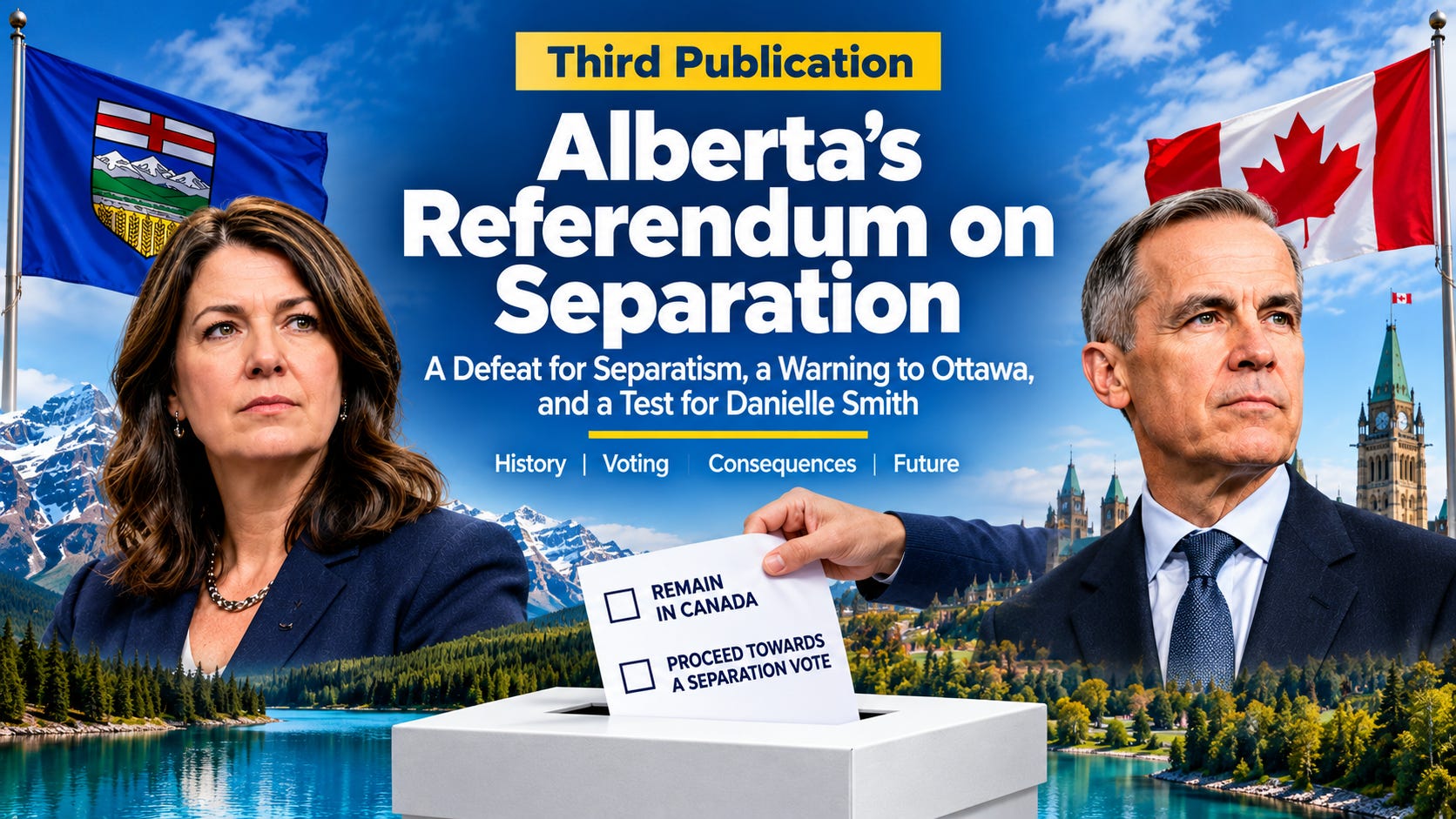
Alberta’s October 19, 2026 referendum became a defining test of regional discontent and Canadian unity. Voters were not deciding whether Alberta would immediately become an independent country. They were choosing whether to remain in Canada or begin the legal process for a future, binding separation referendum.
Preliminary reporting put support for remaining in Canada at roughly 75–76%, against approximately 24–25% for proceeding towards a future separation vote. The result was a clear setback for separatists, but it did not erase the grievances that gave the movement traction.
Premier Danielle Smith, who said she favoured a stronger Alberta within a united Canada, now has an opportunity to pursue greater provincial autonomy without an immediate separation vote hanging over the debate. Prime Minister Mark Carney gains a political win for national unity, but cannot assume that voters’ choice to remain means they endorse every federal policy.
The central question has shifted: can Ottawa and Edmonton address disputes over energy, immigration, provincial powers and economic priorities through negotiation rather than recurring constitutional confrontation?
Why Alberta’s Discontent Took Root
Alberta’s alienation from Ottawa has deep roots. The federal National Energy Program, introduced in 1980, became a lasting symbol of federal interference in the province’s oil and gas economy. Many Albertans came to believe that a resource-rich province had too little control over policies shaping its most important industry.
Separatist sentiment surfaced in the early 1980s, including through the Western Canada Concept Party, but failed to become a durable majority movement. In more recent decades, disputes over climate and energy policy, federal authority, fiscal arrangements and pandemic-era restrictions have helped renew calls for greater autonomy.
Under Jason Kenney, Alberta pressed for more provincial control while rejecting independence. Danielle Smith, who became premier in 2022 and won the 2023 election, placed greater emphasis on Alberta’s constitutional powers and sovereignty within Canada. Her position has generally distinguished autonomy from separation: a province can demand more control without necessarily leaving the federation.
How the Referendum Reached the Ballot
The 2026 vote followed competing petition campaigns and growing pressure to settle the question publicly. In 2025, Smith announced a panel to examine Alberta’s future within Canada. Former deputy premier Thomas Lukaszuk’s Forever Canadian petition gathered substantial support, while the Alberta Prosperity Project pursued a petition for a separation vote.
The Alberta government announced nine referendum questions in February 2026 on matters including immigration, access to provincially funded services and constitutional issues. In May, the Court of King’s Bench quashed the separatist petition over concerns about the duty to consult First Nations on potential effects on treaty rights. Smith challenged the ruling and, on May 21, announced a tenth question for the October ballot.
Smith argued that petitioners deserved an opportunity to express their views, even though she personally favoured remaining in Canada. The referendum therefore served two purposes: testing the strength of separatist sentiment and gauging public support for a broader push for provincial autonomy.
What Voters Were Actually Asked
The separation question offered voters a choice between keeping Alberta as a province of Canada and having the provincial government commence the legal process required for a future binding referendum on separation. It was not an immediate vote for independence, and a majority in favour of proceeding would not, by itself, have made Alberta a separate country.
The ballot also included nine other questions concerning provincial policy and constitutional arrangements. Their results must be considered individually. Support for a change in immigration or service rules, for example, should not automatically be interpreted as support for independence—or as a mandate for every proposal to increase provincial powers.
The Result and Its Meaning
Preliminary figures reported on October 20 indicated that roughly three-quarters of voters favoured remaining in Canada, while about one-quarter supported proceeding towards a separation vote. These figures were reported while counting was still being completed and should not be mistaken for a final certified tally.
The outcome establishes a substantial electoral barrier to the immediate separatist project. It also shows that a significant minority remains dissatisfied enough to support taking the next step. The vote cannot tell us whether every voter in that minority wanted independence itself or was using the ballot to protest federal policy.
The most balanced interpretation is that Albertans rejected the immediate route towards separation without giving Ottawa a blanket endorsement. The constitutional direction is clearer; the policy disputes remain.
Danielle Smith: Before and After the Vote
Before the referendum, Smith maintained that Alberta should remain within Canada while exercising more of its own constitutional powers. She defended the right of separatist petitioners to be heard, arguing that the issue should be tested democratically rather than left unresolved. That stance helped her avoid appearing dismissive of the movement, but also risked giving it a larger public platform.
The result supports Smith’s stated preference for a united Canada and gives her room to turn towards negotiations on provincial autonomy. At the same time, she must manage two constituencies: Albertans seeking practical improvements in federal-provincial relations and separatist activists who wanted a more decisive move towards independence.
The referendum is therefore not a blank cheque for Smith. If she continues to focus on confrontation, she may appear to disregard the result’s message. If she compromises too readily, she may face criticism from parts of her political base. Her credibility will depend on whether she can secure tangible progress on energy, immigration, infrastructure and jurisdictional questions.
Mark Carney and the Conversation After the Vote
Carney opposed separation and argued that Alberta’s future was strongest within Canada. He placed national unity in the context of trade tensions with the United States and Alberta’s importance to Canada’s energy and economic future. In the days before the vote, Carney and Smith appeared together at a pro-Canada event in Red Deer, signalling that they could agree on unity despite wider policy differences.
On October 20, Carney confirmed that he had spoken with Smith by telephone. His public account said they first discussed the deadly fire at Canadian Forces Base Wainwright and support for those affected, then turned to the referendum and cooperation on shared priorities, including immigration. Carney welcomed the result as a choice to build together.
The call was an opening for practical engagement, not evidence of a comprehensive settlement. No public account established that the leaders had reached a binding agreement on Alberta’s autonomy or resolved their disputes. Carney’s opportunity is to turn unity into cooperation; Smith’s is to demonstrate that staying in Canada can deliver meaningful provincial influence.
What If the Vote Had Favoured Proceeding?
A vote for proceeding would have raised pressure for a future separation referendum, but it would not have made Alberta independent. The process would have involved constitutional questions, negotiations with the federal government, legal scrutiny and the interests and rights of First Nations.
Uncertainty could have affected business investment, labour mobility, public services, trade arrangements and the division of federal assets and liabilities. The University of Calgary’s School of Public Policy study cited in the original report estimated potential initial costs of C$50 billion to C$170 billion over five years, depending on the scenario. This is a modelled range, not a guaranteed outcome.
What the Result Means for Alberta and Canada
For businesses and investors: The result reduces immediate uncertainty around Alberta’s constitutional status and allows planning to continue within the existing Canadian framework.
For Ottawa: The vote creates an opportunity to address Alberta’s concerns, but ignoring them could allow separatist sentiment to return.
For Smith: She can pursue autonomy within Canada, but must show that the referendum leads to practical outcomes rather than another round of political confrontation.
For separatists: The movement has failed to demonstrate majority support for proceeding towards separation. It may remain active, but faces a clear electoral setback.
For Indigenous peoples: The court challenge underscored that treaty rights and the duty to consult are central constitutional considerations, not secondary obstacles.
The other referendum questions may influence negotiations, but their mandates should be assessed separately. A vote on a particular policy does not automatically settle questions of federal jurisdiction or constitutional authority.
What Happens Next? Three Plausible Paths
Cooperation and negotiated change:
Ottawa and Alberta could reach practical compromises on energy, immigration, infrastructure and provincial powers.
Continuing disputes within Canada
The governments may disagree over provincial autonomy; separation could recede from the immediate agenda while constitutional and policy arguments continue.
A revival of separatist sentiment
If grievances deepen or leaders use the issue for political advantage, separatism could regain visibility. That would not automatically lead to another referendum or independence, but it could renew pressure for constitutional change.
These are scenarios, not forecasts. Their likelihood will depend on economic conditions, political leadership and whether the two governments can negotiate in good faith.
Conclusion: A Clear Vote, an Unfinished Debate
Alberta’s referendum rejected the immediate path towards separation and strengthened the case for Canadian unity. It also gave Smith a chance to pursue her preferred objective—a stronger Alberta within Canada—while giving Carney an opportunity to improve federal-provincial relations.
But the vote did not resolve the disputes that produced it. A majority chose to remain in Canada; that does not mean every voter is satisfied with Ottawa. The lasting test is whether the federal and provincial governments can respond to regional concerns without allowing them to become a recurring constitutional crisis.
The immediate question has been answered: Alberta has chosen to remain in Canada. The larger question is whether Ottawa and Edmonton can make that choice work better for Albertans.
Disclaimer
This report is for educational, informational and political-analysis purposes. It condenses the reports and reflects the information and preliminary results cited there as of October 21, 2026. Political interpretations and future scenarios are analysis, not established facts or predictions. Referendum figures should be checked against Elections Alberta’s final certified results. The report does not advocate for or against any party, government or constitutional position.
Sources and Further Reading
Elections Alberta — Referendum 2026 and official ballot questions
Government of Alberta — Premier Danielle Smith’s address, May 21, 2026
Reuters — What Alberta’s referendum on separation from Canada means, October 15, 2026
Reuters — Alberta votes by large majority to remain in Canada, October 19, 2026
Prime Minister of Canada — Statement on Albertans choosing unity, October 20, 2026
The Canadian Press /CityNews — Timeline of Alberta’s path to the referendum, Oct 20, 2026
Global News — Cost of Alberta separation could be up to C$170 billion, September 16, 2026
Uni of Calgary, School of Public Policy — Economic and Fiscal Implications of Alberta Separation
Associated Press — Alberta voters reject the separation process, October 20, 2026
Al Jazeera — Alberta rejects separation referendum: What’s next for the province? Oct 20, 2026